
Emergency services are testing drone delivery systems to boost their efficiency in critical situations. Drones can quickly transport medical supplies like defibrillators, operating autonomously even in challenging conditions. They survey hazardous areas, enhance safety, and provide real-time data for effective decision-making. These innovations help responders reach those in need faster and improve overall community safety. Discover how advancements in drone technology are shaping the future of emergency responses and making a significant impact on public health.
Prime for Young Adults — start your free trial
Fast free delivery, streaming and member deals for eligible 18–24 year olds.
As an affiliate, we earn on qualifying purchases.
Key Takeaways
- Emergency services are testing drone delivery systems to enhance rapid response capabilities and deliver critical medical supplies efficiently.
- Drones can operate autonomously and Beyond Visual Line of Sight (BVLOS), facilitating quick deployments in emergencies.
- Real-time data transmission from drones aids in hazard assessment and improves situational awareness for responders.
- Testing involves overcoming challenges like inclement weather, battery life, and payload capacity to optimize delivery systems.
- The integration of drones with traditional emergency services aims to revolutionize community safety and resilience in crisis situations.
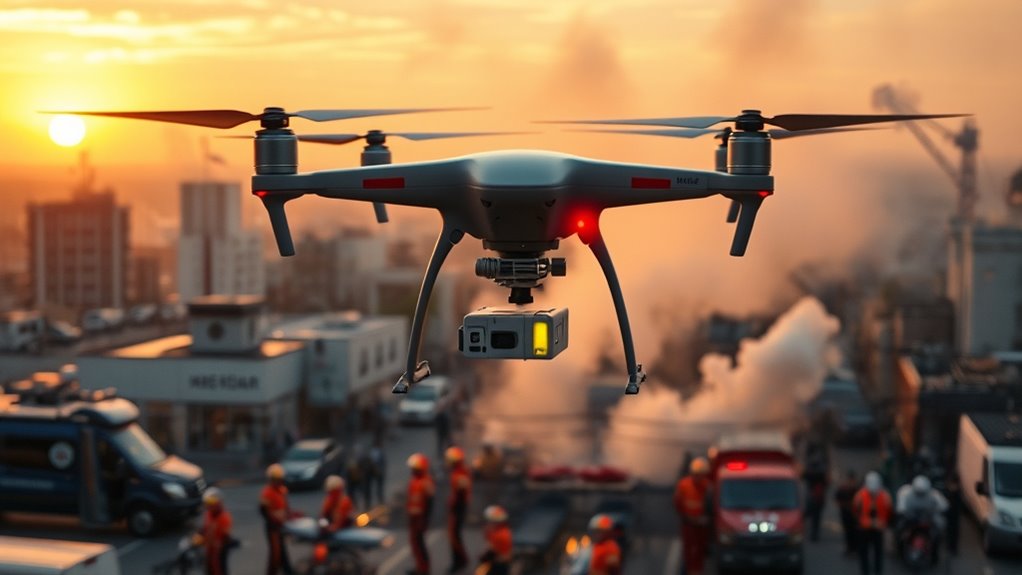
As emergency situations unfold, the need for rapid response becomes imperative, and that’s where drone delivery steps in. Imagine you’re in a congested urban area, and every second counts. Drones can reach emergency scenes faster than traditional vehicles, delivering critical medical supplies like defibrillators or first-aid kits when every moment matters. These drones are often autonomous and operate Beyond Visual Line of Sight (BVLOS), allowing them to navigate through complex environments efficiently.
You might be surprised by the flexibility of these drones. They’re modified to carry various medical supplies, adapting to local conditions and specific needs. Equipped with advanced navigation systems, they guarantee accurate delivery even under challenging circumstances. Real-time data transmission through onboard cameras and sensors gives you valuable intelligence about the situation on the ground, enhancing the overall response strategy.
When disaster strikes, drones aren’t just about delivery; they play an essential role in hazard assessment. By surveying hazardous environments, they reduce risks for human responders. For instance, thermal imaging drones help identify sources of fires and map affected areas, guiding firefighters on safe entry routes. In natural disasters, drones can quickly locate survivors and the safest routes for rescue efforts, proving their worth as invaluable assets in critical situations.
However, operating drones isn’t without challenges. Inclement weather can limit their capabilities, and battery life restricts how far and how long they can fly. The payload capacity can also affect how many supplies can be delivered at once. Additionally, legal restrictions often prevent operations in populated areas, and technical failures can halt missions, underscoring the need for constant advancements in drone technology.
Looking ahead, the future of drone delivery in emergency services seems promising. Innovations in battery technology aim to extend flight times, while obstacle detection systems are being developed to help drones navigate safely around hazards. As these technologies evolve, you can expect drones to become even more integrated with emergency services, coordinating with traditional responders to optimize resource allocation and enhance overall effectiveness.
In this rapidly changing landscape, you’ll find that drones are no longer just a novelty; they’re becoming indispensable tools in emergency response. With their ability to provide immediate presence, assess scenes, and transmit real-time data, drones are set to revolutionize how we handle emergencies, making our communities safer and more resilient.
As an affiliate, we earn on qualifying purchases.
Frequently Asked Questions
What Types of Emergencies Can Drone Delivery Assist With?
Drones can assist with various emergencies, including natural disasters like floods, earthquakes, and wildfires, by delivering supplies and providing damage assessments.
In medical emergencies, they quickly transport essential equipment like AEDs for cardiac arrest or naloxone for overdoses.
During search and rescue operations, drones help locate victims and transport necessary materials.
They also play an important role in logistical support, optimizing supply chains and enhancing communication when traditional methods fail.
How Are Drones Powered During Emergency Operations?
Drones in emergency operations are typically powered by rechargeable batteries, like lithium-ion or lithium-polymer.
You might find some models using dual battery systems that enhance flight time and reliability.
Environmental conditions play a role too, as drones can operate in various temperatures and weather.
Quick recharging stations are essential for continuous use, and some experimental drones even integrate solar panels to extend their operational capabilities.
Energy efficiency is key for effective performance.
Are There Regulations Governing Drone Delivery in Emergencies?
Imagine a bustling town, where the sky’s filled with buzzing bees—those bees represent drones.
Just like bees follow rules to gather honey safely, drone deliveries in emergencies have regulations to follow.
You’ll find global and local laws guiding their flight paths, ensuring safety and efficiency. The FAA oversees operations in the U.S., while communities decide on specific governance models.
How Fast Can Drones Deliver Supplies in Emergencies?
Drones can deliver supplies in emergencies remarkably fast, often bypassing traffic and taking the most direct route.
Studies show they can arrive quicker than ambulances, cutting response times considerably, especially in critical situations.
Depending on the distance and conditions, drones can reach their destinations within minutes.
Their ability to navigate challenging terrains and remote areas enhances their efficiency, making them ideal for urgent, time-sensitive deliveries when every second counts.
What Safety Measures Are in Place for Drone Deliveries?
When it comes to drone deliveries, safety measures are as tight as a drum!
You’ve got collision avoidance systems that detect obstacles, weather monitoring to adapt to changing conditions, and real-time tracking to keep everything on course. Drones avoid crowds and follow predetermined routes to minimize risks.
Plus, operators establish emergency protocols for any unexpected hiccups. All these layers of safety help guarantee a smoother, safer delivery experience for everyone involved.
Conclusion
To sum up, the integration of drone delivery systems into emergency services could revolutionize rapid response efforts. By bridging the gap between need and accessibility, these drones promise to serve as lifelines in critical situations. As technology soars to new heights, we can only imagine the lives saved and the seconds turned into minutes. Embracing this innovation not only enhances efficiency but also redefines what’s possible in emergency care, ensuring help is always just a flight away.
Fall Picks
fall essentials
As an affiliate, we earn on qualifying purchases.