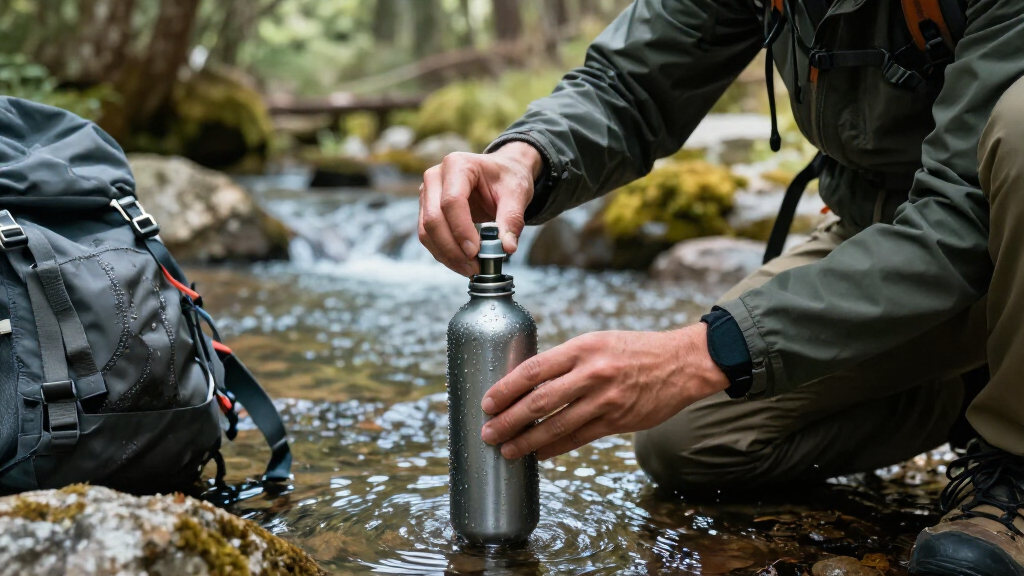

For a versatile balance of portability and water capacity, I would start with the Sawyer Squeeze with Two 32 oz Pouches; the Waterdrop Gravity Straw suits hands-free group use, while the Sawyer Mini favors a smaller pack. Portable water filter systems range from simple personal straws to gravity bags, squeeze kits, hand pumps, and powered units, so the right choice depends on how much water you need and how you plan to collect it. Compact models save space but can slow down group water prep, while larger or powered systems add capacity at the cost of bulk, charging needs, or extra setup. I compare all 14 picks by use case, maintenance, and practical tradeoffs below—continue reading for the full breakdown.

Get emergency and outdoor gear delivered free with Prime
- Fast, free delivery on millions of items
- Prime Video, Amazon Music and more included
- Member-only deals all year
Key Takeaways
- Squeeze systems offer a useful middle ground: the Sawyer Squeeze kits pair packable filters with reservoirs, while the Cnoc bladder version favors a larger collection container.
- Gravity filters shift the work from pumping to waiting: Waterdrop and SimPure bag systems suit camp kitchens and shared water needs better than quick solo stops.
- Personal straws are the simplest carry: LifeStraw, Sawyer Mini, Membrane Solutions S1, and the Practical Survival two-pack favor low weight, but they are less convenient for filling bottles or serving a group.
- Electric and hand-pump models trade simplicity for features: solar, hand-crank, or battery-assisted designs may appeal for emergency kits, but add components and power or maintenance questions.
- Capacity and filter format matter as much as size: choosing a filter that connects to your preferred bottle, bag, or camp setup can make daily use easier than choosing the smallest unit alone.
| Uzima UZ-2 Gravity-Fed Camping Water Filter |  | Best Freestanding Gravity Pick | Purification method: Hollow fiber membrane | Operation: Manual, gravity-fed | Maximum flow rate: 1 liter per minute | VIEW LATEST PRICE | See Our Full Breakdown |
| Practical Survival Reusable Emergency Water Filter Straws, 2-Pack |  | Best Two-Person Backup | Quantity: 2 filters | Purification method: Hollow fiber membrane | Filtration claims: Over 99.99% of waterborne bacteria and parasites; microplastics down to 0.1 micron | VIEW LATEST PRICE | See Our Full Breakdown |
| Portable 3-in-1 Electric Water Filter with Solar and Hand-Crank Charging |  | Best for Multiple Power Options | Filtration: 8-stage system with PP cotton, activated carbon, and ultrafiltration membranes | Filter pore size: 0.01 μm | Maximum flow rate: 800 ml/min | VIEW LATEST PRICE | See Our Full Breakdown |
| Sawyer Products Mini Water Filtration System, Blue | 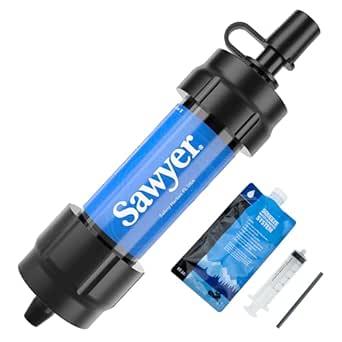 | Best Compact Filter | Filter type: 0.1-micron absolute hollow-fiber membrane | Weight: 2 ounces (41 g) | Filter capacity: Up to 100,000 gallons | VIEW LATEST PRICE | See Our Full Breakdown |
| Sawyer Products Squeeze Water Filtration System with Two 32 oz Pouches |  | Best for Flexible Water Carrying | Filter pore size: 0.1 micron absolute | Filter weight: 2 oz | Filter lifespan: Up to 100,000 gallons | VIEW LATEST PRICE | See Our Full Breakdown |
| LifeStraw Personal Water Filter for Hiking, Travel, and Emergencies |  | Best Compact Personal Filter | Weight: 45 g | Filter capacity: Up to 4,000 liters (1,000 gallons) | Listed removal targets: Bacteria, parasites, and microplastics | VIEW LATEST PRICE | See Our Full Breakdown |
| RETOTLA 3-Stage Portable Hand-Pump Water Filter for Camping |  | Best Manual Pump Option | Filtration stages: 3 | Purification method: Ultrafiltration | Claimed flow rate: 1.5 liters per minute | VIEW LATEST PRICE | See Our Full Breakdown |
| Waterdrop Gravity Water Filter Straw with 1.5-Gallon Water Bag | 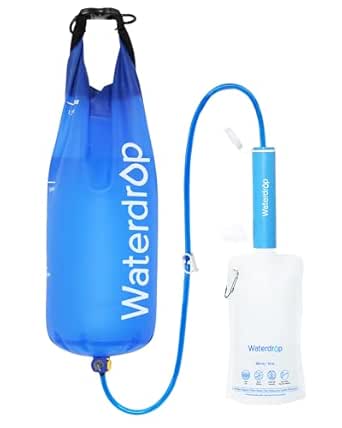 | Best for Gravity-Fed Group Water | Filtration method: Hollow-fiber ultrafiltration membrane | Pore size: 0.1 micron | Water bag capacity: 1.5 gallons | VIEW LATEST PRICE | See Our Full Breakdown |
| SimPure Portable Gravity-Fed Water Filter with 3L Bag |  | Best Hands-Free Lightweight System | Bag capacity: 3 liters | Listed weight: 3.2 ounces; another supplied spec states 2.8 ounces for the filter | Filter lifespan: 5,000 liters (1,320 gallons) | VIEW LATEST PRICE | See Our Full Breakdown |
| Waterdrop Gravity Water Filter Straw with 1.5-Gallon Bag, 2-Pack |  | Best Shared Kit for Two | Included filter straws: 2 | Filter pore size: 0.1 micron | Water bag capacity: 1.5 gallons | VIEW LATEST PRICE | See Our Full Breakdown |
| BKLES BK-2000 Portable Electric Water Filter with Emergency Light |  | Best Electric Pick for Fast Group Water Prep | Filtration stages: 6 | Purification method: Two ultrafiltration membranes, PP cotton, KDF, and activated carbon | Filter pore size: 0.01 micron | VIEW LATEST PRICE | See Our Full Breakdown |
| Membrane Solutions S1 Personal Water Filter Straw |  | Best Lightweight Manual Straw | Filtration stages: 5 | Pore size: 0.1 micron | Maximum flow rate: 500 ml/min | VIEW LATEST PRICE | See Our Full Breakdown |
| ITEHIL Portable Electric Water Filter with Solar Charging | 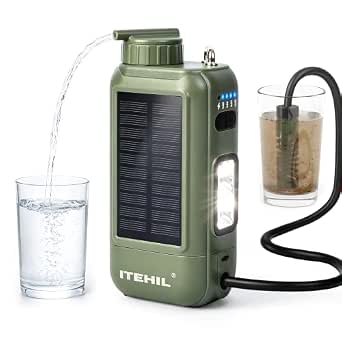 | Best for Solar-Ready Emergency Kits | Filtration precision: 0.01 microns | Purification method: Ahlstrom filter and hollow fiber membrane | Battery capacity: 5200 mAh | VIEW LATEST PRICE | See Our Full Breakdown |
| Sawyer Squeeze Water Filtration System with Cnoc 2-Liter Bladder |  | Best Manual Bladder System | Purification method: Hollow fiber membrane | Filtration size: 0.1 micron absolute | Bladder capacity: 2 liters (64 ounces) | VIEW LATEST PRICE | See Our Full Breakdown |
| portable water filter system | Dimensions | Maximum flow rate | Included components | Weight |
|---|---|---|---|---|
| Uzima UZ-2 Gravity-Fed Camping | 10 x 10 x 17 in | 1 liter per minute | Filter, water tap, filter cleaner | — |
| Practical Survival Reusable Em | 8 x 1.5 x 1.5 inches | — | Backflushing plunger per filter, user manual | 56.7 g |
| Portable 3-in-1 Electric Water | 3.54 × 2.36 × 5.12 in | 800 ml/min | Electric water filter, 27 oz water pouch, filter, 2 straws, manual | 360 g |
| Sawyer Products Mini Water Fil | — | — | — | 2 ounces (41 g) |
| Sawyer Products Squeeze Water | — | — | — | — |
| LifeStraw Personal Water Filte | 3.75 × 1.39 × 12 in | — | — | 45 g |
| RETOTLA 3-Stage Portable Hand- | 10 × 3.5 × 13.5 in | — | Hand pump, instruction, pre-filter, clamps, tubing, and carrying case | 4 pounds |
| Waterdrop Gravity Water Filter | — | 700 ml/min | Filter straw, 1.5-gallon gravity-fed water bag, and 16-ounce water pouch | — |
| SimPure Portable Gravity-Fed W | — | 27 liters per hour | Filter and tree strap | — |
| Waterdrop Gravity Water Filter | — | 700 ml/min | 2 filter straws, 1 gravity-fed water bag, and 2 water pouches | — |
| BKLES BK-2000 Portable Electri | 4.72 × 3.54 × 6.69 in | 0.67 liters per minute | — | 350 g (12.32 oz) |
| Membrane Solutions S1 Personal | 7.1 inches long × 1 inch diameter | 500 ml/min | — | 2 ounces |
| ITEHIL Portable Electric Water | 3.2 × 2.4 × 7 inches | 700 ml/min (0.18 gpm) | — | — |
| Sawyer Squeeze Water Filtratio | 5.5 × 2 × 11.75 inches | — | — | — |
More Details on Our Top Picks
Uzima UZ-2 Gravity-Fed Camping Water Filter
The Uzima UZ-2 is the gravity-fed choice for campers who want a filter that stands on its own rather than one they squeeze or sip through. Its 1-liter capacity and tap make filtered water accessible without electricity, while the hollow-fiber membrane is specified to remove 99.999% of bacteria. Compared with the Sawyer Products Squeeze Water Filtration System, the UZ-2 needs less hands-on pressure during dispensing, but its small reservoir is less suited to serving a group. The tradeoff is a simple, freestanding setup in place of the Squeeze’s larger two-pouch capacity and flexible bottle connections. I’d choose it for solo use or a compact emergency kit, not as the main water station for several people. Its stated 10-year shelf life also suits long-term storage.
Pros:- Gravity-fed operation avoids pumping, squeezing, or electricity
- Freestanding design with a water tap for dispensing
- Specified to remove 99.999% of bacteria
- Stated 10-year product shelf life
Cons:- Only holds 1 liter, so group use calls for frequent refilling
- Maximum flow rate is 1 liter per minute
- Less flexible to carry and drink from than the Sawyer Mini’s bottle and straw connections
Best for: Solo campers and emergency-kit planners who want a freestanding, electricity-free filter with a tap.
Not ideal for: Groups or anyone who needs to filter and store more than a liter at a time; the reservoir is small and flow is limited to 1 liter per minute.
- Purification method:Hollow fiber membrane
- Operation:Manual, gravity-fed
- Maximum flow rate:1 liter per minute
- Capacity:1 liter
- Bacteria protection:99.999%
- Maximum supported TDS:500 ppm
- Dimensions:10 x 10 x 17 in
- Included components:Filter, water tap, filter cleaner
Our verdict“Choose the UZ-2 for simple, freestanding gravity filtration for one person, but pick a larger-capacity system for group water needs.”
Practical Survival Reusable Emergency Water Filter Straws, 2-Pack
This two-filter straw set is a practical way to give two people individual access to a portable filter without carrying a pump or reservoir. Each hollow-fiber unit is specified to remove over 99.99% of waterborne bacteria and parasites, and to filter microplastics down to 0.1 micron. At 56.7 g for the listed product weight, it suits hikers who value a small, direct-drinking setup; compared with the Sawyer Mini, the main distinction is having two filters and a backflushing plunger for each. That makes the set more useful as a shared backup, though it does not provide the Mini’s listed range of bottle, pouch, and hydration-tube connections. I would also treat its capacity cautiously: the supplied information gives both 1,100 and 1,800 gallons per filter. It is for drinking at the source, not storing treated water.
Pros:- Two filters let two people drink independently or provide a spare
- Lightweight format suited to hiking and emergency storage
- Specified to filter bacteria, parasites, and microplastics down to 0.1 micron
- Includes a backflushing plunger for each filter
Cons:- Capacity claims conflict: 1,100 gallons in product information versus 1,800 gallons in the description
- Direct-drinking design does not store filtered water
- Fewer stated connection options than the Sawyer Mini
Best for: Two hikers or travelers who want lightweight, separate direct-drinking filters and individual backflushing tools.
Not ideal for: Buyers who need a shared water container, multiple connection options, or a clearly consistent stated filter capacity.
- Quantity:2 filters
- Purification method:Hollow fiber membrane
- Filtration claims:Over 99.99% of waterborne bacteria and parasites; microplastics down to 0.1 micron
- Weight:56.7 g
- Dimensions:8 x 1.5 x 1.5 inches
- Stated filter capacity:Conflicting claims: 1,100 gallons in product information and up to 1,800 gallons in description, per filter
- Included components:Backflushing plunger per filter, user manual
- Filter lifespan:Up to 10 years
Our verdict“Pick this set when two people need compact, individual backup filters, but choose a pouch-based system for shared or stored water.”
Portable 3-in-1 Electric Water Filter with Solar and Hand-Crank Charging
The Thmomex K8120 takes a different approach from the manual filters here: an electric pump moves water through an 8-stage system, with solar, USB-C, and hand-crank power options. Its listed 800 ml-per-minute flow rate may suit buyers who want faster filling than a personal straw can provide, while the included pouch gives the water somewhere to go. Compared with the Sawyer Products Squeeze System, this adds powered pumping and an LED light, but the Squeeze is simpler and does not depend on a battery or cranking. The K8120’s 360 g weight is also substantially more than the two-ounce Sawyer filters, and its stated flow and 5,000-liter capacity are product claims that can vary with water conditions. I’d favor it for emergency kits or trips where power flexibility matters, not for the lightest hiking load.
Pros:- Solar, USB-C, and hand-crank charging options
- Listed maximum flow rate of 800 ml per minute
- Includes a water pouch, two straws, and built-in LED light
- Washable filter core with a stated capacity of 5,000 liters
Cons:- Requires a charged battery or hand cranking to pump water
- At 360 g, heavier than the two-ounce Sawyer Mini and Squeeze filters
- Listed flow rate and filter capacity may depend on water conditions
Best for: Campers and emergency-preparedness buyers who want powered pumping with several ways to recharge or operate the unit.
Not ideal for: Ultralight hikers or anyone seeking a purely manual filter with fewer components and no power dependence.
- Filtration:8-stage system with PP cotton, activated carbon, and ultrafiltration membranes
- Filter pore size:0.01 μm
- Maximum flow rate:800 ml/min
- Filter capacity:5,000 liters (stated)
- Power sources:Solar, USB-C, hand crank
- Weight:360 g
- Dimensions:3.54 × 2.36 × 5.12 in
- Included components:Electric water filter, 27 oz water pouch, filter, 2 straws, manual
Our verdict“Choose the K8120 if flexible power and pumped filling matter more than minimal weight or a simple manual setup.”
Sawyer Products Mini Water Filtration System, Blue
At 2 ounces, the Sawyer Mini is the clearest choice in this group when pack weight and connection flexibility matter most. Its 0.1-micron hollow-fiber membrane can be used with the included squeeze pouch, a standard 28 mm bottle, hydration-pack tubing, or the supplied straw, so it can serve as a personal filter or fit into a broader carry setup. Compared with the Sawyer Squeeze, it is the more compact option, while the Squeeze kit includes two larger 32 oz pouches for collecting and carrying water. The Mini’s small format does not remove the need for manual operation, and hydration tubing is not included. Its listed capacity of up to 100,000 gallons is a long stated lifespan, but the filter still needs suitable cleaning and handling. I’d choose it for a light, adaptable kit rather than for hands-off group filtration.
Pros:- Lightweight 2-ounce filter for compact kits
- Works with an included pouch, standard 28 mm bottles, hydration tubing, or the included straw
- Specified to remove bacteria, protozoa, and microplastics
- Includes a cleaning plunger
Cons:- Requires manual drinking or squeezing rather than powered filtration
- Hydration-pack tubing is sold separately
- Includes a 16-ounce pouch, smaller than the two 32-ounce pouches supplied with the Sawyer Squeeze
Best for: Weight-conscious hikers and travelers who want one small filter that can connect to bottles, a pouch, or hydration tubing.
Not ideal for: People who want powered or gravity-fed filtration, or buyers who need a larger included water-carrying capacity.
- Filter type:0.1-micron absolute hollow-fiber membrane
- Weight:2 ounces (41 g)
- Filter capacity:Up to 100,000 gallons
- Bacteria removal:99.99999%
- Protozoa removal:99.9999%
- Microplastics removal:100%
- Compatibility:Included pouch, standard 28 mm bottles, hydration-pack tubing, or included straw
- Included accessories:16-ounce reusable squeeze pouch, 7-inch drinking straw, cleaning plunger
Our verdict“Choose the Sawyer Mini for a highly adaptable, low-weight personal filter, and choose the Squeeze if larger included pouches matter more.”
Sawyer Products Squeeze Water Filtration System with Two 32 oz Pouches
The Sawyer Squeeze earns its place for buyers who want a compact filter plus more water-carrying flexibility than a personal straw provides. The kit’s two 32 oz pouches let you collect and carry water, and the filter can also connect to compatible bottles, hydration packs, or a gravity setup. Compared with the Sawyer Mini, it comes with larger pouches and adapters, making it easier to organize a small backcountry water system; the Mini is the leaner pick if minimum weight is the priority. Both require manual operation, and squeezing or setting up a gravity arrangement takes more effort than the Uzima UZ-2’s tap-based dispensing. The pouches also need careful handling on repeated outings. Backwashing can restore flow, but buyers should expect routine maintenance rather than a maintenance-free system.
Pros:- Two reusable 32 oz pouches provide more carrying capacity than the Sawyer Mini’s included pouch
- Compatible with most standard 28 mm threaded plastic bottles
- Includes a drinking straw, hydration-pack adapters, and mesh storage bag
- Backwashing can restore up to 98% of original flow rate
Cons:- Requires manual squeezing or setup in a gravity system
- Included pouches may need careful handling with repeated outdoor use
- More pieces to manage than a single direct-drinking filter straw
Best for: Hikers and campers who want a lightweight filter with included water storage and options for bottle, hydration-pack, or gravity use.
Not ideal for: Buyers seeking hands-off filtration, powered pumping, or a reservoir built to dispense without squeezing or setup.
- Filter pore size:0.1 micron absolute
- Filter weight:2 oz
- Filter lifespan:Up to 100,000 gallons
- Pouch capacity:32 oz each
- Pouches included:Two collapsible pouches
- Bottle compatibility:Most standard 28 mm threaded plastic bottles
- Filtration claims:Removes 99.99999% of bacteria, 99.9999% of protozoa, and 100% of microplastics
- Included accessories:Drinking straw, hydration-pack adapters, mesh storage bag
Our verdict“Choose the Squeeze if you want a compact filter that also carries water; pick a simpler straw for direct drinking with less gear.”
LifeStraw Personal Water Filter for Hiking, Travel, and Emergencies
At just 45 g, this LifeStraw is the simplest option here to pack as an individual backup: drink directly from a water source or use it to filter water into a container. Its stated filtration targets bacteria, parasites, and microplastics, while the 4,000-liter capacity gives it a long potential service life when used and maintained properly. Unlike the Waterdrop Gravity Water Filter Straw models, it has no large bag for preparing water for a group; its strength is the compact, direct-drinking format. That design also sets a limit: you need to drink through the straw or arrange a separate container, rather than hang a bag and let water flow hands-free. I would choose it for a light personal kit, but not as the main system for supplying several people.
Pros:- Very low listed weight of 45 g suits minimalist packs and emergency kits.
- Targets bacteria, parasites, and microplastics.
- Can be used directly at a source or with a separate container.
- Stated filter capacity is up to 4,000 liters with proper use and maintenance.
Cons:- Drinking through the filter is less convenient than gravity systems with a water bag.
- Does not include a reservoir for collecting or storing filtered water.
- The stated capacity depends on proper use and maintenance.
Best for: Solo hikers and travelers who want a lightweight backup for drinking from natural water sources.
Not ideal for: Groups that need hands-free batch filtration or anyone who wants a built-in water reservoir.
- Weight:45 g
- Filter capacity:Up to 4,000 liters (1,000 gallons)
- Listed removal targets:Bacteria, parasites, and microplastics
- Microplastic filtration:Down to 1 micron
- Dimensions:3.75 × 1.39 × 12 in
- Power:None
- Warranty:1 year
Our verdict“Choose this LifeStraw for compact, individual use; pick a Waterdrop gravity model if you need hands-free water for more than one person.”
RETOTLA 3-Stage Portable Hand-Pump Water Filter for Camping
The RETOTLA stands apart from the straw and gravity models in this lineup because it uses a manual pump and a three-stage setup: a debris pre-filter, 5-micron PP cotton, and 0.01-micron ultrafiltration. Its claimed flow rate of 1.5 liters per minute could suit campers who prefer pumping water into a separate container instead of drinking through a straw or waiting on gravity. The carrying case and replaceable cartridges also make it more like a small preparedness kit than a minimalist backpacking filter. That added setup comes with real costs: it weighs 4 pounds, needs repeated pumping, and the product data does not provide independent verification for its contaminant-removal claims. Compared with the 45 g LifeStraw, this is far less suitable for a light pack; I would favor it only when pump operation and the included accessories matter more than weight.
Pros:- Three-stage design combines a debris pre-filter, PP cotton, and ultrafiltration.
- Claimed flow rate of 1.5 liters per minute supports filling containers.
- Includes a carrying case, tubing, clamps, and pre-filter.
- Replaceable cartridges can avoid replacing the entire unit.
Cons:- Listed weight of 4 pounds is heavy beside the LifeStraw and gravity-filter options.
- Manual pumping takes ongoing effort.
- Contaminant-removal claims are not independently verified in the supplied product data.
Best for: Campers or emergency-preparedness buyers who want a manual pump, replaceable cartridges, and a kit with tubing and clamps.
Not ideal for: Ultralight hikers and buyers who require independently verified contaminant-removal claims.
- Filtration stages:3
- Purification method:Ultrafiltration
- Claimed flow rate:1.5 liters per minute
- Stated capacity:3,000 liters
- Weight:4 pounds
- Dimensions:10 × 3.5 × 13.5 in
- Power source:Manual
- Included components:Hand pump, instruction, pre-filter, clamps, tubing, and carrying case
Our verdict“Pick the RETOTLA if you want a pump-based kit for camp or emergency storage, not a lightweight filter for hiking.”
Waterdrop Gravity Water Filter Straw with 1.5-Gallon Water Bag
This Waterdrop kit is a better fit than the LifeStraw Personal Water Filter when I want to collect water first and let gravity do the work. Its included 1.5-gallon bag supports batch filtration, while the 0.1-micron hollow-fiber membrane is listed to reduce chlorine, sediment, particulates, and unpleasant tastes and odors. A stated lifespan of up to 1,400 gallons and a backwashable design make it useful for repeat outdoor trips, though actual filter life depends on water and care. The tradeoff is a slower, less direct setup than drinking through a personal straw: its maximum listed flow is 700 ml per minute. Its 30-day filter warranty is also limited, and the supported TDS ceiling is 300 ppm. I’d choose this over the LifeStraw for shared water prep, but not for a minimal kit centered on direct drinking.
Pros:- Included 1.5-gallon bag can hold a larger batch than a personal straw.
- Gravity-fed operation requires no electricity or hand pumping.
- Backwashing can help restore flow as the filter loads with sediment.
- Stated filter lifespan is up to 1,400 gallons.
Cons:- Maximum listed flow rate is 700 ml per minute, so batch filtration takes time.
- Filter warranty is limited to 30 days.
- Maximum supported TDS is 300 ppm.
Best for: Campers and small groups who want a gravity-fed reservoir for preparing water without pumping.
Not ideal for: Minimalist hikers seeking a direct-drinking filter or users whose source water exceeds the stated 300 ppm TDS limit.
- Filtration method:Hollow-fiber ultrafiltration membrane
- Pore size:0.1 micron
- Water bag capacity:1.5 gallons
- Stated filter lifespan:Up to 1,400 gallons (5,300 liters)
- Maximum flow rate:700 ml/min
- Item weight:4.64 ounces
- Maximum supported TDS:300 ppm
- Included components:Filter straw, 1.5-gallon gravity-fed water bag, and 16-ounce water pouch
Our verdict“Choose this Waterdrop kit for gravity-fed batch filtration, while the LifeStraw is the lighter choice for direct individual drinking.”
SimPure Portable Gravity-Fed Water Filter with 3L Bag
The SimPure is the most backpack-friendly gravity setup in this group for buyers who want to filter more than a single drink without carrying a large, rigid system. Its 3-liter bag hangs for hands-free use, and the filter can also connect to a bottle or be used with the included extension tube. The listed flow rate of up to 27 liters per hour is faster than the Waterdrop straw kits’ stated 700 ml per minute, though those figures are maximum claims and real flow can vary with water conditions. Its filtration combines hollow fiber, activated carbon, and PP fiber, giving it a broader described setup than the LifeStraw’s personal-straw format. The compromises are a smaller reservoir than Waterdrop’s 1.5-gallon bag and inconsistent listed filter weight: the product data gives both 2.8 and 3.2 ounces. Its 5,000-liter lifespan is also stated, not a guarantee for every source.
Pros:- 3-liter bag supports hands-free batch filtration without a pump.
- Rollable, lightweight design is suited to backpacking.
- Can be used with the bag, an extension tube, or a water bottle.
- Listed maximum flow rate is up to 27 liters per hour.
Cons:- Smaller bag capacity than either 1.5-gallon Waterdrop gravity kit.
- Product data gives conflicting filter weights of 2.8 and 3.2 ounces.
- Stated filter life can vary with usage and water conditions.
Best for: Backpackers who want hands-free gravity filtration with a compact, flexible bag and options for bottle or extension-tube use.
Not ideal for: Groups needing the larger 1.5-gallon Waterdrop reservoir or buyers who need consistent published weight and lifespan figures.
- Bag capacity:3 liters
- Listed weight:3.2 ounces; another supplied spec states 2.8 ounces for the filter
- Filter lifespan:5,000 liters (1,320 gallons)
- Maximum flow rate:27 liters per hour
- Filtration:0.1-micron hollow fiber, 5-micron coconut shell GAC, and 0.2-micron PP fiber
- Power source:Non-electric
- Maximum supported TDS:1,000 ppm
- Included components:Filter and tree strap
Our verdict“Choose the SimPure for a lightweight, versatile gravity kit; opt for a Waterdrop model if a larger water bag matters more.”
Waterdrop Gravity Water Filter Straw with 1.5-Gallon Bag, 2-Pack
This two-straw Waterdrop set is the clearest choice here for pairs who want matching personal filters and a shared gravity bag. It includes two filter straws and two 16-ounce pouches, so two people can carry a drinking option while using the 1.5-gallon bag for batch filtration. The filtration details and maximum flow rate match the single-straw Waterdrop kit: a 0.1-micron hollow-fiber membrane, backwashing, and up to 700 ml per minute. That makes it a more group-oriented purchase than the SimPure, which is lighter and more flexible for one backpacker but includes only one filter. The shared setup does not mean twice the bag capacity, and the supplied data gives a 500 ppm TDS limit, compared with 300 ppm for the single Waterdrop listing. I’d pick this for a pair, while solo travelers can avoid carrying a second straw they may not need.
Pros:- Includes two filter straws and two water pouches for a pair.
- Shared 1.5-gallon bag supports gravity-fed batch filtration.
- Backwashable design can help maintain flow.
- Non-electric operation suits off-grid trips.
Cons:- One shared bag does not provide twice the reservoir capacity of the single-straw kit.
- Maximum listed flow rate is 700 ml per minute.
- Filter warranty is limited to 30 days, and flow can decrease until backwashing.
Best for: Two-person camping or travel groups who want a straw for each person plus one shared gravity bag.
Not ideal for: Solo hikers who want the lightest kit, or groups expecting two separate large reservoirs.
- Included filter straws:2
- Filter pore size:0.1 micron
- Water bag capacity:1.5 gallons
- Stated filter lifespan:Up to 1,400 gallons (5,300 liters)
- Maximum flow rate:700 ml/min
- Maximum supported TDS:500 ppm
- Included components:2 filter straws, 1 gravity-fed water bag, and 2 water pouches
- Warranty:30-day limited filter warranty
Our verdict“Choose the two-pack when two people need separate straws; solo buyers are better served by the single Waterdrop kit or the lighter SimPure.”
BKLES BK-2000 Portable Electric Water Filter with Emergency Light
The BKLES BK-2000 suits buyers who want powered filtration and a faster fill than a personal straw can provide. Its six-stage setup combines ultrafiltration membranes, PP cotton, KDF, and activated carbon, while the stated flow rate reaches about 0.67 liters per minute. Compared with the non-electric Membrane Solutions S1, it is better suited to preparing water for more than one person, but the S1 is lighter and does not depend on a battery. The BK-2000’s USB-C charging, backwashing feature, storage bag, and emergency light add useful flexibility at camp. The tradeoff is dependence on a charged battery or another power source, plus cartridge replacement after 180 days or 1,000 liters. Its stated 350 g weight also makes it heavier than a straw-style filter.
Pros:- Six-stage filtration combines ultrafiltration membranes, PP cotton, KDF, and activated carbon.
- Up to 0.67 liters per minute supports quicker water preparation than a personal straw.
- USB-C charging and compatibility with power banks, solar panels, or vehicle power add charging options.
- Built-in emergency light, storage bag, and electric backwashing add practical utility.
Cons:- Requires a charged battery or access to a power source.
- The cartridge needs replacement after 180 days or 1,000 liters.
- At 350 g, it weighs more than compact manual straw filters.
Best for: Campers and emergency-kit planners who want powered, faster water preparation and can keep a battery or charging source available.
Not ideal for: Ultralight hikers or users who need a fully manual filter that works without charging.
- Filtration stages:6
- Purification method:Two ultrafiltration membranes, PP cotton, KDF, and activated carbon
- Filter pore size:0.01 micron
- Maximum flow rate:0.67 liters per minute
- Weight:350 g (12.32 oz)
- Battery capacity:One charge purifies up to 168,000 ml
- Charging port:USB Type-C
- Dimensions:4.72 × 3.54 × 6.69 in
Our verdict“Choose the BK-2000 if you value powered flow and added emergency features more than minimum weight and battery-free operation.”
Membrane Solutions S1 Personal Water Filter Straw
At 2 ounces, the Membrane Solutions S1 is the simplest fit here for a hiker who wants a backup filter with little pack weight and no charging routine. Its five-stage design combines a hollow fiber membrane, activated carbon, PP cotton, and a coarse screen; the stated capacity is up to 5,000 liters. Unlike the powered BKLES BK-2000, the S1 needs no battery and is easier to carry, though its 500 ml/min flow and personal-straw format are less convenient for preparing larger amounts of water. A threaded 28 mm connection gives it more setup flexibility than a straw used only directly at a source. It is certified to NSF/ANSI 42, 372, and 401, but does not reduce TDS, so it is not a solution for dissolved salts or similar substances.
Pros:- Weighs only 2 ounces and requires no power.
- Rated for up to 5,000 liters of filtration.
- Fits 28 mm threaded bottles and supports different filtration setups.
- Removable ends allow backflushing, and the product lists NSF/ANSI 42, 372, and 401 certifications.
Cons:- Does not reduce TDS.
- Personal-straw format is less suited to preparing larger volumes for a group.
- Its 500 ml/min maximum flow is slower than the stated rates of the electric BKLES and ITEHIL filters.
Best for: Solo hikers, travelers, and emergency-kit builders who want a light, non-electric filter that can connect to compatible 28 mm threaded bottles.
Not ideal for: Groups needing high-volume water preparation or buyers seeking a filter that reduces dissolved solids.
- Filtration stages:5
- Pore size:0.1 micron
- Maximum flow rate:500 ml/min
- Filter capacity:Up to 1,320 gallons (5,000 liters)
- Weight:2 ounces
- Dimensions:7.1 inches long × 1 inch diameter
- Bottle compatibility:28 mm threaded bottles
- Certifications:NSF/ANSI 42, 372, and 401
- TDS reduction:Does not reduce TDS
Our verdict“Pick the S1 for a light, battery-free personal filter, but choose a powered or gravity system when shared water volume matters more.”
ITEHIL Portable Electric Water Filter with Solar Charging
The ITEHIL’s main distinction is its combination of USB-C and solar charging with an emergency light and power-bank function. That gives it a broader role in an emergency kit than the manual Sawyer Squeeze with Cnoc 2-Liter Bladder, which filters without batteries but offers no charging or lighting features. ITEHIL lists a 0.01-micron dual filtration system and a flow rate of up to 700 ml/min, making it a powered option for filling water without squeezing a pouch. Its backpack attachment hook helps keep it accessible on the move. The tradeoff is more gear to manage: the solar charging rate depends on conditions, and the cartridge is rated for up to 1,000 liters, with replacement timing varying by water quality. The supplied data also lists its weight as just 1 ounce, a figure buyers may want to verify before packing.
Pros:- Offers both USB-C and solar charging.
- Provides a stated flow rate of up to 700 ml/min.
- Combines an emergency light, power-bank function, and backpack attachment hook.
- Uses an Ahlstrom filter and hollow fiber membrane with 0.01-micron filtration precision.
Cons:- Solar charging time depends on available conditions.
- The cartridge is rated for up to 1,000 liters and needs periodic replacement.
- The listed 1-ounce weight is unusually low for this feature set and may warrant confirmation.
Best for: Emergency-preparedness buyers and campers who want solar charging, a light, and powered filtration in one portable device.
Not ideal for: Ultralight travelers who prioritize a proven manual setup, or anyone who needs reliable charging regardless of sunlight.
- Filtration precision:0.01 microns
- Purification method:Ahlstrom filter and hollow fiber membrane
- Battery capacity:5200 mAh
- Charging options:USB-C and solar
- Maximum flow rate:700 ml/min (0.18 gpm)
- Filter capacity:Up to 1,000 liters (265 gallons)
- Dimensions:3.2 × 2.4 × 7 inches
- Listed weight:1 ounce
- Additional features:Emergency light, power bank, and backpack attachment hook
Our verdict“Choose ITEHIL if solar charging and emergency functions matter more than the simplicity of a manual filter such as the Sawyer Squeeze.”
Sawyer Squeeze Water Filtration System with Cnoc 2-Liter Bladder
This Sawyer bundle makes the most sense for buyers who want to carry water in a reusable reservoir and filter it manually, rather than depend on a powered unit. The included 2-liter TPU bladder has a wide opening for filling, and the hollow fiber filter can connect to threaded bottles or work in a gravity setup. Compared with the Membrane Solutions S1, it is a more complete water-carrying system, not just a personal straw; the S1 is lighter and better suited to a minimal emergency backup. Sawyer lists a 0.1-micron absolute filter and a lifespan of up to 100,000 gallons, with backwashing available to restore flow. The tradeoff is hands-on effort: squeezing takes time, and gravity use may be slower. Product information also gives only an incomplete system weight, making pack-weight comparisons less certain.
Pros:- Includes a 2-liter TPU bladder with a wide opening for filling.
- Connects to threaded bottles and supports gravity filtration.
- Reusable hollow fiber filter can be backwashed.
- Filter is rated for up to 100,000 gallons.
Cons:- Filtering requires manual squeezing or a gravity setup.
- The listed system weight is incomplete, limiting pack-weight comparisons.
- The 2-liter bladder is less compact than a standalone personal straw when empty.
Best for: Hikers and campers who want a reusable 2-liter reservoir, manual filtration, and the option to connect the filter to bottles or use gravity.
Not ideal for: Buyers who want powered, hands-free filtration or need a clearly stated complete system weight before choosing gear.
- Purification method:Hollow fiber membrane
- Filtration size:0.1 micron absolute
- Bladder capacity:2 liters (64 ounces)
- System weight:Less than 6 ounces
- Bladder material:TPU
- Dimensions:5.5 × 2 × 11.75 inches
- Filter lifespan:Up to 100,000 gallons
- Power source:Manual
- Special features:Reusable, backwashable, BPA- and PVC-free bladder
Our verdict“Choose this Sawyer bundle if carrying a refillable 2-liter reservoir and having flexible manual filtration matter more than powered convenience or a fully specified weight.”
How We Picked
I compared these portable water filter systems by the job they are built to do: provide a personal drinking option, support a camp or group, or add flexibility to an emergency kit. I weighed packability against usable water capacity, then looked at how each format collects and dispenses water—direct-drink straw, squeeze reservoir, gravity bag, hand pump, or powered unit. Setup effort, likely cleaning needs, included accessories, and compatibility with common containers also shaped the evaluation.
The ranking favors useful balance and clear fit over feature count. Squeeze and gravity models rank well when they make it easier to collect and share water without excessive bulk; personal straws rise for minimal carry and straightforward use. Powered and multi-stage pump options are judged by whether their added capability justifies extra parts and reliance on charging or upkeep. Since product specifications and water conditions vary, I also treat filtration claims as model-specific and recommend checking the manufacturer’s stated limits before relying on any filter for a particular source.
Factors to Consider When Choosing Portable Water Filter Systems
Before choosing a format, I would decide how water will move from its source to the person drinking it. That decision often matters more than a long feature list: a solo hiker, a family at a campsite, and someone assembling an emergency kit have different needs for speed, storage, and backup options.
Match the Filter Format to How You Collect Water
A straw is direct and compact, but it generally works best when you can drink at the source or pair it with a compatible container. Squeeze kits let you collect water in a pouch and push it through the filter, which can be more flexible for filling a bottle. Gravity bags take little active effort once hung, though they need a place to hang and time to filter. Hand-pump and electric systems can suit users who prefer a more controlled transfer, but their moving parts add setup and upkeep. Avoid buying by filter size alone; think through the entire path from stream or tap to drinking vessel. If that path requires extra fittings you do not own, the system may be less convenient than its headline format suggests.
Estimate Water Demand Before Choosing Capacity
Personal drinking and group water preparation call for different capacities. A lightweight straw can be enough for one person who refills often, while a gravity bag or larger reservoir can reduce repeated collection for a camp. Higher capacity does not automatically mean faster output, so check the maker’s stated flow rate and the conditions used for that figure. Cold, cloudy, or sediment-heavy water can affect practical flow and may require more frequent cleaning. A common mistake is to count only the water container’s volume and ignore how long it takes to filter it. For a group, think about how many people need water at once and whether you can tolerate waiting between refills.
Check What the Filter Is Certified or Designed to Reduce
Portable filters do not all address the same contaminants, and a generic label such as “water filter” is not a guarantee of protection against every hazard. Read the specific manufacturer claims for bacteria, protozoa, particulates, chemicals, viruses, or other concerns, and check whether independent testing or a stated standard supports those claims. Many compact outdoor filters are designed around particular biological risks, not every possible contaminant in unknown water. If chemical pollution, heavy metals, or viruses are a concern, a filter alone may not be the right treatment method. Do not assume that clearer-tasting water is safe or that one system is suitable for every source. Choose based on likely water conditions and follow the product’s instructions for treatment and storage.
Factor Cleaning, Drying, and Long-Term Storage Into Ownership
Maintenance affects how reliably a portable system works after repeated use. Backwashing, rinsing, drying, replacing parts, and protecting a filter from freezing can differ by model, so review those instructions before buying. A system that is easy to clean at camp may be a better fit than one with more stages but a complicated routine. For emergency storage, check whether the filter needs periodic inspection or replacement and keep any required accessories together. Do not put a wet filter away in a sealed kit unless its instructions allow it. Skipping maintenance can reduce flow or damage a filter, which matters most when you need it away from home.
Treat Power Features as a Tradeoff, Not a Free Upgrade
Solar panels, hand-crank charging, and electric pumps can add convenience, particularly in an emergency kit, but they bring extra components that need testing and care. Solar charging depends on available light and may not replenish a device quickly in poor conditions. A hand crank can provide a fallback, but it still takes effort and may not suit continuous group use. Powered models also raise practical questions about battery life, charging cables, and whether the filter remains usable if the electronics fail. Compare those dependencies with a gravity or squeeze system that works without power. I would pay for powered features only when their role in the kit is clear and there is a simple backup plan.
Check Packability, Compatibility, and Backup Plans Together
The lightest filter may not be the easiest system to use if it needs a separate bottle, collection bag, or adapter. Check what is included and whether the connections match containers you already carry. For hiking, decide how much space you can give to a reservoir and whether it will be protected from punctures inside your pack. For a vehicle or home emergency kit, a larger system may be acceptable if it serves more people. Keep a backup way to collect and carry untreated water, since the filter itself cannot help if its pouch or connector is lost. A well-matched system is one you can operate with the containers and spares available on the trip.
Frequently Asked Questions
Can one portable water filter system work for both solo hikes and group camping?
It can, but a single system may not be equally convenient for both situations. A squeeze kit with a larger reservoir can cover solo use and provide some shared water, while a gravity bag is usually easier when several people need repeated fills at camp. Personal straws are compact but make it awkward to prepare water for others or fill multiple bottles. Think about your most common trip rather than choosing around a rare scenario. If you expect both frequent solo hikes and group trips, check whether the filter works with separate reservoirs or a compatible gravity setup.
Are portable filter straws enough for emergency water storage?
A straw can serve as a compact backup for drinking from an accessible source, but it does not store treated water or make water collection convenient for a household. You may need to drink directly at the source, which is not always practical or safe. For a home or vehicle kit, pair a personal filter with clean, sealable containers and a plan for treating or collecting enough water for more than one person. Check the straw’s stated contaminant limits and storage instructions before relying on it. A straw is best treated as one layer in an emergency plan, not a complete water supply system.
Should I choose a gravity filter or a squeeze filter for camping?
Choose based on whether you value hands-free filtering or active control. A gravity system can process water while you set up camp or prepare food, but it needs a hanging point and enough time for water to pass through. A squeeze filter lets you control the transfer and can pack smaller, though repeated squeezing may be less convenient for several people. Group size, water demand, and campsite layout can tip the decision more than the filter itself. If you often camp where hanging the bag is difficult, a squeeze setup may be easier to manage.
Do solar or hand-crank water filters remove the need for a backup?
No. Charging features can add flexibility, but they do not remove the possibility of a dead battery, damaged cable, poor sunlight, or mechanical failure. Check whether the unit can still filter water when its powered functions are unavailable and what the maker says about operating it manually. Keep a separate treatment method or non-powered filter if the system is part of an emergency plan. Also test charging and operation before storing the device, rather than discovering a problem during use. Backup planning matters most when you expect to depend on the system for multiple days.
What should I check before using a portable filter on an unfamiliar water source?
Read the exact product instructions and contaminant claims, then compare them with the risks associated with that source. A compact outdoor filter may address some biological contaminants while leaving chemicals, viruses, or other hazards outside its stated scope. Avoid assuming that clear water is safe, and follow guidance from local authorities when available. Pre-filtering visible sediment and using a separate disinfection step may be appropriate for some situations, but only when the filter maker’s instructions and local guidance support that approach. If the source may contain industrial or agricultural pollution, choose a treatment designed for those risks rather than relying on a general-purpose label.
Conclusion
For most buyers seeking one adaptable system, I would begin with the Sawyer Squeeze with Two 32 oz Pouches as the best overall balance of portability and reservoir flexibility; the Cnoc bladder version is a stronger fit if a larger collection bag suits your routine. For best value, compare the Sawyer Mini or a personal straw against your actual needs: they keep the kit simple, but they are not substitutes for group capacity. Beginners who want straightforward, direct drinking can start with a personal straw, while campers who prefer low-effort shared water should look at the Waterdrop or SimPure gravity format. For a premium-style feature set, the electric and hand-pump options make sense only if their added operation or emergency features solve a specific need. My final choice would follow the trip: compact straw for a solo pack, squeeze filter for versatile carry, gravity bag for camp, and a powered unit only with a tested backup.
Halloween Picks

12-Foot Inflatable Pumpkin Halloween Archway with LED Lights

Jenaai 5.3-Foot Motion-Activated Halloween Animatronic Skeleton

Kalolary 11 ft Halloween Inflatable Archway Ghost House Tunnel
As an affiliate, we earn on qualifying purchases.