Solar-powered emergency radios can provide weather updates and basic lighting when household power is unavailable, but solar charging is usually better treated as a backup than a fast refill. My best overall pick is the Kaito KA500 for its range of charging and emergency features; the Sony ICF-B300 is a standout for buyers who prefer a simpler, established radio design, while the FosPower A3 offers a more clearly specified 4,000mAh power bank. The main tradeoffs are battery capacity versus portability, extra features versus simple operation, and broad radio-band coverage versus ease of use. A crank, USB input, and solar panel each help in different situations, so no single charging method should be your only plan. Read on for the full breakdown and guidance on matching a radio to your emergency kit.

Get emergency and outdoor gear delivered free with Prime
- Fast, free delivery on millions of items
- Prime Video, Amazon Music and more included
- Member-only deals all year
Key Takeaways
- The Kaito KA500 earns the overall spot by combining several charging methods with a broad emergency feature set, though buyers seeking a minimal control layout may prefer the Sony.
- The Sony ICF-B300 and FosPower A3 serve different priorities: Sony favors a straightforward radio-first approach, while FosPower lists a 4,000mAh power bank and multiple backup charging options.
- Two listed models specify 12,000mAh batteries, but a large capacity is most useful when the radio can be recharged reliably and the extra size fits your kit.
- USB-C and built-in charging cables solve different problems: USB-C can simplify recharging with newer cables, while attached cables may help when you do not want to pack a separate lead.
- Shortwave and Bluetooth are specialist extras on the Kaito Voyager Solo, Feexot, Supersonic SC-1180BT, and Bluetooth emergency model; for many emergency kits, clear weather alerts and usable controls matter more.
| RunningSnail Hand-Crank Emergency Weather Radio with Built-In Charging Cables |  | Best for Charging a Mix of Phones | Radio bands: AM, FM, NOAA Weather Band | Battery capacity: 7400mWh | Power sources: USB-C, solar, hand crank, rechargeable battery, or 3 AAA batteries (not included) | VIEW LATEST PRICE | See Our Full Breakdown |
| Sony ICF-B300 Emergency Radio with Hand Crank, Solar Charging, LED Light, and Phone Charging |  | Best Compact Pick | Model: ICF-B300 | Radio bands: FM, AM | Charging methods: Hand crank, solar, USB | VIEW LATEST PRICE | See Our Full Breakdown |
| Peakeep NOAA Emergency Weather Radio with Solar Charging and Hand Crank |  | Best for Weather and Band Coverage | Radio bands: NOAA, AM, FM, SW, WB | Tuner: Digital | Battery capacity: 18,500mWh | VIEW LATEST PRICE | See Our Full Breakdown |
| Solar Emergency Radio with Hand Crank, 12000mAh Battery, NOAA/AM/FM Reception, Flashlight and Reading Lamp |  | Best for a Large Built-In Battery | Radio bands: NOAA, AM, FM | Battery capacity: 12,000mAh lithium battery | Power sources: Solar panel, hand crank, USB-C input, or 3 AAA batteries | VIEW LATEST PRICE | See Our Full Breakdown |
| Emgykit Emergency Hand Crank Radio with AM/FM/NOAA Weather Band, Flashlight and SOS Alarm |  | Best Lightweight Basic Pick | Model: 086S | Radio bands: AM, FM, NOAA | Battery capacity: 2000mAh / 7400mWh | VIEW LATEST PRICE | See Our Full Breakdown |
| RunningSnail Hand Crank Emergency Radio with NOAA, AM/FM, Solar Charging, and Flashlight |  | Best Compact Pick | Radio bands: AM/FM/NOAA | Power sources: Hand crank, solar panel, rechargeable battery | Battery capacity: 2,000mAh / 7,400mWh | VIEW LATEST PRICE | See Our Full Breakdown |
| Portable AM/FM/NOAA Weather Radio with Solar Panel, Hand Crank, USB-C Charging, Flashlight, Reading Lamp and SOS Alarm |  | Best for Flexible Backup Power | Radio bands: AM/FM/NOAA | Power options: Solar panel, hand crank, USB-C charging, AAA batteries | Battery capacity: 5,000mAh | VIEW LATEST PRICE | See Our Full Breakdown |
| Kaito KA500 Emergency Weather Radio with Solar Charging, Hand Crank, Flashlight, Reading Lamp, and USB Charger |  | Best for Broadcast Range | Radio bands: AM, FM, two-band shortwave, seven NOAA weather channels | Power sources: Hand crank, solar, rechargeable NiMH pack, three AA batteries, USB input, AC/DC input | USB output: 5V | VIEW LATEST PRICE | See Our Full Breakdown |
| FosPower A3 NOAA Emergency Weather Radio with 4000mAh Power Bank, Solar and Hand-Crank Charging, SOS Alarm, and Lights |  | Best for Motion-Activated Lighting | Radio bands: AM, FM, NOAA weather band | Battery capacity: 4,000mAh / 14,800mWh | Charging methods: Solar, hand crank, USB-C | VIEW LATEST PRICE | See Our Full Breakdown |
| NOAA Weather Radio with 12,000mAh Battery, Hand Crank, and Solar Charging | 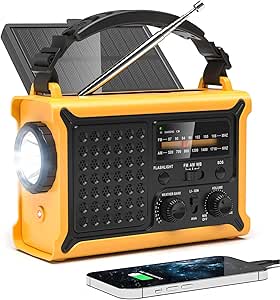 | Best for Longer Backup Power | Radio bands: AM, FM, seven NOAA weather channels | Battery capacity: 12,000mAh rechargeable battery | Power options: USB-C, solar panel, hand crank, three AAA batteries | VIEW LATEST PRICE | See Our Full Breakdown |
| Feexot Portable AM/FM/SW Radio with Solar Charging and COB Light |  | Best Compact, Simple Radio | Radio bands: AM/FM/SW | Tuning: Analog | Charging: USB Type-C and solar | VIEW LATEST PRICE | See Our Full Breakdown |
| Kaito Voyager Solo Emergency AM/FM/Shortwave NOAA Weather Alert Radio with Solar Charging, Hand Crank, and Flashlight |  | Best for Weather Alerts | Radio bands: AM, FM, shortwave, and 7 preset NOAA weather bands | AM range: 530–1710 kHz | FM range: 87–108 MHz | VIEW LATEST PRICE | See Our Full Breakdown |
| Supersonic SC-1180BT SolarWave Emergency Radio with Bluetooth, AM/FM/SW, Solar and USB-C Rechargeable Battery, LED Flashlight, and Portable Speaker (Red) |  | Best for Shortwave and Bluetooth Audio | Radio bands: AM/FM/SW1–4 | Connectivity: Bluetooth 6.0 | Charging: Solar panel and USB-C rechargeable battery | VIEW LATEST PRICE | See Our Full Breakdown |
| Emergency Hand-Crank Weather Radio with Solar Charging, Bluetooth, Flashlights, and SOS |  | Best Lighting and Multi-Use Setup | Battery capacity: 3500mAh | Radio bands: AM 520–1710 kHz; FM 87–108 MHz; WB 162.400–162.550 MHz | Charging options: Solar panel, hand crank, USB-C input | VIEW LATEST PRICE | See Our Full Breakdown |
| solar powered emergency radio | Radio bands | Dimensions | Battery capacity | Power sources |
|---|---|---|---|---|
| RunningSnail Hand-Crank Emerge | AM, FM, NOAA Weather Band | — | 7400mWh | USB-C, solar, hand crank, rechargeable battery, or 3 AAA batteries (not included) |
| Sony ICF-B300 Emergency Radio | FM, AM | 3.15 × 2.28 × 5.2 inches | — | — |
| Peakeep NOAA Emergency Weather | NOAA, AM, FM, SW, WB | — | 18,500mWh | Rechargeable battery, solar, hand crank, corded electric |
| Solar Emergency Radio with Han | NOAA, AM, FM | 6.8 × 4.7 × 2.9 inches | 12,000mAh lithium battery | Solar panel, hand crank, USB-C input, or 3 AAA batteries |
| Emgykit Emergency Hand Crank R | AM, FM, NOAA | 5.16 × 2.09 × 2.6 inches | 2000mAh / 7400mWh | Hand crank, solar panel, USB-C |
| RunningSnail Hand Crank Emerge | AM/FM/NOAA | 5 × 1.8 × 2.4 inches | 2,000mAh / 7,400mWh | Hand crank, solar panel, rechargeable battery |
| Portable AM/FM/NOAA Weather Ra | AM/FM/NOAA | 3 × 2 × 3 inches (listed) | 5,000mAh | — |
| Kaito KA500 Emergency Weather | AM, FM, two-band shortwave, seven NOAA weather channels | 8.3 × 2.3 × 5.3 inches | — | Hand crank, solar, rechargeable NiMH pack, three AA batteries, USB input, AC/DC input |
| FosPower A3 NOAA Emergency Wea | AM, FM, NOAA weather band | 6.23 × 2.48 × 3.19 inches | 4,000mAh / 14,800mWh | — |
| NOAA Weather Radio with 12,000 | AM, FM, seven NOAA weather channels | 4.7 × 2.9 × 6.8 inches | 12,000mAh rechargeable battery | — |
| Feexot Portable AM/FM/SW Radio | AM/FM/SW | 5.31 × 2.56 × 1.26 in | — | — |
| Kaito Voyager Solo Emergency A | AM, FM, shortwave, and 7 preset NOAA weather bands | — | — | Built-in rechargeable battery, 3 AAA batteries, solar panel, hand crank, USB/AC adapter |
| Supersonic SC-1180BT SolarWave | AM/FM/SW1–4 | 2.17 × 3.94 × 5.9 in | — | — |
| Emergency Hand-Crank Weather R | AM 520–1710 kHz; FM 87–108 MHz; WB 162.400–162.550 MHz | — | 3500mAh | — |
More Details on Our Top Picks
RunningSnail Hand-Crank Emergency Weather Radio with Built-In Charging Cables
The three built-in charging cables make this RunningSnail a practical pick for households with different phone connectors: Lightning, Micro USB, and USB-C are already on hand, so there is less to pack or hunt for during an outage. It also covers the core emergency-radio needs with NOAA alerts, solar and hand-crank power, an SOS siren, and two types of lighting. Compared with the Emgykit 086S, it offers more built-in charging convenience and a reading lamp, while the Emgykit is smaller and lighter. Its 7400mWh battery is a more modest reserve than the Peakeep’s listed 18,500mWh capacity, so I would choose it for cable flexibility rather than extended device charging. The AAA backup option adds another fallback, but those batteries are not included, and the water-resistance level is unspecified.
Pros:- Built-in Lightning, Micro USB, and USB-C cables reduce the need to pack separate charging leads.
- Solar, hand-crank, USB-C, and optional AAA power provide several ways to keep it running.
- NOAA alerts, an SOS siren, a flashlight, and a reading lamp cover key outage needs.
- AAA batteries offer a backup power option when rechargeable power is unavailable.
Cons:- The 7400mWh battery is smaller than the Peakeep’s listed 18,500mWh capacity.
- Three AAA backup batteries are not included.
- The water-resistance level is not specified.
Best for: Households with a mix of Lightning, Micro USB, and USB-C devices that want a radio with cables and backup lighting built in.
Not ideal for: People who need a documented water-resistance rating or a larger battery reserve for charging phones repeatedly.
- Radio bands:AM, FM, NOAA Weather Band
- Battery capacity:7400mWh
- Power sources:USB-C, solar, hand crank, rechargeable battery, or 3 AAA batteries (not included)
- Built-in charging cables:3: Lightning, Micro USB, and USB-C
- Lighting:3-level LED flashlight and 6-LED reading lamp
- Emergency features:NOAA weather alerts and SOS siren
- Water resistance:Water resistant; rating not specified
- Enclosure material:ABS
Our verdict“Choose this RunningSnail if built-in cables for several phone types matter more than a larger battery or a published water-resistance rating.”
Sony ICF-B300 Emergency Radio with Hand Crank, Solar Charging, LED Light, and Phone Charging
The Sony ICF-B300 is the most compact choice in this group, at 3.15 × 2.28 × 5.2 inches and 395 g. That size makes it easier to keep in a small emergency kit than the broader-featured Peakeep NOAA Emergency Weather Radio, which adds shortwave reception, a reading lamp, and a much larger stated battery capacity. The Sony instead keeps its job simple: receive AM and FM, provide an LED spotlight, and accept hand-crank, solar, or USB charging, with a USB-C connector and IPX4 water resistance. It can also charge a connected device, though the product information does not give battery capacity, runtime, or charge times. That missing detail makes it harder to judge as a phone-power backup, and it lacks the NOAA band listed for several other radios here. I see it as a compact general broadcast option, not the most feature-rich weather-alert station.
Pros:- Compact dimensions and 395 g weight suit a small emergency kit.
- Solar, hand-crank, and USB charging offer multiple ways to replenish power.
- IPX4 water resistance is a clearer specification than the unrated water resistance listed for several alternatives.
- LED spotlight and connected-device charging add basic emergency utility.
Cons:- Radio reception is limited to FM and AM; NOAA weather band is not listed.
- Battery capacity, runtime, and charging times are not specified.
- It lacks the Peakeep’s shortwave reception, reading lamp, and stated 18,500mWh battery.
Best for: Buyers assembling a compact go-bag who want AM/FM reception, basic lighting, and a stated water-resistance rating.
Not ideal for: People who specifically need NOAA weather-band reception, shortwave, a reading lamp, or published battery-runtime details.
- Model:ICF-B300
- Radio bands:FM, AM
- Charging methods:Hand crank, solar, USB
- USB connector:USB Type-C
- Lighting:LED spotlight
- Water resistance:IPX4
- Dimensions:3.15 × 2.28 × 5.2 inches
- Weight:395 g
Our verdict“Pick the Sony for a compact, IPX4-rated AM/FM radio, but choose a NOAA-equipped model if weather alerts are a priority.”
Peakeep NOAA Emergency Weather Radio with Solar Charging and Hand Crank
The Peakeep stands out for buyers who want more than basic AM/FM and NOAA listening: it adds shortwave reception, digital tuning, and 16 volume levels. Its listed 18,500mWh battery and weather-alert runtime of up to 65 hours give it a stronger stated reserve than the RunningSnail’s 7400mWh battery, although runtime claims should not be read as a guarantee for every use pattern. A 2.7-inch backlit display, retractable antenna, flashlight, reading lamp, and 120 dB SOS siren make it the most information- and feature-heavy option here. That breadth comes with more bulk than the Sony ICF-B300, and the Peakeep’s rechargeable battery is non-removable. The product details also mention two nonstandard batteries without clearly explaining their role, which leaves some ambiguity for buyers planning a long-term emergency kit.
Pros:- NOAA, AM, FM, shortwave, and WB reception provide the broadest listed band coverage in this group.
- The 18,500mWh battery and stated weather-alert runtime of up to 65 hours offer a substantial reserve on paper.
- Digital tuning, 16 volume levels, and a backlit 2.7-inch display support more controlled listening.
- Flashlight, reading lamp, and 120 dB SOS siren add useful emergency functions.
Cons:- The rechargeable battery is non-removable.
- The product information does not clearly explain the role of two nonstandard batteries.
- It is larger and heavier than the compact Sony ICF-B300.
Best for: Preparedness-minded listeners who want NOAA alerts, shortwave access, digital tuning, and a larger stated battery reserve in one radio.
Not ideal for: Buyers prioritizing a small, simple radio or anyone who needs a removable battery and clearly explained battery options.
- Radio bands:NOAA, AM, FM, SW, WB
- Tuner:Digital
- Battery capacity:18,500mWh
- Weather-alert battery runtime:Up to 65 hours
- Power sources:Rechargeable battery, solar, hand crank, corded electric
- Display:2.7-inch screen with button-activated backlight
- SOS siren:120 dB
- Dimensions and weight:6.89 × 2.09 × 3.43 inches; 14.88 ounces
Our verdict“Choose the Peakeep if broad radio-band coverage and a larger stated battery matter more than compact size and a removable battery.”
Solar Emergency Radio with Hand Crank, 12000mAh Battery, NOAA/AM/FM Reception, Flashlight and Reading Lamp
This radio’s main case is its 12,000mAh lithium battery, paired with solar, hand-crank, USB-C, and three AAA power options. That combination suits buyers who want a substantial built-in reserve plus a fallback if the rechargeable battery runs down. The Peakeep lists a larger battery in mWh and broader shortwave coverage, but this model counters with a clearly stated USB-C input and an analog display that keeps operation straightforward. It also adds a phone-charging function, SOS alarm, two-level flashlight, and flip-up reading lamp. At 1.6 pounds, it is heavier than the Sony ICF-B300 and the Emgykit, so it fits a home emergency shelf or car kit better than a minimalist pocket kit. Water resistance is mentioned, but no IP rating is provided; I would not treat it as a proven choice for wet conditions.
Pros:- The 12,000mAh lithium battery is paired with solar, hand-crank, USB-C, and AAA power options.
- NOAA, AM, and FM reception covers weather alerts and standard broadcasts.
- Phone charging, SOS alarm, flashlight, and flip-up reading lamp combine several emergency functions.
- Two flashlight brightness levels allow a choice between stronger light and less intense illumination.
Cons:- At 1.6 pounds, it is heavier than the compact Sony ICF-B300 and Emgykit 086S.
- Water resistance is claimed without a stated IP rating.
- The product recommends fully charging the battery before first use.
Best for: Households or car-kit planners who want a large stated battery, multiple backup power paths, and both a flashlight and reading lamp.
Not ideal for: Ultralight kit builders or buyers who need a defined IP water-resistance rating and detailed battery runtime figures.
- Radio bands:NOAA, AM, FM
- Battery capacity:12,000mAh lithium battery
- Power sources:Solar panel, hand crank, USB-C input, or 3 AAA batteries
- USB-C input:5V/2A
- Lighting:Two-level flashlight and flip-up reading lamp
- Additional emergency features:Phone charging and SOS alarm
- Dimensions:6.8 × 4.7 × 2.9 inches
- Weight:1.6 pounds
Our verdict“Choose this model for its 12,000mAh battery and varied backup power, provided you do not need a lightweight radio or a documented water-resistance rating.”
Emgykit Emergency Hand Crank Radio with AM/FM/NOAA Weather Band, Flashlight and SOS Alarm
At 0.23 kg and 5.16 × 2.09 × 2.6 inches, the Emgykit is an easy fit for a small go-bag where every bit of space matters. It covers the essentials—AM/FM/NOAA reception, solar and hand-crank power, USB-C charging, a 140-lumen flashlight, and an SOS siren—without the extra reading lamp or built-in cable set found on the RunningSnail. Its 2000mAh battery can charge a connected device, but it is the smallest stated battery among these five, so I would treat phone charging as a limited backup rather than a dependable power source. The listed speaker output is only 1 watt, another reason this is a utility-first choice rather than a radio for filling a room with sound. For a larger reserve and more lighting options, the 12,000mAh radio is the stronger home-kit alternative.
Pros:- Compact size and 0.23 kg weight make it easy to pack.
- Solar, hand-crank, and USB-C charging provide three listed power paths.
- The 3-LED flashlight is rated at 140 lumens.
- NOAA reception and an SOS siren add emergency functions beyond basic AM/FM listening.
Cons:- The 2000mAh battery is small for charging a phone and is best treated as a limited backup.
- The listed maximum speaker output is 1 watt.
- It lacks the reading lamp and built-in charging cables offered by the RunningSnail.
Best for: Hikers and go-bag owners who want a lightweight NOAA radio with solar and hand-crank charging, a bright flashlight, and a basic phone-power fallback.
Not ideal for: People who need a large phone-charging reserve, a reading lamp, or stronger speaker output for group listening.
- Model:086S
- Radio bands:AM, FM, NOAA
- Battery capacity:2000mAh / 7400mWh
- Power sources:Hand crank, solar panel, USB-C
- Flashlight:3W, 3 LEDs, 140 lumens
- SOS alarm:Over 80 dB
- Dimensions:5.16 × 2.09 × 2.6 inches
- Weight:0.23 kg
Our verdict“Pick the Emgykit for a lightweight, basic emergency kit, but choose a larger-battery radio if phone charging or extended lighting matters more.”
RunningSnail Hand Crank Emergency Radio with NOAA, AM/FM, Solar Charging, and Flashlight
At just 0.5 lb and 5 inches long, this RunningSnail is the easiest of these five to keep in a go-bag or drawer without giving up weather-band reception. Its solar panel, hand crank, and rechargeable battery offer fallback power, while the retractable antenna can help improve reception when conditions are poor. Compared with the larger Kaito KA500, it is simpler and easier to pack, but gives up shortwave reception, a reading lamp, and the Kaito’s wider set of power inputs. The 1W flashlight is useful for basic tasks, and USB output can provide a small emergency charge. The tradeoff is its 2,000mAh battery: treat phone charging as a backup, not a dependable way to replenish a depleted phone. Water-repellent construction also falls short of waterproof protection.
Pros:- Compact 0.5 lb design is easy to store in a go-bag.
- Receives NOAA weather alerts as well as AM/FM broadcasts.
- Hand-crank, solar, and rechargeable-battery power provide several fallback options.
- Includes a 1W LED flashlight and USB output for compatible devices.
Cons:- The 2,000mAh battery offers limited capacity for charging a phone.
- Water-repellent construction is not described as waterproof.
- Lacks the Kaito KA500’s shortwave bands and reading lamp.
Best for: People assembling a lightweight car or home emergency kit who want NOAA, AM/FM, a flashlight, and multiple backup power methods in one small radio.
Not ideal for: Buyers who need substantial phone charging, shortwave broadcasts, or a radio they can confidently expose to heavy rain.
- Radio bands:AM/FM/NOAA
- Power sources:Hand crank, solar panel, rechargeable battery
- Battery capacity:2,000mAh / 7,400mWh
- Flashlight:1W LED
- USB:USB connectivity for device charging
- Dimensions:5 × 1.8 × 2.4 inches
- Weight:0.5 lb
- Water resistance:Water repellent
Our verdict“Choose this RunningSnail for a compact, basic emergency radio, but choose the Kaito KA500 or FosPower A3 if you want more features or greater device-charging capacity.”
Portable AM/FM/NOAA Weather Radio with Solar Panel, Hand Crank, USB-C Charging, Flashlight, Reading Lamp and SOS Alarm
The Rartlytir stands apart from the RunningSnail by accepting AAA batteries as well as solar, hand-crank, and USB-C power. That extra option can help when the rechargeable battery is drained and sunlight or a charging port is unavailable. Its 5,000mAh battery and USB output also give it more phone-charging potential than the RunningSnail’s 2,000mAh cell, though neither spec alone promises a full recharge. For nighttime use, it adds an adjustable six-LED reading lamp alongside a flashlight, plus an SOS alarm. The listed dimensions are unusually small for a radio with this set of features, so buyers should check the physical controls and lighting expectations carefully. Solar charging depends on sunlight, and the supplied information does not specify water resistance or light output, making this a less certain choice for harsh outdoor conditions than a model with explicit protection details.
Pros:- Four power options include solar, hand crank, USB-C, and AAA batteries.
- 5,000mAh rechargeable battery offers more device-charging capacity than the RunningSnail’s 2,000mAh battery.
- Combines NOAA, AM/FM, a flashlight, an adjustable reading lamp, and an SOS alarm.
- USB output can charge compatible devices.
Cons:- Solar charging performance depends on available sunlight.
- The provided product data does not specify water resistance or lighting output.
- Its very compact listed dimensions may mean smaller controls and a limited reading lamp.
Best for: Households that want several ways to power a compact emergency radio and value replaceable AAA batteries as a backup when recharging is unavailable.
Not ideal for: Outdoor users who need a clearly specified water-resistant enclosure or buyers who prioritize documented flashlight output and larger controls.
- Radio bands:AM/FM/NOAA
- Power options:Solar panel, hand crank, USB-C charging, AAA batteries
- Battery capacity:5,000mAh
- Lighting:Flashlight and adjustable six-LED reading lamp
- Additional features:SOS alarm, USB power output, telescopic antenna
- Dimensions:3 × 2 × 3 inches (listed)
- Weight:500g
- Enclosure material:ABS
Our verdict“Pick the Rartlytir if replaceable batteries and varied charging options matter more than documented weather protection or detailed lighting specifications.”
Kaito KA500 Emergency Weather Radio with Solar Charging, Hand Crank, Flashlight, Reading Lamp, and USB Charger
The Kaito KA500 is the most broadcast-flexible pick here: alongside AM/FM and NOAA weather channels, it receives two shortwave bands, which the RunningSnail and FosPower A3 do not. That wider tuning range can be useful when local broadcasts are disrupted, though its NOAA coverage is specified for the USA and Canada. Power options are unusually varied too, with solar, hand crank, a rechargeable NiMH pack, three AA batteries, USB input, and AC/DC input. A reading lamp, flashlight, and SOS beacon make it better equipped for a fixed home emergency station than the simpler RunningSnail. The tradeoff is its larger 8.3-inch body and a less straightforward kit: AA batteries are not included and the wall adapter is sold separately. Its water-resistant, impact-resistant shell adds practical protection, but the supplied data does not give a battery capacity for comparing phone-charging endurance.
Pros:- Receives AM, FM, two shortwave bands, and seven NOAA weather channels.
- Offers hand-crank, solar, NiMH-pack, AA-battery, USB, and AC/DC power options.
- Includes a reading lamp, flashlight, and red LED SOS beacon.
- Impact-resistant, water-resistant ABS enclosure suits indoor and outdoor storage.
Cons:- Larger than the compact RunningSnail, at 8.3 × 2.3 × 5.3 inches.
- Three AA batteries are not included, and the wall adapter is sold separately.
- Product data does not state battery capacity, limiting comparisons of phone-charging endurance.
Best for: Preparedness-minded households in the USA or Canada that want shortwave reception, several ways to power the radio, and multiple built-in lights.
Not ideal for: Buyers who need a very compact radio, an included wall adapter and AA batteries, or a clearly stated battery capacity for planning phone charging.
- Radio bands:AM, FM, two-band shortwave, seven NOAA weather channels
- Power sources:Hand crank, solar, rechargeable NiMH pack, three AA batteries, USB input, AC/DC input
- USB output:5V
- Lighting:Five-LED reading lamp, LED flashlight, red LED SOS beacon
- Antenna:Telescopic, extends up to 14.5 inches
- Enclosure:Impact-resistant, water-resistant ABS plastic
- Dimensions:8.3 × 2.3 × 5.3 inches
- Compatible devices:Smartphones, GPS units, MP3 players, digital cameras
Our verdict“Choose the Kaito KA500 for shortwave coverage and broad power flexibility, but skip it if packability or a simpler included setup matters more.”
FosPower A3 NOAA Emergency Weather Radio with 4000mAh Power Bank, Solar and Hand-Crank Charging, SOS Alarm, and Lights
The FosPower A3’s strongest distinction is its motion-activated reading light, which can illuminate a nearby area without requiring a person to find a switch in the dark. It pairs that with an SOS siren and flashing light, a flashlight, and a 4,000mAh power bank. Compared with the RunningSnail, it offers double the stated battery capacity and adds USB-C charging; compared with the Kaito KA500, it is more focused on emergency lighting than shortwave listening. Its AM/FM and NOAA reception covers the core radio needs, while solar, hand-crank, and USB-C input provide charging alternatives. The battery remains a modest phone-charging reserve rather than a large power station, and its water resistance is not detailed to a particular rating. The required AA battery is included, but it is another item to track when maintaining an emergency kit.
Pros:- Motion-activated reading light can provide hands-free illumination.
- 4,000mAh power bank and USB-C input add device charging and a convenient recharge method.
- SOS siren with flashing light, flashlight, and reading light support emergency use.
- Receives AM/FM and NOAA weather broadcasts.
Cons:- The 4,000mAh battery is limited for repeated or full phone recharges.
- Water resistance is listed without a specific rating.
- Requires one AA battery, even though it is included.
Best for: People who want a weather radio with automatic area lighting and an SOS signal for power outages, bedside use, or a household emergency kit.
Not ideal for: Buyers seeking shortwave reception, a high-capacity phone power bank, or a precisely rated level of water protection.
- Radio bands:AM, FM, NOAA weather band
- Battery capacity:4,000mAh / 14,800mWh
- Charging methods:Solar, hand crank, USB-C
- Lighting and alert features:Flashlight, motion-sensor reading light, SOS alarm with flashing light
- Display:LCD tuner display
- Water resistance:Water resistant
- Dimensions:6.23 × 2.48 × 3.19 inches
- Battery requirement:One AA battery, included
Our verdict“Choose the FosPower A3 for motion-triggered lighting and a useful range of emergency signals, not for shortwave listening or extended phone charging.”
NOAA Weather Radio with 12,000mAh Battery, Hand Crank, and Solar Charging
This radio has the largest stated rechargeable battery in this group: 12,000mAh, versus 5,000mAh in the Rartlytir and 4,000mAh in the FosPower A3. That gives it the strongest stated reserve for radio use, lighting, and emergency phone charging, though real charging results depend on the connected device and available power. It also has a 300-lumen flashlight, 250-lumen reading light, and 115dB SOS siren, making it the most specification-rich lighting and alert package here. USB-C, solar, hand crank, and three AAA batteries give several ways to keep it running. One limitation needs attention: NOAA alerts require the radio to be on and tuned to the weather band, so it is not described as providing unattended alert standby. The wall adapter is also not included, and its larger body is less compact than the RunningSnail.
Pros:- 12,000mAh rechargeable battery is the largest stated capacity among these five radios.
- USB-C, solar, hand crank, and three AAA batteries provide multiple power options.
- Bright 300-lumen flashlight and 250-lumen reading light are specified.
- Includes a 115dB SOS siren and receives AM/FM plus seven NOAA weather channels.
Cons:- NOAA alerts require the radio to be on and tuned to a weather channel.
- Wall adapter is not included.
- At 4.7 × 2.9 × 6.8 inches, it is less compact than the RunningSnail.
Best for: Households that prioritize a larger stated battery reserve, bright built-in lights, and several backup power options for extended outages.
Not ideal for: Buyers who need unattended NOAA alert standby, an included wall adapter, or a pocket-sized radio for a small kit.
- Radio bands:AM, FM, seven NOAA weather channels
- Battery capacity:12,000mAh rechargeable battery
- Power options:USB-C, solar panel, hand crank, three AAA batteries
- Flashlight:300 lumens; beam distance up to 70m
- Reading light:250 lumens
- SOS siren:115dB
- Dimensions:4.7 × 2.9 × 6.8 inches
- Water resistance:Listed as waterproof
Our verdict“Pick this model for its larger stated battery and powerful lighting, but choose another radio if you need unattended NOAA alerts or a smaller carry size.”
Feexot Portable AM/FM/SW Radio with Solar Charging and COB Light
The Feexot is a straightforward pick for buyers who want a small solar-capable radio without a long list of extras. Its AM, FM, and shortwave reception covers more broadcast types than the NOAA-focused Emergency Hand-Crank Weather Radio with Solar Charging, Bluetooth, Flashlights, and SOS, but the Feexot does not list NOAA weather bands or a hand crank. Solar and USB-C charging offer two ways to replenish its included battery, while the COB light and wrist strap suit a go-bag or short outdoor trip.
The tradeoff is simplicity: analog tuning lacks digital station controls, and its nonstandard battery may be harder to replace than common cells. Choose it for compactness and broad radio-band access; skip it if weather alerts or multiple backup power sources are your priority.
Pros:- Receives AM, FM, and shortwave broadcasts.
- Supports both solar and USB-C charging.
- Compact body includes a COB LED light and wrist strap.
- Analog controls keep operation simple.
Cons:- Does not list NOAA weather-band reception or a hand-crank charging option.
- Uses an included nonstandard battery, which may be difficult to replace.
- Analog tuning does not provide digital station controls.
Best for: Travelers and campers who want a compact AM/FM/shortwave radio with solar charging and a basic emergency light.
Not ideal for: Preparedness-focused buyers who need NOAA weather alerts, a hand crank, or easy-to-source replacement batteries.
- Radio bands:AM/FM/SW
- Tuning:Analog
- Charging:USB Type-C and solar
- Light:COB LED
- Battery:One included nonstandard battery
- Dimensions:5.31 × 2.56 × 1.26 in
- Included items:Instruction manual, lanyard, USB cable
- Warranty:1 year
Our verdict“Choose the Feexot for compact AM/FM/shortwave listening with solar backup, but pick a NOAA-equipped crank radio for weather alerts and more power options.”
Kaito Voyager Solo Emergency AM/FM/Shortwave NOAA Weather Alert Radio with Solar Charging, Hand Crank, and Flashlight
The Kaito Voyager Solo is the strongest fit here for people who put emergency broadcasts ahead of entertainment extras. It combines AM/FM/shortwave reception with seven preset NOAA weather bands, giving it a more direct severe-weather role than the Feexot, which has shortwave but no listed NOAA coverage. Its five power options—rechargeable battery, AAA cells, solar, hand crank, and USB/AC adapter—also give it more fallback choices than the Supersonic SC-1180BT, which relies on solar and USB-C charging.
At 9 oz, it is easy to carry, and its flashlight adds a practical backup light. The compromises are a plastic, non-water-resistant enclosure and AAA batteries that are not included. This is a capable alert-focused choice, not a radio to leave exposed to rain.
Pros:- Receives AM, FM, shortwave, and seven preset NOAA weather bands.
- Offers five power options, including solar and hand crank.
- Lightweight design includes an LED flashlight with SOS mode.
- Telescopic antenna and earphone jack add useful listening options.
Cons:- Not water resistant, limiting use in rain or damp outdoor settings.
- Three AAA batteries are not included.
- Plastic enclosure offers less reassurance for rough handling than a more rugged build.
Best for: Campers and household emergency planners who want NOAA alerts plus several ways to power a compact radio.
Not ideal for: People who need a water-resistant radio or want a rugged unit for wet, exposed conditions.
- Radio bands:AM, FM, shortwave, and 7 preset NOAA weather bands
- AM range:530–1710 kHz
- FM range:87–108 MHz
- Shortwave range:3.2–22.0 MHz
- Power sources:Built-in rechargeable battery, 3 AAA batteries, solar panel, hand crank, USB/AC adapter
- Lighting:LED flashlight with SOS signal mode
- Dimensions and weight:8 × 5 × 2 in; 9 oz
- Water resistance:Not water resistant
- Warranty:1 year manufacturer warranty
Our verdict“Pick the Kaito Voyager Solo if NOAA alerts and varied backup power matter more than water resistance.”
Supersonic SC-1180BT SolarWave Emergency Radio with Bluetooth, AM/FM/SW, Solar and USB-C Rechargeable Battery, LED Flashlight, and Portable Speaker (Red)
The Supersonic SC-1180BT is the entertainment-minded pick in this group. Along with AM and FM, it receives four shortwave bands, and Bluetooth, USB/Micro SD playback, and a built-in speaker let it serve as more than an alert radio. Its 360° antenna and USB-C plus solar charging make it a more versatile listening companion than the Feexot, whose simpler analog design lacks Bluetooth and listed playback features.
For emergency readiness, though, this is less complete than the Kaito Voyager Solo: the supplied details do not list NOAA weather-band reception or hand-crank charging. It can also charge a phone through USB, but the compact form factor may limit speaker output, and the listed nonstandard battery and 90-day warranty are drawbacks for long-term preparedness. Pick it for varied audio; skip it for weather-first use.
Pros:- Receives AM, FM, and four shortwave bands.
- Combines solar charging with USB-C rechargeable power.
- Bluetooth, USB/Micro SD playback, and a built-in speaker support varied audio use.
- Includes an LED flashlight and USB phone-charging capability.
Cons:- No NOAA weather-band reception or hand-crank charging is listed.
- Compact size may limit speaker output.
- The listed battery is nonstandard, and the warranty is 90 days.
Best for: Campers and listeners who want shortwave reception, Bluetooth audio, and USB/Micro SD playback in a compact radio.
Not ideal for: Buyers who need NOAA weather alerts, hand-crank power, or a longer listed warranty for emergency storage.
- Radio bands:AM/FM/SW1–4
- Connectivity:Bluetooth 6.0
- Charging:Solar panel and USB-C rechargeable battery
- Additional playback:Micro SD and USB
- Other features:LED flashlight, USB phone charging, 360° antenna, built-in speaker
- Audio interface:3.5 mm
- Dimensions:2.17 × 3.94 × 5.9 in
- Warranty:90 days
Our verdict“Choose the Supersonic for shortwave and flexible audio playback, but choose the Kaito Voyager Solo for NOAA alerts and hand-crank backup.”
Emergency Hand-Crank Weather Radio with Solar Charging, Bluetooth, Flashlights, and SOS
This radio makes the most sense for buyers who want emergency lighting as much as radio reception. It covers AM, FM, and NOAA weather broadcasts, while solar, hand-crank, and USB-C charging provide three ways to replenish its 3500mAh battery. Its dual flashlights and folding reading lamp offer more dedicated lighting than the Kaito Voyager Solo’s single flashlight, and Bluetooth 5.4 adds everyday audio use.
The Kaito still has an advantage for broadcast range because it adds shortwave and seven preset NOAA bands; this model lists NOAA weather-band reception but not shortwave. Its USB output can help power compatible devices, though it should be treated as a backup rather than a dependable phone-charging bank. The plastic construction is another reason to avoid rough or wet handling.
Pros:- Offers solar, hand-crank, and USB-C charging.
- Receives AM, FM, and NOAA weather broadcasts.
- Dual flashlights and a three-level folding reading lamp cover different lighting needs.
- Bluetooth 5.4, SOS siren, and USB output add useful emergency functions.
Cons:- USB device charging may be limited and is not a substitute for a dedicated power bank.
- Plastic construction may be less suitable for rough handling.
- Shortwave reception is not listed, unlike the Kaito Voyager Solo and Feexot.
Best for: Households and campers who want NOAA reception, multiple charging methods, and separate lights for reading and finding their way.
Not ideal for: Shortwave listeners or buyers who need a rugged, water-resistant radio or substantial phone-charging capacity.
- Battery capacity:3500mAh
- Radio bands:AM 520–1710 kHz; FM 87–108 MHz; WB 162.400–162.550 MHz
- Charging options:Solar panel, hand crank, USB-C input
- USB output:For compatible devices
- Bluetooth:5.4
- Lighting:Dual LED flashlights and 180-degree folding reading lamp with 3 brightness levels
- Alarm:SOS siren
- Dimensions and weight:5.75 × 1.73 × 3.78 in; 409.5 g
- Included accessories:Charging cable, carrying strap, storage pouch, compass, cleaning cloth, user manual
Our verdict“Choose this model for a compact weather radio with unusually flexible lighting, but choose the Kaito Voyager Solo if shortwave reception matters.”
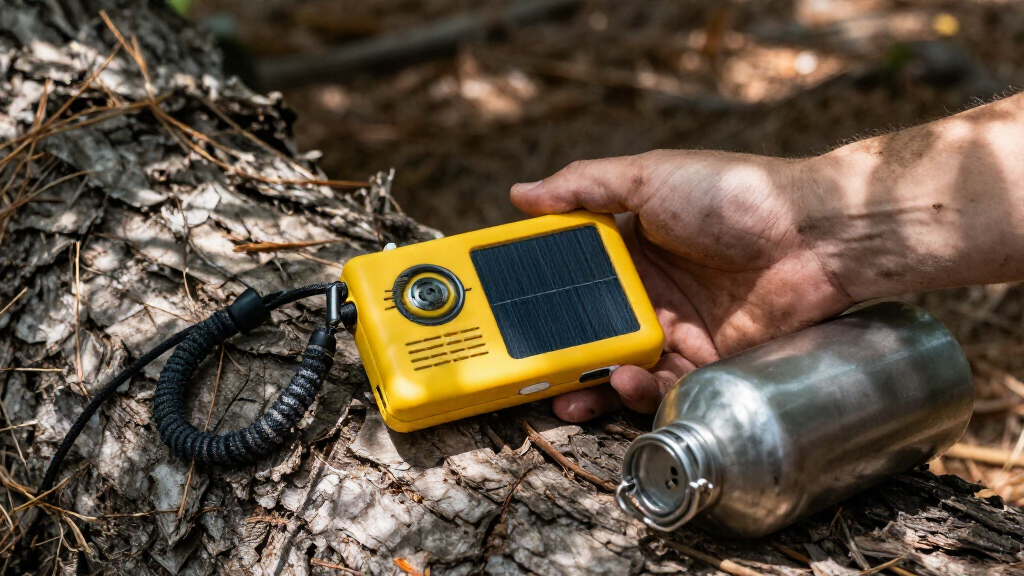
How We Picked
I compared these radios by how well their stated features address the practical jobs of an emergency device: receiving local weather information, keeping the radio usable without wall power, providing light, and offering a way to recharge a phone. I gave more weight to multiple independent power options, clearly stated battery capacity, weather-band functionality, and useful controls than to feature count alone. Extras such as Bluetooth, reading lamps, shortwave bands, and built-in cables mattered when they served a distinct use, but they did not automatically move a model higher.
The order reflects the balance of emergency usefulness, versatility, and clarity of the listed specifications—not a claim that every model has been independently tested. Models with a recognizable combination of radio, lighting, and backup charging features rank ahead of options whose main appeal is a single specialty. The product list does not provide comparable runtime, solar input, water-resistance, or alert-performance figures for every radio, so I treat those as questions buyers should verify rather than assume. A higher-capacity battery can improve phone-backup potential, but it does not by itself prove longer radio runtime or faster solar charging.
Factors to Consider When Choosing Solar Powered Emergency Radios
Choosing among these radios is less about collecting the most features and more about deciding which functions must work when normal power and communications are limited. I would plan around how the radio will be stored, charged, and used, then check the details that product listings often leave unclear.
Treat Solar as Supplemental Charging
A small radio panel can help maintain a charge when the device sits in strong sunlight, but buyers should not assume it will quickly refill a depleted battery. Solar performance depends on panel size, sun angle, cloud cover, and how much power the radio is using. Ask the manufacturer for solar input or recharge-time information when that detail matters to your plan. A hand crank can provide a manual backup, while USB charging is usually more practical for preparing the radio before an outage. Keep a charged power bank or another independent charging option if phone power is a priority. The common mistake is buying a solar-labeled radio and treating sunlight as its only dependable power source.
Match Battery Capacity to the Job
A stated battery capacity, such as the 4,000mAh FosPower A3 or the 12,000mAh models in this lineup, gives buyers a useful point of comparison but not a complete runtime estimate. Radio volume, lighting use, battery age, and the device’s power-management design all affect how long it lasts. Phone charging also draws from the same stored energy, so using the radio as a power bank can shorten its own operating time. If your priority is weather updates, conserving charge by limiting bright lights and phone charging may matter more than buying the largest listed capacity. Check whether the battery is built in, replaceable, or rechargeable through a standard port. Do not compare capacity figures alone without checking what the manufacturer says they power.
Check Weather Alerts and Reception Details
NOAA or weather-band labeling signals the intended use, but it does not tell you how well a radio will receive alerts in your location. Reception depends on distance from transmitters, terrain, buildings, antenna design, and local service coverage. Look for clear information about alert modes, station tuning, and whether alerts can sound while the radio is otherwise off. A wider selection of AM, FM, or shortwave bands can be useful for news and varied listening, yet it may add controls that are unnecessary for someone focused on local forecasts. Shortwave is most relevant if you have a specific plan for using it; it is not a substitute for confirming local weather-alert compatibility. Before an emergency, tune and test the radio where you expect to use it.
Prioritize Controls You Can Use Under Stress
Emergency gear should be simple to operate in darkness, with cold hands, or when several people need information quickly. A radio with many bands, lights, alarms, and Bluetooth functions can be versatile, but extra modes may make essential tuning less direct. Check whether buttons are labeled clearly and whether the flashlight or alert can be activated without searching through menus. A reading lamp can help with close-up tasks, while a focused flashlight is more useful for moving around; one does not necessarily replace the other. If this is for an older adult or a first-time radio owner, favor a clear radio-first layout over a long feature list. Practice turning on the radio, finding a station, and starting the light before storing it.
Choose Lighting and Durability for Your Setting
Emergency radios may be used in a basement, tent, vehicle, or during an evacuation, and those settings place different demands on lighting and construction. A reading lamp can illuminate a table or map, while a flashlight helps with walking or checking a breaker panel. Confirm whether the device has any stated water-resistance or drop-protection rating instead of assuming that an emergency label means it can handle rain. Consider where the radio will live: a larger unit may offer more battery capacity or features but take up more room in a go-bag. Inspect the charging-port cover, antenna, crank, and handle as likely wear points. If you need outdoor reliability, seek clear durability specifications before prioritizing convenience features.
Decide Whether Phone Charging Is a Must
Many radios in this group advertise phone charging, but emergency power-bank use is best viewed as a limited backup rather than a replacement for a dedicated battery pack. The radio may need substantial stored energy to provide a useful phone charge, and some phones may draw power faster than a small radio can supply it. Check the output type and power rating, as well as whether a cable is included or built in. USB-C can reduce cable clutter if it supports the charging direction you need; the connector alone does not confirm output speed or compatibility. If staying in contact is central to your plan, pack a separate power bank and keep the radio’s reserve for weather information. Choose phone charging as a bonus unless the specifications clearly match your device and expected use.
Frequently Asked Questions
Can a solar emergency radio keep a phone charged during a long outage?
It may provide limited backup power, but the result depends on the radio’s battery capacity, output, and the phone’s battery size. Solar panels on compact radios should not be assumed to refill either device quickly, especially in poor light. Save the radio’s charge for listening and alerts if that is your main safety need. For communications, store a separate charged power bank and use the radio’s phone output as a reserve. Check the listed output and cable compatibility before relying on it for a particular phone.
Is a hand crank more dependable than solar charging?
They solve different problems: a crank can generate power on demand without sunlight, while solar charging can add energy when the radio is left in suitable sun. Cranking takes effort and may produce only a limited amount of operating or phone power, so it is not a substitute for charging the device ahead of time. Solar charging is less effort but depends on weather, exposure, and panel performance. A radio with both methods plus USB charging gives you more options if one source is unavailable. Check the manufacturer’s guidance for crank time and expected output instead of assuming all radios perform alike.
Should I choose a 12,000mAh model over a smaller emergency radio?
A larger stated capacity can be useful if you plan to run the radio for extended periods or use its phone-charging output. It may also mean a larger or heavier unit, which can be inconvenient in a compact go-bag. Capacity figures alone do not establish real-world runtime, charging speed, or how much energy remains after powering lights. Compare the radio’s size, charging options, and stated output alongside the battery figure. If you mainly need occasional weather checks, a smaller, simpler radio may fit your needs better.
Do I need shortwave or Bluetooth on an emergency radio?
Shortwave can add listening options for buyers who have a particular use for it, but it is not required for receiving local weather information. Bluetooth is mainly a convenience for playing audio from a phone and can consume battery that you may want to reserve. Both features may add controls or complexity without improving the core emergency functions you need. Prioritize weather-band access, understandable tuning, reliable power options, and lighting first. Choose the extras only if you expect to use them outside an emergency as well.
What should I verify before depending on a radio’s NOAA alert feature?
Confirm that weather-alert service is available in your area and check the radio’s instructions for alert mode, channel selection, and standby behavior. A NOAA or weather-band label does not guarantee strong reception in every building or location. Test the radio at home and at the place where you plan to store or use it, since terrain and walls can affect reception. Learn how to tune local stations and keep the antenna positioned as directed. For a household emergency plan, pair the radio with other ways to receive official alerts rather than relying on one device alone.
Conclusion
For the strongest balance of backup charging and emergency features, I would start with the Kaito KA500 as best overall. Buyers who want a more straightforward radio-first option should compare the Sony ICF-B300, while the FosPower A3 is my best value-style pick for shoppers who want a clearly stated 4,000mAh power bank and several charging methods without chasing the largest battery. For beginners, I would favor the model whose controls and weather-alert instructions are easiest to understand, then test it before storing it; the Sony is a sensible shortlist choice for that simpler-use priority. For higher-capacity needs, compare the two listed 12,000mAh radios against their size, outputs, and charging details rather than choosing by capacity alone. Shortwave listeners may prefer the Kaito Voyager Solo or Feexot, while Bluetooth buyers can look at the Supersonic SC-1180BT or the Bluetooth emergency radio. Whichever you choose, keep a separate charging plan and confirm local reception before depending on the radio in an outage.
Black Friday Picks

Vitamix Nano Personal Blender with SmoothiePilot, Black
As an affiliate, we earn on qualifying purchases.