For most households preparing for a short-notice water outage, I’d start with the waterBOB bathtub bladder: it can hold up to 100 gallons and includes a hand pump, though it depends on having a clean, usable tub when an emergency begins. The 55-gallon stackable tanks suit households that want dedicated, larger-volume storage, while the Scepter 5-gallon jugs are easier to move and divide among storage spots. The main choice is between high capacity and portability, with space, filling time, access, and upkeep shaping what works in practice. A bathtub liner is compact to store but cannot hold water before use; a rigid tank takes up room year-round but is ready for planned storage. Read on for the full comparison of all 15 emergency water storage containers and the tradeoffs behind each format.

Get emergency and outdoor gear delivered free with Prime
- Fast, free delivery on millions of items
- Prime Video, Amazon Music and more included
- Member-only deals all year
Key Takeaways
- Bathtub bladders lead for rapid, temporary volume: waterBOB and AquaPod store away until needed, but require an available tub and advance filling during a warning.
- Rigid tanks make more sense for planned storage: 55-gallon stackable models offer substantial capacity without relying on a bathtub, at the cost of permanent floor space and a harder move when full.
- Five-gallon jugs favor flexible handling: Scepter, FastRack, and the multipack options divide water into manageable units, though many containers take more filling, labeling, and storage organization.
- Seven-gallon Aqua-Tainers sit between small jugs and large tanks: they offer more capacity per vessel than a five-gallon jug, but a full container is heavier to lift and reposition.
- The 116-gallon foil option is a different storage format: its listed capacity is high, but buyers should confirm the package’s placement, filling, dispensing, and protection requirements before relying on it as their main supply.


| emergency water storage container | Material | Capacity | Color | Dimensions |
|---|---|---|---|---|
| waterBOB Bathtub Emergency Wat | LLDPE (linear low-density polyethylene) | Up to 100 gallons | Clear | — |
| AquaPod Kit Made in USA | Heavy-duty plastic | 65–100 gallons | — | — |
| Scepter Portable Plastic Milit | BPA-free polyethylene | — | Blue | 7.5 in W × 18.87 in H |
| Reliance Products Aqua-Tainer | Polyethylene (PE) | 7 gallons (26 liters) | Blue | 15.3 in D × 11.3 in W × 15.3 in H |
| 55 Gallon Stackable Emergency | Rotationally molded polyethylene | 55 gallons | Blue | 27.75 in L × 21.75 in W × 29.5 in H |
| WaterPrepared 55-Gallon Stacka | High-density polyethylene (HDPE) | 55 gallons | Blue | 28 x 22 x 29.5 inches |
| 30 Gallon Stackable Emergency | Plastic; described as food-grade polyethylene | 30 gallons | Blue | 21 x 21 x 21 inches |
| Augason Farms 55-Gallon Water | Food-grade polyethylene | 55 gallons | — | — |
| Godwolf 100 Gallon Bathtub Dri | Food-grade LLDPE | 100 gallons | — | 15.39 x 3.31 x 2.83 inches |
| 5-Gallon Stackable Water Stora | BPA-free HDPE plastic | — | — | — |
| Scepter 4 Pack Military Style | HDPE plastic | — | Black | 13.50 x 6.50 x 18.75 inches |
| FastRack 5 Gallon Water Jug | Plastic | — | White | — |
| Reliance Products Aqua Tainer | Polypropylene (PP) | — | — | — |
| 116 Gallon Aluminum Foil Emerg | Aluminum foil | — | — | 63 x 37 inches |
| Scepter 5-Gallon Portable Mili | BPA-free high-density polyethylene | 5 gallons | Sand | 13.5 x 6.5 x 18.75 inches |
More Details on Our Top Picks
waterBOB Bathtub Emergency Water Storage Bladder Up To 100 Gallon Capacity
For households with a clean, standard bathtub available before an outage, the waterBOB’s 100-gallon capacity can provide far more stored water than the portable jugs in this roundup. Its food-grade, BPA-free liner sits inside the tub, while the included hand pump helps dispense water without lifting a heavy container. Compared with the AquaPod Kit, it offers the same stated maximum capacity and a pump, but the AquaPod specifies an 8–16 week water-purity duration while this product data does not give a storage-duration claim. The tradeoff is dependence on a bathtub, faucet access, and time to set up: it is not a portable reserve, and the listed setup can take around 20 minutes. I’d choose it for rapid household-scale storage, not for water that must already be on hand when an emergency begins.
Pros:- Stores up to 100 gallons in a standard bathtub
- Food-grade, BPA-free LLDPE liner
- Included hand pump supports dispensing without lifting a filled vessel
- Requires no bathtub modifications or installation tools
Cons:- Usable only where a suitable bathtub and filling faucet are available
- Setup may take around 20 minutes, so it is not an immediate reserve
- Not portable once filled, and no water-storage duration is specified in the supplied data
Best for: Households with a standard bathtub who can fill it before a forecast storm and want a large reserve with pump-assisted dispensing.
Not ideal for: Renters without bathtub access, people who need a portable supply, or anyone who may not have faucet access or setup time during an emergency.
- Capacity:Up to 100 gallons
- Material:LLDPE (linear low-density polyethylene)
- Food grade:Yes
- BPA status:BPA-free
- Weight:1.3 pounds
- Color:Clear
- Included accessory:Hand pump
- Setup:Fits standard bathtubs; no tools or modifications required
Our verdict“Choose the waterBOB if you have a standard tub and want a large, pump-accessible reserve prepared before an emergency.”
AquaPod Kit Made in USA – Emergency Bathtub Water Storage Bladder
The AquaPod Kit suits buyers who want bathtub-scale storage and value a stated water-purity window: its product data gives 8–16 weeks, unlike the waterBOB listing, which does not specify a duration. It holds 65–100 gallons, so the actual amount depends on the tub and fill; that makes its capacity range more qualified than the waterBOB’s stated 100-gallon maximum. Both depend on a standard bathtub and take roughly 15–20 minutes to set up, so neither is a ready-filled portable cache. Its heavy-duty, BPA-free, food-grade plastic targets household emergency storage rather than repeated transport. I’d favor this model when the duration claim is useful to your planning, while buyers who need water in separate, carryable units should look instead at the Scepter 5-gallon jug. The supplied details do not list a pump or other dispensing accessory.
Pros:- 65–100 gallon capacity uses available bathtub space for a substantial reserve
- BPA-free, food-grade plastic
- Product data specifies an 8–16 week water-purity duration
- Made in the USA
Cons:- Requires a standard bathtub and takes about 15–20 minutes to set up
- Filled bladder is bulky and not practical to transport
- Supplied product details do not list a pump or dispensing accessory
Best for: Preparedness-minded households with a standard bathtub who want a large emergency reserve and a stated 8–16 week water-purity duration.
Not ideal for: People without bathtub access, buyers who need portable containers, or shoppers who require a listed hand pump or other included dispensing accessory.
- Capacity:65–100 gallons
- Material:Heavy-duty plastic
- Food grade:Yes
- BPA status:BPA-free
- Made in:USA
- Setup time:15–20 minutes
- Stated water-purity duration:8–16 weeks
- Setup location:Standard bathtub
Our verdict“Pick the AquaPod if bathtub storage and its stated 8–16 week purity window matter more than portability or included dispensing hardware.”
Scepter Portable Plastic Military Style 5-Gallon Water Jug Container with Reversible Spout, Blue
Unlike the bathtub bladders, the Scepter 5-gallon jug stores water in a self-contained unit that can be carried and positioned where it is needed. The listed item count is four, giving buyers a set of separate containers rather than one large reservoir; that can make allocation and transport easier, though the total capacity is still far below the waterBOB’s 100 gallons. Its reversible spout helps control dispensing and stows against the jug, while the puncture-resistant, BPA-free polyethylene is suited to emergency use beyond the home. The tradeoff is repeated handling: five gallons is still a substantial load, and four jugs need more storage space and filling effort than one large tank. I’d choose this set for households that value portability and manageable portions, not for those trying to build a high-capacity reserve in minimal space.
Pros:- Four separate containers support portioning and transport
- Food-grade, BPA-free polyethylene
- Puncture-resistant construction for portable use
- Reversible spout helps with controlled dispensing and storage
Cons:- Five gallons per jug is heavy to carry when full
- Four containers require more storage and filling effort than a single large tank
- Hand-wash-only care is less convenient than dishwasher-safe containers
Best for: Campers and households that want separate, carryable emergency water units for moving between a vehicle, shelter, or storage area.
Not ideal for: Buyers prioritizing maximum water volume in one footprint or anyone with limited space for multiple jugs.
- Capacity per container:5 gallons
- Item count:4
- Material:BPA-free polyethylene
- Color:Blue
- Dimensions:7.5 in W × 18.87 in H
- Spout:Reversible
- Construction:Puncture-resistant
- Care:Hand wash only
Our verdict“Choose the Scepter set if transport and dividing water into separate loads matter more than matching the bathtub bladders’ high capacity.”
Reliance Products Aqua-Tainer 7 Gallon Rigid Water Container, Blue
The Reliance Aqua-Tainer lands between small portable jugs and large fixed reserves: its 7-gallon capacity holds more than one Scepter jug while remaining a single rigid container. A reversible spigot makes dispensing more convenient than lifting and tipping a full vessel, and the molded contour grip helps with handling when empty. Its rectangular form is easier to place in storage than a round barrel, though it cannot approach the 55-gallon tank’s capacity without using several containers. The key limitation is storage location: the product data warns that prolonged direct sunlight can degrade the polyethylene, so it needs a shaded indoor or protected spot rather than exposed outdoor storage. I’d pick it for buyers seeking a reusable, moderate-capacity container that is easier to manage than a large tank, provided they can protect it from sun.
Pros:- Seven-gallon capacity offers more per container than the Scepter’s 5-gallon jug
- Reversible spigot supports convenient dispensing
- Rectangular shape and molded grip aid storage and handling
- Lightweight when empty at 2.4 pounds
Cons:- Prolonged direct sunlight can degrade the container
- Seven-gallon capacity is modest compared with large storage tanks
- A full container is heavy to lift and reposition
Best for: Households wanting a moderate-capacity rigid container with a spigot for shaded garage, pantry, or emergency-kit storage.
Not ideal for: People planning to leave water containers in direct sunlight or buyers who want a single high-capacity household reservoir.
- Capacity:7 gallons (26 liters)
- Material:Polyethylene (PE)
- Dimensions:15.3 in D × 11.3 in W × 15.3 in H
- Weight:2.4 pounds
- Color:Blue
- Shape:Rectangular
- Dispensing:Reversible spigot
- Sun exposure guidance:Store in shaded areas
Our verdict“Choose the Aqua-Tainer for manageable, spigot-equipped storage if you have a shaded place to keep it.”
55 Gallon Stackable Emergency Water Storage Tank – Food Grade BPA-Free Water Container
For buyers building a home reserve rather than a portable kit, this 55-gallon tank offers a middle ground between the bathtub bladders and a much smaller jug. Its rotationally molded polyethylene body and listed stackable design make it suited to dedicated garage or outdoor storage, while the built-in brass spigot supports dispensing without tipping the tank. Compared with the waterBOB, it does not depend on a bathtub and can remain a standalone container; compared with the 7-gallon Aqua-Tainer, it stores substantially more water in one unit. The tradeoff is size and weight: at 22 pounds empty, it is already harder to place than a portable jug, and a full tank is not something to move casually. It also includes no filtration or treatment system, so buyers must plan water handling separately.
Pros:- 55-gallon capacity provides a substantial household reserve
- Food-grade, BPA-free rotationally molded polyethylene
- Built-in brass spigot allows dispensing without tipping
- Stackable design helps make use of suitable storage space
Cons:- Large footprint limits placement in small homes or apartments
- A full tank is extremely heavy and difficult to move
- No included water treatment or filtration system
Best for: Households with a dedicated garage or outdoor storage area seeking a large, standalone reserve with built-in dispensing.
Not ideal for: Apartment residents, buyers who need to move their water regularly, or anyone expecting an included filtration or treatment system.
- Capacity:55 gallons
- Material:Rotationally molded polyethylene
- Food grade:Yes
- BPA status:BPA-free
- Dimensions:27.75 in L × 21.75 in W × 29.5 in H
- Weight:22 pounds
- Color:Blue
- Shape:Oblong
- Dispensing:Built-in brass spigot
Our verdict“Choose this tank for a fixed, high-capacity household reserve if you have space to place it before filling.”
WaterPrepared 55-Gallon Stackable Utility Water Tank – Blue
The WaterPrepared 55-gallon tank makes sense when a household wants a substantial reserve in a rigid container and needs to use storage space efficiently. Its stackable design gives it an advantage over the Augason Farms 55-Gallon Water Storage Barrel, which is also a large-capacity option but has no stackable feature listed. The hose-compatible spigot also offers a direct dispensing route without lifting and tipping a full barrel. That convenience comes with a footprint of 28 by 22 by 29.5 inches, and a filled tank will be difficult to relocate, so I’d plan its storage spot before filling it. The UV-proof HDPE construction suits storage where light exposure may be a concern, but the product data does not specify a potable-water certification or a treatment schedule. Choose it for organized bulk storage, not frequent movement.
Pros:- 55-gallon capacity provides a substantial household reserve.
- Stackable shape can make better use of storage space than a single non-stackable barrel.
- Integrated spigot fits standard garden hoses for controlled dispensing.
- UV-proof HDPE construction is intended to resist sunlight-related damage.
Cons:- Large filled tank is cumbersome to move.
- Its 28 x 22 x 29.5-inch dimensions require a dedicated storage area.
- Product details do not state a potable-water certification or water-treatment guidance.
Best for: Households with a fixed garage or shed storage area that want 55 gallons, stackable storage, and hose-compatible dispensing.
Not ideal for: People who need to carry water regularly, move a filled container, or store water in a tight space that cannot accommodate its dimensions.
- Capacity:55 gallons
- Dimensions:28 x 22 x 29.5 inches
- Material:High-density polyethylene (HDPE)
- Color:Blue
- Shape:Round
- Stackable:Yes
- Dispensing:Integrated spigot compatible with standard garden hoses
- Model number:WW-55 BLUE DS
Our verdict“Choose this tank if you want a fixed, stackable 55-gallon reserve with hose-compatible dispensing and have room to leave it in place.”
30 Gallon Stackable Emergency Water Storage Tank – Heavy-Duty Water Barrel for Long-Term Drinking Water or Preparedness
This 30-gallon square tank offers a middle ground between small carry containers and the 55-gallon WaterPrepared tank. Its 21-inch cube-like footprint and 17-pound empty weight make it easier to position before filling than a larger bulk tank, while the stackable design helps households with limited floor space. The listing describes the polyethylene as food-grade and BPA-free, a useful distinction for buyers planning potable-water storage. Compared with the WaterPrepared model, though, this tank holds 25 fewer gallons and has no spigot or hose-compatible outlet specified, so dispensing may require more handling. It is still heavy once full; the compact shape does not make a filled container easy to move. I’d pick it for a measured reserve that fits a home, RV, or shed rather than for maximum household capacity.
Pros:- Food-grade, BPA-free polyethylene is specified for potable-water storage.
- 30-gallon capacity offers more reserve than portable 5-gallon containers without the size of a 55-gallon tank.
- Square 21-inch dimensions support space-efficient placement.
- Stackable construction can reduce the floor area used by stored containers.
Cons:- Provides less capacity than the 55-gallon WaterPrepared and Augason Farms tanks.
- Heavy when filled and may require help to move.
- No spigot or dispensing hardware is specified in the product data.
Best for: Households or RV owners who want a stackable, food-grade 30-gallon reserve and can fill it near its final storage location.
Not ideal for: Buyers planning a large household reserve or seeking a listed spigot for convenient dispensing.
- Capacity:30 gallons
- Dimensions:21 x 21 x 21 inches
- Empty weight:17 pounds
- Material:Plastic; described as food-grade polyethylene
- BPA-free:Yes
- Color:Blue
- Shape:Square
- Stackable:Yes
Our verdict“Pick this tank if 30 gallons is enough for your plan and a compact, stackable footprint matters more than bulk capacity or built-in dispensing.”
Augason Farms 55-Gallon Water Storage Barrel – BPA-Free Plastic
The Augason Farms 55-gallon barrel is a straightforward choice for buyers who want a large, rigid water reserve with food-grade, BPA-free polyethylene. Its easy-fill and drain fittings address two practical parts of storage: putting water in and emptying the container for cleaning or rotation. Compared with the WaterPrepared 55-gallon tank, this model has no stackability or hose-compatible spigot listed, so it is less appealing when dispensing convenience or layered storage is the deciding factor. The tradeoff is a simple bulk-storage format that can suit a basement or garage, provided there is enough room and a plan to handle it when full. Product details do not include dimensions, a listed capacity for stacking, or specific water-treatment instructions, so I’d verify the intended placement and follow current guidance for maintaining stored drinking water.
Pros:- 55-gallon capacity supports a substantial emergency reserve.
- Food-grade, BPA-free polyethylene is specified.
- Fill and drain plug fittings simplify filling and emptying.
- Rigid barrel format suits stationary basement or garage storage.
Cons:- Heavy when full and difficult to relocate.
- No stackable design or hose-compatible spigot is listed.
- Product data does not provide dimensions or water-maintenance instructions.
Best for: Households with a basement or garage who want a rigid 55-gallon reserve made from food-grade, BPA-free material.
Not ideal for: Buyers who need a stackable tank, hose-compatible dispensing, or a container they can move after filling.
- Capacity:55 gallons
- Material:Food-grade polyethylene
- BPA-free:Yes
- Included component:Water drum
- Fittings:Fill and drain plug fittings
- Model number:6-00425
- UPC:078716004254
Our verdict“Choose the Augason Farms barrel for a stationary 55-gallon reserve when food-grade material and fill-and-drain fittings matter more than stacking or hose dispensing.”
Godwolf 100 Gallon Bathtub Drinking Water Bladder, Emergency Food-Grade Water Storage Bag, BPA Free, Disaster & Hurricane Survival
For an emergency where a bathtub is available, the Godwolf 100-gallon bladder can hold more water than either rigid 55-gallon option without requiring a permanently stored barrel. Its lightweight, compact package is suited to keeping a reserve kit on hand and setting it up when needed. The bathtub-dependent format is also its main limitation: unlike the WaterPrepared or Augason Farms tanks, it cannot serve as a filled, freestanding reserve, and the tub is occupied while it is in use. The product description says it can keep water clean and fresh for up to eight weeks, but that claim does not remove the need to follow safe filling and water-storage practices. A manual pump may also be slower or less convenient than a fixed spigot. I’d choose it for emergency capacity at home, not for outdoor or mobile storage.
Pros:- 100-gallon capacity exceeds the rigid 55-gallon tanks in this lineup.
- Lightweight package is easier to store before an emergency than a rigid barrel.
- Food-grade, BPA-free LLDPE is specified.
- Bathtub setup avoids needing a dedicated permanent tank location.
Cons:- Requires a bathtub and occupies it while filled.
- Manual pump may be less convenient than a tank spigot.
- Not suited to outdoor transport or use as a freestanding filled container.
Best for: Households preparing for storms who have a standard bathtub and want a compactly stored way to hold a large emergency water supply.
Not ideal for: Campers, RV users, or households without a suitable bathtub, and anyone who needs a filled container that can be moved or stored elsewhere.
- Capacity:100 gallons
- Material:Food-grade LLDPE
- BPA-free:Yes
- Weight:1.04 pounds
- Dimensions:15.39 x 3.31 x 2.83 inches
- Setup:Designed for use in a bathtub
- Water freshness claim:Up to 8 weeks, as stated in the product description
- Dispensing:Manual pump
Our verdict“Choose this bladder if you have a bathtub and want high-capacity emergency storage that packs away between uses.”
5-Gallon Stackable Water Storage Containers, Emergency Water Storage for Camping and Disaster Preparedness, 20 Gallons
This four-container set is the most flexible option here for buyers who want to divide water among four 5-gallon units rather than commit to one large tank. Handles make individual containers easier to carry than the full 30-gallon tank, while stackable BPA-free HDPE suits shelves, camping gear, or a garage. Compared with the Godwolf bathtub bladder, these containers can be used away from home and do not depend on a bathtub; compared with the WaterPrepared tank, they are easier to distribute but hold much less overall. The listed full-set weight is 40 pounds, so each filled container is still substantial, and the product data does not list an included spigot or faucet. Twist ports support pouring, but repeated lifting may be less convenient than dispensing from a fixed tank.
Pros:- Four separate containers let users distribute water instead of managing one large tank.
- Handles support carrying individual containers.
- BPA-free HDPE is specified.
- Stackable design helps organize storage.
Cons:- 20-gallon total capacity is well below the 30- and 55-gallon rigid tanks.
- Filled containers remain heavy, and the listed full-set weight is 40 pounds.
- No spigot or faucet is included according to the product details.
Best for: Campers and households who want to split a 20-gallon reserve into manageable containers for carrying, storage, or separate use.
Not ideal for: Buyers seeking a high-capacity single tank or a built-in spigot for dispensing without lifting and pouring.
- Capacity per container:5 gallons
- Number of containers:4
- Total capacity:20 gallons
- Material:BPA-free HDPE plastic
- Dimensions per container:11 x 10 x 14 inches
- Weight:40 pounds for the full set, as listed
- Stackable:Yes
- Dispensing:Built-in twist ports; no included spigot or faucet listed
Our verdict“Pick this set if portability and dividing water into separate 5-gallon containers matter more than maximum capacity or spigot-based dispensing.”
Scepter 4 Pack Military Style Water Container for Off-Road, Black, 5 Gallon
This four-container set suits buyers who want water divided into portable, impact-resistant units rather than concentrated in one large tank. Each 5-gallon HDPE container has a molded carry handle, and the military-style build is aimed at demanding outdoor conditions. Compared with the Reliance Aqua Tainer 7 Gallon, these hold less per container, but the smaller individual loads can be easier to assign, move, or stage around a camp or vehicle. The pack gives you 20 gallons in total, though a full container is still heavy for long carries. Its black finish may also make water levels harder to inspect than in a lighter-colored jug. I’d choose this set for rugged transport and separated storage, not for maximizing capacity in limited space.
Pros:- Four separate 5-gallon containers make water easier to distribute across vehicles or storage areas.
- Impact-resistant HDPE construction is suited to rough outdoor handling.
- Molded carry handles support individual transport.
- BPA-free material is suitable for water storage.
Cons:- A full 5-gallon container is heavy for extended carrying.
- Four containers take more storage space than a single larger tank.
- Black plastic makes it harder to see the water level.
Best for: Off-road travelers and emergency planners who want 20 gallons split into four rugged, carryable containers.
Not ideal for: Households with tight storage space or anyone who needs to carry full containers over long distances.
- Capacity per container:5 gallons
- Total capacity:20 gallons
- Unit count:4
- Material:HDPE plastic
- BPA status:BPA-free
- Color:Black
- Dimensions:13.50 x 6.50 x 18.75 inches
Our verdict“Choose this set if rugged, divided water storage matters more than compact storage or lighter full-container loads.”
FastRack 5 Gallon Water Jug (Pack of 4) | BPA-Free, Food-Grade, Leak-Proof White Water Containers
FastRack is the practical pick for buyers who want several sealed containers that can serve emergency storage alongside brewing, camping, or other liquid-storage tasks. Its four 5-gallon, food-grade BPA-free jugs provide 20 gallons total, with screw-top lids described as leak-proof and airtight. That closure emphasis separates it from the Scepter four-pack, which is framed more around impact resistance and off-road handling. FastRack’s rounded shape and large filled capacity are less convenient to stack or carry than a compact, purpose-built emergency tank, and hand washing rules out dishwasher cleanup. I’d favor it when reliable screw closures and versatility matter more than ruggedized handling or easy inspection; the white plastic may help make stored contents easier to view, but the listing gives no dimensions to plan a tight fit.
Pros:- Four containers provide 20 gallons of divided storage.
- Food-grade, BPA-free plastic is specified for liquid storage.
- Screw-top lids are described as leak-proof and airtight.
- Versatile for emergency water, brewing, fermentation, and camping.
Cons:- Full 5-gallon jugs can be cumbersome to lift and carry.
- Hand washing is required; they are not dishwasher safe.
- Round shape may be harder to pack efficiently than rectangular containers.
Best for: Preparedness-minded home brewers and campers who need several food-grade, screw-top containers for water and other liquids.
Not ideal for: Buyers who need documented stackability, compact rectangular storage, or containers they can clean in a dishwasher.
- Capacity per jug:5 gallons
- Package quantity:4
- Total capacity:20 gallons
- Material:Plastic
- Material type:BPA-free, food-grade
- Color:White
- Shape:Round
- Closure:Screw top
- Listed features:Leak-proof, airtight
Our verdict“Pick FastRack if sealed, food-grade containers for both emergency water and other liquid uses fit your plan.”
Reliance Products Aqua Tainer 7 Gallon Drinking Water Storage Container Tank (4 Pack)
For buyers who want fewer containers to manage, this four-pack offers 28 gallons total, with 7 gallons in each rectangular tank. That is more per unit than the Scepter 5-gallon four-pack, so it can reduce the number of containers needed for a given reserve. The stackable shape helps make better use of storage space, while the included hideaway spigot gives water a dispensing point without needing to tip the whole tank. A screw-on vent supports flow during dispensing. The tradeoff is weight: a filled 7-gallon unit is a substantial load, so the larger capacity is less convenient if water must be carried far. I’d place these in a home, cabin, or vehicle storage area where the spigot and capacity matter more than frequent relocation.
Pros:- Four 7-gallon tanks provide 28 gallons total.
- Rectangular design is suited to space-efficient storage and stacking.
- Hideaway spigot allows dispensing without lifting and tipping the container.
- Screw-on vent supports water flow during dispensing.
Cons:- A filled 7-gallon tank is heavy and cumbersome to move.
- Each container is larger than a 5-gallon jug, limiting handling flexibility.
- No UV-resistance information is provided for prolonged outdoor storage.
Best for: Households and cabin owners who want a larger reserve per container and convenient spigot dispensing.
Not ideal for: People who expect to carry filled containers over long distances or need smaller, lighter units for frequent relocation.
- Capacity per container:7 gallons
- Total capacity:28 gallons
- Pack quantity:4
- Material:Polypropylene (PP)
- Item weight:5 pounds
- Shape:Rectangular
- Dispensing feature:Hideaway spigot
- Vent:Screw-on vent
Our verdict“Choose the Aqua Tainer four-pack if you want more water per container and built-in dispensing for a mostly stationary reserve.”
116 Gallon Aluminum Foil Emergency Water Storage
This is the high-capacity choice in this group: two 58-gallon bags provide 116 gallons of storage while weighing 3.36 pounds empty, according to the listing. That makes it a different kind of solution from the rigid Reliance Aqua Tainer four-pack: it concentrates a substantial reserve in foldable bags rather than spreading water across handled tanks. A manual siphon pump is included for dispensing, but setup and careful handling matter because the foil material can be scratched. The package also includes limited instruction detail, which may leave first-time users wanting clearer guidance. Its 63-by-37-inch dimensions still require a suitable footprint when deployed, so compact folded storage does not mean it can fit anywhere in use. I’d choose it for a planned household reserve, not for frequent transport or rough handling.
Pros:- Two bags offer 116 gallons of stated total capacity.
- Foldable construction takes less storage space before setup than rigid tanks.
- Manual siphon pump is included for dispensing.
- Empty weight is listed as 3.36 pounds.
Cons:- Foil bags need careful handling to avoid scratches or damage.
- The stated dimensions require a substantial footprint when deployed.
- Limited instruction detail may make setup less straightforward for first-time users.
Best for: Households planning a large emergency reserve who have a suitable setup area and can handle the bags carefully.
Not ideal for: Buyers who need rigid, reusable containers for frequent movement, rough conditions, or quick setup without preparation.
- Total capacity:116 gallons
- Included bags:2 x 58-gallon water bags
- Material:Aluminum foil
- Dimensions:63 x 37 inches
- Weight:3.36 pounds
- Included pump:Manual siphon pump
- Pump length:3.28 feet
- Other included item:Instruction manual
Our verdict“Choose this bladder set for a high-volume household reserve if you can protect it during setup and have room for deployment.”
Scepter 5-Gallon Portable Military Style Water Container – Sand
This single 5-gallon Scepter jug makes sense for buyers who want one rugged container to add to an existing emergency supply or carry for camping and RV use. Its impact-resistant, BPA-free HDPE construction and wide-mouth opening support straightforward filling and pouring. Compared with the Scepter four-pack, this model gives up bulk capacity and the convenience of buying several matching containers together, but a single jug is easier to fit into a small preparedness plan or vehicle setup. The filled weight will still be substantial, and the listing specifies hand washing rather than dishwasher cleaning. I’d pick it when one durable, portable unit is enough; households building a larger reserve should compare it with the Reliance Aqua Tainer 7-gallon four-pack, which stores more water per container and includes a spigot.
Pros:- Impact-resistant HDPE construction suits outdoor and emergency use.
- BPA-free material is specified for drinking-water storage.
- Wide-mouth opening supports filling and pouring.
- Listed weight of 4.5 pounds keeps the empty container portable.
Cons:- Five-gallon capacity may be insufficient as a household’s only reserve.
- A filled container is heavy to carry for extended distances.
- Hand washing is required; it is not dishwasher safe.
Best for: Campers, RV owners, or emergency planners who need one rugged 5-gallon container to supplement an existing water reserve.
Not ideal for: Households building a large reserve from scratch or buyers who need a dispensing spigot and higher capacity per container.
- Capacity:5 gallons
- Material:BPA-free high-density polyethylene
- Dimensions:13.5 x 6.5 x 18.75 inches
- Weight:4.5 pounds
- Color:Sand
- Model number:05935
- Manufacturer:Scepter
- Opening:Wide mouth
Our verdict“Choose this Scepter jug when you need one rugged, easy-to-fill 5-gallon unit rather than a multi-container or higher-capacity setup.”
How We Picked
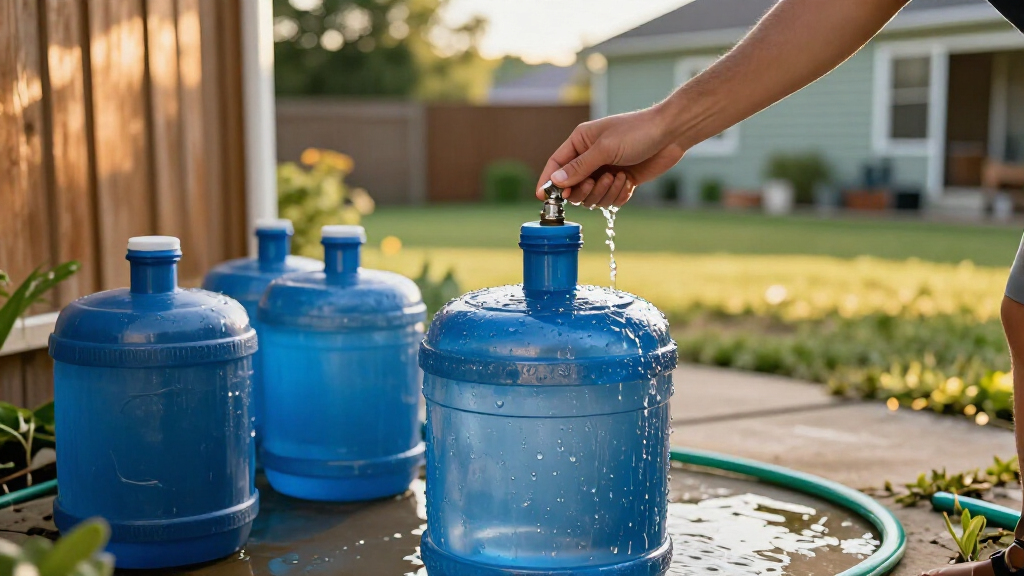
I compared these 15 emergency water storage containers by the job they can realistically do during an outage: how much water they hold, whether they can be stored ready to use or must be filled after a warning, and how practical they are to fill, access, move, and maintain. I also weighed form factor and household fit. A bathtub liner can provide a large reserve without taking up a dedicated tank footprint, while rigid tanks and portable jugs suit different storage and dispensing routines.
The ranking favors useful capacity paired with practical access, not capacity alone. The waterBOB leads as a flexible emergency reserve with its included hand pump; dedicated rigid tanks rank well for households planning ahead, and portable jugs are stronger for modular storage and transport. Multipacks and specialized formats can be a better match for particular setups, but their extra capacity does not automatically make them a better primary solution. Product listings do not establish details such as filled weight, exact dimensions, water treatment, or long-term storage life, so I treat those as points buyers should verify rather than assume.
Factors to Consider When Choosing Emergency Water Storage Containers
Before choosing a container, I’d plan how water will move from storage to the people using it. Capacity figures are only useful when the container fits your space, can be filled in time, and can be dispensed without awkward lifting or improvised tools. These broader checks help avoid buying a large reserve that is difficult to use when the supply is interrupted.
Match Capacity to a Real Storage Plan
Start with the number of people you are preparing for and how many days you want stored water to cover, then check local emergency guidance for a suitable daily amount. A single large tank reduces the number of containers to fill and track, but it concentrates the supply in one place. Several smaller jugs let you spread water around the home or share it, while adding more caps, surfaces, and inventory to manage. Avoid choosing a container by its maximum capacity alone; usable capacity depends on whether you can fill it fully, reach its opening, and dispense the water. A mixed setup can balance a large reserve with smaller containers for everyday access. Keep a written count of stored water so you can spot gaps before an outage.
Decide Whether Storage Must Be Ready Before a Warning
A bathtub bladder saves storage space because it can remain folded until needed, but it is not a pre-filled reserve. It depends on having a suitable bathtub, a usable water supply, enough warning to fill it, and a clear area around the tub. That makes it a poor sole option for sudden interruptions or homes without a bathtub. A rigid tank takes up space continuously, yet it can support planned storage that is already in place. Buyers who choose a bladder should think through how they would get it filled during a storm warning, including whether other household tasks compete for the same time. Pairing an on-demand liner with smaller stored jugs can reduce reliance on a single filling window.
Plan for Filled Weight, Placement, and Access
Water is heavy, so a container that is manageable when empty may be difficult to move after filling. Before ordering a large tank, measure the intended floor area and check that the floor and route to the storage spot can accommodate the filled load. Think about the path from the container to the place where water will be used: a tank that fits in a garage may still be inconvenient if water must be carried upstairs. Smaller jugs can be divided among locations, but repeated lifting can become tiring during a prolonged outage. Avoid planning to move a full container unless its design and handling instructions support that use. If possible, place long-term storage near its point of use and keep a separate pourable vessel available.
Check the Full Filling and Dispensing Routine
Buyers often focus on the opening size or capacity and overlook how the water comes back out. Check whether the container has a spout, hand pump, compatible outlet, or another stated dispensing method, and confirm that the method suits your household. A pump can help draw water from a large bladder, while a wide-mouth jug may be easier to fill but heavier to pour. For multi-container setups, consider whether you can identify contents, rotate containers, and clean each vessel without special tools. Do not assume a container includes purification treatment or that stored water will remain safe indefinitely; follow the manufacturer’s care instructions and local public-health guidance. The easiest container to use is the one your household can access without lifting, tipping, or opening it in an improvised way.
Verify Materials and Long-Term Care
Food-grade or BPA-free wording can help narrow a search, but it does not replace checking the product’s intended use and care directions. Confirm that the container is meant for drinking water, and follow its instructions for cleaning, filling, sealing, and storage. Sunlight, heat, dust, and contact with chemicals can affect a storage area, so choose a clean, protected location rather than leaving containers exposed outdoors. Large tanks can reduce the number of vessels to maintain, while multipacks increase flexibility but also multiply inspection tasks. Set a reminder to check for leaks, damaged lids, or other changes on a schedule consistent with the manufacturer’s guidance. Keep water containers separate from fuel and household chemicals, and label them clearly so they are not mistaken for utility storage.
Choose a Format That Fits Your Emergency Scenario
Households preparing for hurricanes may value a bathtub liner that can be filled after a forecast, while people planning for routine outages may prefer a dedicated tank that stays in place. Campers and off-road users may favor durable, portable-style jugs that can travel with them, even if those vessels hold less than a large home tank. A foil-format product may appeal where its storage arrangement suits the space, but buyers should confirm setup and dispensing details before making it the centerpiece of a household plan. Do not assume a product designed for portability is the best long-term home reserve, or that a high-capacity product is easy to use in a small space. Match the container to the event, the warning time available, and the people who will handle it. For many homes, combining one high-capacity solution with several manageable vessels is more practical than relying on one format alone.
Frequently Asked Questions
Should I choose a bathtub bladder or a rigid water tank?
I’d choose a bathtub bladder when compact storage and rapid, temporary capacity matter more than having water ready in advance. It needs a suitable tub and time to fill, so it is a weak sole reserve if an outage could happen without warning. A rigid tank occupies floor space year-round but supports a planned supply that does not depend on setting up a tub. Compare the waterBOB and AquaPod with the 55-gallon tanks by your available warning time, storage area, and ability to access the water. If those factors are uncertain, a combination of stored jugs and an on-demand bladder can spread the risk.
Is one large tank better than several smaller containers?
One large tank can simplify storage and reduce the number of vessels to fill and track, but it puts much of your supply in one location and may be difficult to move or dispense from. Smaller jugs are easier to distribute around a home, carry in portions, or use for trips, though a multipack takes more room across several spots and needs more routine checks. A household with a dedicated, accessible storage area may prefer a 55-gallon tank, while a home with limited space or multiple floors may benefit from smaller units. Think about who will retrieve the water, not just how much can be stored. A mixed setup can provide a main reserve plus manageable containers for daily use.
Can I rely on a bathtub bladder if the water shuts off suddenly?
Not as your only supply. A bathtub bladder must be deployed and filled while water is still available, which makes it most useful when a forecast or warning gives you time to prepare. A sudden outage, plumbing problem, or evacuation could leave it unfilled or unusable. Keep some water in containers that are already filled if you need a reserve independent of a warning. Also confirm that your bathtub is suitable and that you know where the bladder and pump are stored. Treat the bladder as a way to add capacity, not as a substitute for every other part of your water plan.
What should I check before storing a full-size tank indoors?
Measure the tank’s footprint and confirm the storage spot can accommodate the filled load, rather than judging fit from the empty container. Water weighs about 8.3 pounds per gallon, so a 55-gallon tank holds more than 450 pounds of water before the tank itself is counted. Check the manufacturer’s placement guidance and ask a qualified professional if you are unsure whether a floor can support it, particularly on an upper level. Leave enough access for filling, inspection, and dispensing, and keep the tank away from chemicals and unsuitable heat or light. A tank that fits physically but cannot be reached easily may not serve your household well during an outage.
Do BPA-free or food-grade labels mean the stored water needs no upkeep?
No. Those labels describe material claims, not a guarantee that water remains safe forever or that the container never needs inspection. Follow the product’s cleaning, sealing, and storage directions, along with local public-health guidance on emergency water. Check periodically for leaks, damaged closures, contamination, or other changes, and keep the container in a clean, protected location. Do not assume any of these products includes water treatment unless the listing explicitly says so. A simple rotation and inspection plan is part of owning any emergency water container, whether it is a tank, jug, or bathtub liner.
Conclusion
For the best overall balance of stored-away convenience and emergency capacity, I’d choose the waterBOB, provided your home has a suitable bathtub and you can fill it during a warning. For planned large-volume storage, compare the 55-gallon stackable tanks and choose by dimensions, placement, and dispensing details rather than capacity alone. The best value approach for flexible household use is a set of smaller containers, such as the 5-gallon multipack or four-pack options, if you have room to organize and maintain them. For beginners, a few portable jugs are easier to understand and distribute than a large tank or a bladder that depends on timely setup. For specific needs, the Aqua-Tainer’s 7-gallon format bridges small jugs and large tanks, Scepter’s portable-style containers suit transport, and the 116-gallon foil option calls for careful verification of setup and dispensing. My main recommendation is to choose around how your household will fill, access, and maintain its reserve—not the largest number on the label.
Halloween Picks
halloween
As an affiliate, we earn on qualifying purchases.