
When an emergency cuts off your water supply, the right filtration system becomes the difference between a manageable situation and a dangerous one. After comparing 15 options side by side, the MSR Guardian Gravity stands out as the best overall pick — it is one of the few systems here that purifies against viruses, not just bacteria and protozoa, making it safe for worst-case sources. For prepared households on a budget, the Katadyn TRK Drip Ceradyn offers massive capacity with no pumping required, while Aquatabs tablets are the cheapest backup that fits in a drawer. The main tradeoff you will face in this category is between throughput and portability: high-capacity gravity systems keep a family hydrated but are heavy to evacuate with, while pocket-sized filters are easy to carry but slow for groups. There is also the question of whether you need a filter or a true purifier, since not every emergency scenario involves virus-contaminated water. Read on for the full breakdown, including who each system is for and who should skip it.
Open a free Amazon Business account
Business pricing, bulk buying and tax-exempt orders.
Create a free accountAs an affiliate, we earn on qualifying purchases.
Key Takeaways
- Only two systems in this lineup — the MSR Guardian Gravity and the pressurized LifeStraw Escape — filter fine enough to address viruses, which matters if your emergency plan includes treating water from flood zones or questionable municipal sources.
- Gravity-fed drip systems like the Katadyn TRK Drip and the Outback Emergency Water Filter deliver far more water per day than pump or straw filters, but they weigh several pounds and make poor bug-out-bag choices.
- Price tracked poorly with emergency readiness here: several sub-$50 options like the Sawyer SP160 and Membrane Solutions 6L Pro out-filtered pricier survival-branded products with vague specifications.
- Filter longevity varied by more than a factor of 20 across the lineup — from a few hundred gallons on budget straw filters to over 13,000 gallons on the Katadyn Drip — which changes the real cost per gallon far more than sticker price does.
- Chemical tablets (Aquatabs) and hollow-fiber filters solve different problems: tablets beat every filter on viruses per dollar but add taste and a waiting period, so the strongest emergency setup pairs a mechanical filter with tablets as a redundant layer.
| MSR Guardian Gravity Water Purifier |  | Best Overall Purification | Purification Technology: Hollow fiber membrane + activated carbon | Filter Capacity: 3,000 liters | Reservoir Volume: 10 liters | VIEW LATEST PRICE | See Our Full Breakdown |
| Outback Emergency Water Filter System |  | Best Long-Term Survival Value | Type: Gravity-fed filtration system | Daily Capacity: Up to 24 gallons per day | Extras Included: Extra replacement filter set | VIEW LATEST PRICE | See Our Full Breakdown |
| Aquatabs Water Purification Tablets, 397mg, 100 Pack |  | Best Ultralight Backup | Type: Chlorine-based purification tablets | Tablet Dose: 397mg | Quantity: 100 tablets | VIEW LATEST PRICE | See Our Full Breakdown |
| LifeStraw Escape Pressurized Gravity Water Purifier |  | Best for Household Preparedness | Filtration Stages: 3-stage: pre-filter, 0.02-micron ultrafilter, carbon + ion exchange | Reservoir Capacity: 5.25 gallons | Flow Rate: Over 1 liter per minute | VIEW LATEST PRICE | See Our Full Breakdown |
| Membrane Solutions 6L Gravity Water Filter Pro |  | Best Budget Group Filter | Reservoir Capacity: 6 liters | Filtration Stages: 4-stage (hollow fiber + activated carbon) | Filter Life: Up to 1,320 gallons (5,000L) | VIEW LATEST PRICE | See Our Full Breakdown |
| Uzima UZ-2 Camping Water Filter System |  | Best for Grab-and-Go Kits | Type: Gravity-fed water filter | Capacity: 1 liter | Flow Rate: 1 liter per minute | VIEW LATEST PRICE | See Our Full Breakdown |
| Katadyn TRK Drip Ceradyn Gravity Water Filter |  | Best for Long-Term Off-Grid Emergencies | Technology: 0.2 micron ceramic depth filter | Output: 4 liters per hour | Cartridge Capacity: 150,000 liters | VIEW LATEST PRICE | See Our Full Breakdown |
| Pro Portable Water Filter for Camping – Water Purifier Survival |  | Best Hand Pump for Groups | Flow Rate: 1.5 liters per minute | Filter Life: Up to 3,000 liters | Filtration Stages: 3-stage (pre-filter, PP cotton, ultrafiltration membrane) | VIEW LATEST PRICE | See Our Full Breakdown |
| Survivor Filter PRO Portable Water Filter | 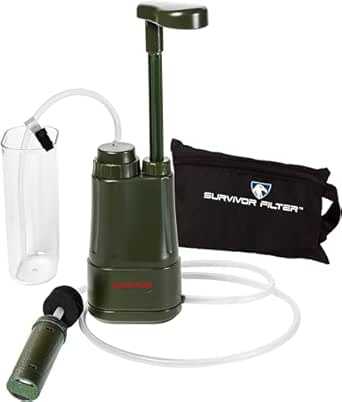 | Best for Virus Protection | Weight: 12.8 oz | Flow Rate: 500 ml (17 oz) per minute | Filtration Stages: Three-stage (Pre-Filter, Carbon, Ultra Filter) | VIEW LATEST PRICE | See Our Full Breakdown |
| Emergency Water Filter Large Water Filtration System for Camping |  | Best Flow Rate for the Money | Filtration Technology: Multi-stage (mineral prefilter, PP cotton, ultrafiltration membrane) | Flow Rate: 1.5 liters/min (max 3 liters/min) | Material: BPA and BPS free plastic | VIEW LATEST PRICE | See Our Full Breakdown |
| Gravity Water Filtration System – 2 High Capacity Lightweight Hanging Bags |  | Best for Group Base Camps | Capacity: 6 gallons (two 6L bags) | Weight: Under 1 pound | Maximum Flow Rate: 0.6 gpm | VIEW LATEST PRICE | See Our Full Breakdown |
| Yuclet Gravity Water Filter System with 2-Gallon Bag & Filter Straw |  | Best Two-in-One Value | Capacity: 2 gallons | Filter Pore Size: 0.1 micron | Flow Rate: 600 ml/min | VIEW LATEST PRICE | See Our Full Breakdown |
| Sawyer Products SP160 One Gallon Gravity Water Filtration System |  | Best Ultralight Emergency Kit | Filter Micron Rating: 0.1 micron absolute | Reservoir Capacity: 1 gallon | Weight: 2 ounces | VIEW LATEST PRICE | See Our Full Breakdown |
| Waterdrop Gravity Water Filter Straw with 1.5-Gallon Bag | 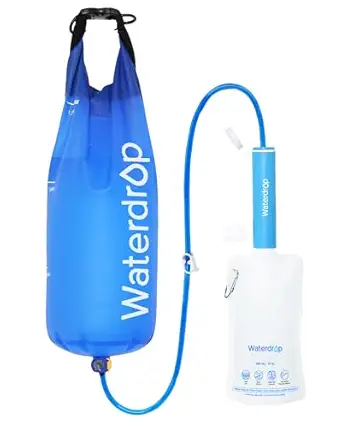 | Best Filtration Stages for Taste | Filtration Stages: 5-stage | Filtration Micron: 0.1 micron ultrafiltration | Bag Capacity: 1.5 gallons | VIEW LATEST PRICE | See Our Full Breakdown |
| Katadyn Pocket Ceramic Hand Pump Water Filter |  | Best Premium Build for Long-Term Survival | Filter Type: Cleanable ceramic element | Removes: Bacteria and protozoa | Operation: Manual hand pump | VIEW LATEST PRICE | See Our Full Breakdown |
| water filtration systems for emergencie | Flow Rate |
|---|---|
| MSR Guardian Gravity Water Pur | Up to 0.5 L per minute |
| Outback Emergency Water Filter | — |
| Aquatabs Water Purification Ta | — |
| LifeStraw Escape Pressurized G | Over 1 liter per minute |
| Membrane Solutions 6L Gravity | 0.5 L per minute |
| Uzima UZ-2 Camping Water Filte | 1 liter per minute |
| Katadyn TRK Drip Ceradyn Gravi | — |
| Pro Portable Water Filter for | 1.5 liters per minute |
| Survivor Filter PRO Portable W | 500 ml (17 oz) per minute |
| Emergency Water Filter Large W | 1.5 liters/min (max 3 liters/min) |
| Gravity Water Filtration Syste | — |
| Yuclet Gravity Water Filter Sy | 600 ml/min |
| Sawyer Products SP160 One Gall | — |
| Waterdrop Gravity Water Filter | 700 ml/min |
| Katadyn Pocket Ceramic Hand Pu | — |
More Details on Our Top Picks
MSR Guardian Gravity Water Purifier
The MSR Guardian Gravity sits at the top of this lineup because it is one of the few options here that is a true purifier, not just a filter — it removes viruses along with bacteria and protozoa, which matters enormously when emergencies involve floodwater or sewage contamination. Compared with the Membrane Solutions 6L, which handles chlorine and sediment but not viruses, the Guardian covers the widest range of threats. Its 10-liter reservoir and roughly 1 liter per 2 minutes output keep a household supplied without babysitting the system.
The tradeoff is cost and weight: at 18.7 ounces and a premium price, it’s overbuilt for someone who just wants a weekend backup. It also needs to hang for gravity to work, so it’s awkward in a vehicle kit.
Pros:- Full purification: removes viruses, bacteria, protozoa, and microplastics, not just sediment and chlorine
- Large 10-liter reservoir keeps a family supplied without constant refilling
- Durable, USA-made construction with a 3,000-liter filter life
- PFAS-free storage case adds thoughtful emergency-ready details
Cons:- Premium price puts it out of reach for many preparedness budgets
- Requires hanging and elevation to achieve full flow rate
- At 18.7 ounces, heavier than simpler gravity bags like the Sawyer SP160 setup
Best for: Households preparing for serious contamination scenarios — floods, travel abroad, or long grid-down situations where viral threats are possible
Not ideal for: Budget preppers or ultralight backpackers — the price and weight exceed what a basic chlorine-and-sediment kit requires
- Purification Technology:Hollow fiber membrane + activated carbon
- Filter Capacity:3,000 liters
- Reservoir Volume:10 liters
- Flow Rate:Up to 0.5 L per minute
- Weight:18.7 ounces
- Removes:Viruses, bacteria, protozoa, sediment, microplastics
- Made In:USA
Our verdict“If a genuine worst-case scenario is what you’re preparing for, this is the one system in the lineup that covers viruses without compromise.”
Outback Emergency Water Filter System
What separates the Outback system from flashier picks like the LifeStraw Escape is its focus on sustained output over months rather than convenience: at up to 24 gallons per day, it out-produces nearly everything in this roundup, and the bundled extra filter set means you’re not hunting for replacements mid-crisis. It’s gravity-fed with no power or pumping, which is exactly what you want when utilities are down.
The catch is that it treats volume, not variety — it won’t touch chemicals or viruses the way the MSR Guardian does, and it’s bulkier than a collapsible bag system like the Membrane Solutions 6L. Think of it as a workhorse for a fixed location, not something you toss in a go-bag.
Pros:- High daily throughput of up to 24 gallons supports a whole household
- Includes replacement filters, extending usable life through a prolonged event
- No power or pumping required — works from nearly any natural water source
- Rugged materials built for repeated field use
Cons:- Bulkier and less portable than collapsible gravity bags or straw filters
- Gravity filtration alone may not remove viruses or chemical contaminants
- Requires dedicated hanging space and setup time
Best for: Off-grid cabins, homesteads, and shelter-in-place planners who need daily household-scale water for weeks
Not ideal for: Bug-out-bag builders — it needs setup space, elevation, and time that mobile scenarios don’t allow
- Type:Gravity-fed filtration system
- Daily Capacity:Up to 24 gallons per day
- Extras Included:Extra replacement filter set
- Power Required:None
- Water Sources:Natural sources, emergency, off-grid
- Materials:Rugged, durable construction
Our verdict“For shelter-in-place preparedness where daily volume matters more than portability, this delivers the most water per dollar over a long emergency.”
Aquatabs Water Purification Tablets, 397mg, 100 Pack
Every emergency plan should include a layer that cannot break, clog, or run out of battery, and that’s precisely the Aquatabs‘ role here. At a fraction of the weight of even the smallest hardware option in this roundup — the Sawyer SP160 or the Waterdrop straw — a 100-tablet pack purifies 400 gallons total and slips into a glovebox, desk drawer, or first-aid kit. Each tablet treats 4 gallons in 30 minutes against bacteria, viruses, and cysts, with no chemical taste.
The limitation is real, though: unlike the LifeStraw Escape, tablets do nothing for cloudy or sediment-heavy water, so they pair best with a cloth pre-filter or a coffee filter. They’re a complement to a physical filter, not a replacement for one.
Pros:- Weighs almost nothing and stores indefinitely — true pocket-sized insurance
- Kills bacteria, viruses, and cysts, covering threats most budget filters miss
- 30-minute treatment time with no odor, color, or bad taste
- 100 tablets treat roughly 400 gallons total
Cons:- Ineffective in cloudy water unless sediment is removed first
- No removal of chemicals, heavy metals, or microplastics
- Slower and more hands-on than a continuous gravity system
Best for: Anyone building redundancy — car kits, office drawers, and go-bags where weight and space are nearly zero
Not ideal for: Anyone expecting a standalone solution — turbid or sediment-filled water must be pre-filtered before tablets are effective
- Type:Chlorine-based purification tablets
- Tablet Dose:397mg
- Quantity:100 tablets
- Treatment Capacity:4 gallons per tablet
- Treatment Time:30 minutes
- Shelf Life:Expires February 2029
Our verdict“Buy these as your second or third layer of backup, not your only one — redundancy this light and cheap is hard to argue with.”
LifeStraw Escape Pressurized Gravity Water Purifier
The LifeStraw Escape lands between the MSR Guardian and budget gravity bags by doing something neither does well: combining virus-grade purification with a 5.25-gallon stationary reservoir and a 3-stage process that tackles chemicals and taste. Where the Membrane Solutions 6L stops at chlorine and sediment, the Escape’s 0.02-micron ultrafilter plus carbon and ion exchange targets the full microbiological spectrum, and it’s certified to EPA and NSF P231 standards — a claim most competitors here can’t make.
Its weaknesses are scale and upkeep: the carbon stage lasts only 600 liters before replacement, and the whole unit is too large for a backpack. Compared with the Outback system, it filters more thoroughly but produces less daily volume.
Pros:- 3-stage purification handles viruses, chemicals, and taste in one system
- Certified to US EPA and NSF P231 microbiological standards
- 5.25-gallon capacity and 1L/minute flow serve a household continuously
- Ultrafilter rated for 18,000 liters of long-term use
Cons:- Carbon/ion-exchange stage needs replacement after just 600 liters
- Large footprint makes it impractical for travel or bug-out bags
- Regular maintenance required to keep flow rate and safety performance
Best for: Families sheltering at home who want certified purification plus better-tasting water from a single countertop station
Not ideal for: Backpackers and vehicle-kit builders — the size and filter maintenance schedule don’t suit mobile use
- Filtration Stages:3-stage: pre-filter, 0.02-micron ultrafilter, carbon + ion exchange
- Reservoir Capacity:5.25 gallons
- Flow Rate:Over 1 liter per minute
- Ultrafilter Lifespan:18,000 liters
- Carbon Filter Lifespan:600 liters
- Certifications:US EPA + NSF P231
Our verdict“The strongest choice for a fixed home station where certified protection and taste both matter — just budget for replacement filters.”
Membrane Solutions 6L Gravity Water Filter Pro
For group camping and casual preparedness on a budget, the Membrane Solutions 6L Pro covers the basics well: a 4-stage process rated for up to 1,320 gallons, NSF-certified materials, and a collapsible design that packs down smaller than anything from MSR or LifeStraw. Where the MSR Guardian costs several times more to gain virus protection, this option accepts that gap and delivers chlorine, sediment, and odor reduction for typical North American backcountry water.
The compromises show up under load: at 0.5 liters per minute with only 6 liters of capacity, a large group will wait on refills, and the Sawyer SP160-style single-bag approach handles one person more gracefully. It’s also strictly a filter — skip it for floodwater or viral threats.
Pros:- Low cost per gallon with up to 1,320 gallons of filter life
- 4-stage filtration improves taste and reduces chlorine and sediment
- Collapsible, puncture-resistant, BPA-free design packs small
- No pumping or electricity — simple gravity operation anyone can manage
Cons:- 0.5L/minute flow rate feels slow when serving several people
- 6-liter capacity forces frequent refills for larger groups
- Does not remove viruses or dissolved chemicals
Best for: Campers and casual preppers who want an affordable, packable group filter for clear lakes and streams
Not ideal for: Anyone facing viruses, chemical contamination, or very turbid water — the filtration spectrum stops short of true purification
- Reservoir Capacity:6 liters
- Filtration Stages:4-stage (hollow fiber + activated carbon)
- Filter Life:Up to 1,320 gallons (5,000L)
- Flow Rate:0.5 L per minute
- Materials:BPA-free, puncture-resistant
- Certifications:NSF/ANSI 42, 372, 401
Our verdict“The cheapest credible way to keep a small group in drinking water outdoors — just know it’s a filter, not a purifier.”
Uzima UZ-2 Camping Water Filter System
The Uzima UZ-2 earns its spot as the easiest system to throw into an emergency bin and forget about until you need it. Its 10-year shelf life is the standout here — compared with the Survivor Filter PRO, which depends on replaceable carbon cartridges that degrade, the Uzima can sit untouched for a decade and still work. It is gravity-fed, so there is no pumping, and assembly is simple enough that a first-time user can get it running in minutes. The tradeoff is capacity: one liter per cycle is fine for one or two people sipping over a day, but a family will be refilling constantly, and the Katadyn TRK Ceradyn handles group demand far better. It is also bulkier than a straw-style filter like the Waterdrop, so backpackers should think twice.
Pros:- 10-year shelf life makes it ideal for long-term storage
- Gravity-fed operation requires no pumping or power
- Removes 99.999% of bacteria from untreated sources
- Fast 1 liter per minute output for its size
Cons:- Only 1 liter of capacity per use
- Too bulky for ultralight backpacking
Best for: Solo preppers or couples building a shelf-stable emergency kit they hope to never open
Not ideal for: Families or groups — the 1-liter capacity means constant refills during a real emergency
- Type:Gravity-fed water filter
- Capacity:1 liter
- Flow Rate:1 liter per minute
- Bacteria Removal:99.999%
- Shelf Life:10 years
- Maximum Water TDS Level:500 ppm
- Operation:Manual, gravity-fed
Our verdict“This is the set-it-and-forget-it pick for a home emergency kit, not the right choice if you need to hydrate a group quickly.”
Katadyn TRK Drip Ceradyn Gravity Water Filter
If your emergency plan involves weeks without running water rather than a weekend outage, the Katadyn TRK Ceradyn is the most durable investment in this lineup. Its ceramic elements treat up to 150,000 liters — orders of magnitude beyond the 3,000-liter filter life of the Pro Portable pump — and the ceramic can be cleaned and regenerated, stretching its lifespan even further. Three replaceable elements also mean a single clogged filter does not end your water supply. The compromises are real, though: at 3.3 kg this is base-camp gear, not something you carry like the Survivor Filter PRO, and the 4 liters-per-hour drip rate demands patience. Compared with the Uzima UZ-2, you trade portability for genuine staying power.
Pros:- 150,000-liter cartridge capacity outlasts nearly every competitor
- Ceramic elements are cleanable and regenerable for extended service
- Chemical-free filtration with no power or pumping needed
- Removes sediment, bacteria, and protozoa
Cons:- Heavy at 3.3 kg and requires hanging space
- 4 liters per hour is slow for large groups
Best for: Off-grid homes, cabins, and households prepping for extended grid-down scenarios
Not ideal for: Bug-out bags or mobile evacuation plans — the weight and setup requirements make it impractical to move
- Technology:0.2 micron ceramic depth filter
- Output:4 liters per hour
- Cartridge Capacity:150,000 liters
- Filter Elements:3 replaceable ceramic cartridges
- Material:Ceramic with impregnated silver
- Weight:3.3 kg
- Size:25 x 45 cm
Our verdict“The clear choice when the emergency might last months, provided you can leave it set up in one place.”
Pro Portable Water Filter for Camping – Water Purifier Survival
When four to six people need water now, gravity systems like the Katadyn TRK Ceradyn simply cannot keep pace — its drip rate works out to a trickle compared with this pump’s 1.5 liters per minute. The Pro Portable filter is built around that speed, with a 3-stage system (pre-filter, PP cotton, ultrafiltration membrane) that clears bacteria, protozoa, cysts, and microplastics from murky natural sources. The complete kit means fewer missing pieces when stress is high. The honest tradeoff is effort: pumping at that rate for a group is physically demanding, and unlike the MSR Guardian Gravity, there is no hands-off option once your arms tire. Add a 3,000-liter filter life that trails the Katadyn’s ceramic longevity, and this is a short-term tool, not a multi-month solution.
Pros:- 1.5 liters per minute output rivals much pricier systems
- 3-stage filtration handles bacteria, protozoa, cysts, and microplastics
- Complete kit arrives ready to use
- Sized specifically for groups of 4-6
Cons:- Manual pumping becomes tiring during extended group use
- 3,000-liter filter life requires replacement parts on hand
Best for: Camping groups of 4-6 people who need high-volume water at a remote site
Not ideal for: Solo travelers or anyone with limited upper-body strength — pumping for one is overkill, pumping for six is exhausting
- Flow Rate:1.5 liters per minute
- Filter Life:Up to 3,000 liters
- Filtration Stages:3-stage (pre-filter, PP cotton, ultrafiltration membrane)
- Removes:Bacteria, protozoa, cysts, microplastics, sediment
- Suitable For:4-6 people
- Use Cases:Camping, hiking, survival, emergency preparedness
Our verdict“The fastest way to hydrate a small group from a creek, as long as someone is willing to do the pumping.”
Survivor Filter PRO Portable Water Filter
Most filters in this roundup stop at bacteria and protozoa — the Uzima UZ-2 and the Sawyer SP160 both fall into that category — but the Survivor Filter PRO goes further with a 0.01 micron ultra filter that removes 99.999% of viruses as well. For emergencies involving floodwater or contaminated municipal supplies, that difference matters. It also reduces heavy metals, which ceramic-only systems like the Katadyn Pocket ignore entirely, and it meets NSF/ANSI standards. At 12.8 ounces, it is one of the lightest serious systems here. The tradeoff is throughput: 500 ml per minute is a third of the Pro Portable pump’s output, and the replaceable carbon stage means ongoing filter costs that a self-regenerating ceramic filter avoids. It is a personal tool, not a group solution.
Pros:- 0.01 micron filter removes viruses, not just bacteria and protozoa
- Reduces heavy metals that most filters pass through
- Lightweight at 12.8 ounces with a compact footprint
- Meets NSF/ANSI standards with replaceable filter stages
Cons:- Replaceable filters add long-term cost and require spares
- 500 ml per minute is slow compared with pump rivals
Best for: Travelers and individuals who may face virally contaminated water, especially in flood zones or developing regions
Not ideal for: Groups needing fast volume — the flow rate and small format make it a one-person system
- Weight:12.8 oz
- Flow Rate:500 ml (17 oz) per minute
- Filtration Stages:Three-stage (Pre-Filter, Carbon, Ultra Filter)
- Filter Micron Sizes:0.1 micron pre-filter, 0.01 micron ultra filter
- Removes:99.999% of viruses, bacteria, protozoa; reduces heavy metals
- Standards:NSF/ANSI certified
Our verdict“The pick for anyone whose emergency plan includes questionable water sources where viruses are a real risk.”
Emergency Water Filter Large Water Filtration System for Camping
This unbranded-looking system competes on raw throughput: a claimed 1.5 liters per minute, up to 3 liters maximum, puts it at the top of this batch alongside the Pro Portable pump. The multi-stage stack — mineral prefilter, PP cotton, ultrafiltration membrane — also tackles odor and cloudiness, which matters when your emergency source is a stagnant pond rather than a clear stream. A ceramic core check valve improves sealing integrity, and the lifetime warranty signals confidence the Survivor Filter PRO cannot match with its consumable-cartridge model. The honest concerns: with no established brand reputation, long-term filter availability is a gamble, and without published micron ratings you are trusting the manufacturer’s claims in a way you would not with Katadyn or MSR. It is larger than straw-style options too, so it belongs in a vehicle or camp kit, not a pocket.
Pros:- Up to 3 liters per minute maximum flow rate leads this price class
- Multi-stage filtration removes odors and cloudiness, not just pathogens
- Lifetime warranty on the system
- BPA/BPS-free construction with replaceable filters
Cons:- No published micron rating or independent certification
- Lesser-known brand means uncertain long-term filter support
Best for: Budget-minded campers who want maximum flow rate and odor reduction without paying brand premiums
Not ideal for: Buyers who want verified micron ratings and a track record — the lack of published specs and brand history is a real risk in an emergency
- Filtration Technology:Multi-stage (mineral prefilter, PP cotton, ultrafiltration membrane)
- Flow Rate:1.5 liters/min (max 3 liters/min)
- Material:BPA and BPS free plastic
- Sealing:Ceramic core check valve
- Filter Type:Replaceable multi-stage cartridges
- Warranty:Lifetime
Our verdict“A high-throughput value pick for camp use, provided you accept the uncertainty that comes with an unproven brand.”
Gravity Water Filtration System – 2 High Capacity Lightweight Hanging Bags
This dual-bag setup stands out for its 12 liters of total capacity, which lets one bag filter while the other refills — a workflow advantage the single-reservoir Sawyer SP160 simply can’t match. For a family or group hunkered down during an emergency, that continuous cycle matters more than raw speed, especially since the 0.6 gpm flow rate is modest for crowd-sized demands. The sub-one-pound weight makes it surprisingly carry-friendly for a system this size, and the hollow fiber membrane handles bacteria, parasites, and microplastics. The tradeoff is longevity: the 1,800-gallon filter life will eventually run dry with regular use, and bottle compatibility is spotty without adapters.
Pros:- Dual 6-liter bags enable continuous filter-and-refill cycling
- Under 1 pound total for a group-capacity system
- Removes 99.99% of bacteria, parasites, and microplastics
- Sets up in about 60 seconds
Cons:- Flow rate is slow when serving several people at once
- Filter needs replacement after 1,800 gallons
- Bottle compatibility requires adapters
Best for: Families and small groups who need continuous filtered water at a base camp or shelter-in-home emergency
Not ideal for: Solo hikers counting grams or anyone wanting to drink directly from a bottle without adapters
- Capacity:6 gallons (two 6L bags)
- Weight:Under 1 pound
- Maximum Flow Rate:0.6 gpm
- Purification Method:Hollow fiber membrane
- Maximum TDS Supported:1000 ppm
- Filter Life:1,800 gallons
- Durability Rating:10 years
Our verdict“The pick for groups who value capacity and redundancy over speed, as long as they plan for filter replacement.”
Yuclet Gravity Water Filter System with 2-Gallon Bag & Filter Straw
What makes this option clever is the pairing: a 2-gallon gravity bag for camp plus a detachable 0.1-micron filter straw you can toss in a pocket for day trips. Compared with the Waterdrop Gravity Filter Straw, you get similar straw-versatility but with a dedicated reservoir included, so there’s no separate purchase required. The TPU construction feels built for repeated outdoor abuse, and the 1,300-gallon filter life is respectable for the price bracket. The catches are real, though: 600 ml/min means a thirsty group will wait, and the system only works when you have somewhere to hang the bag — no pumping option when trees or hooks aren’t available.
Pros:- Combines a gravity system and a personal filter straw in one kit
- Durable TPU reservoir for long-term field use
- 0.1-micron filtration removes microplastics and particulates
- Works with lakes, streams, and bottles
Cons:- 600 ml/min flow rate is slow for groups
- Requires a hanging point to operate
- No active pumping backup if hanging isn’t possible
Best for: Budget-conscious campers who want both a base-camp gravity setup and a portable straw in one purchase
Not ideal for: Groups larger than three or four who need fast throughput at mealtimes
- Capacity:2 gallons
- Filter Pore Size:0.1 micron
- Flow Rate:600 ml/min
- Filter Life:1,300 gallons
- Material:TPU
- Weight:0.43 kg
- Maximum TDS Supported:1000 ppm
Our verdict“A smart two-in-one buy for couples or small families who want redundancy without buying two products.”
Sawyer Products SP160 One Gallon Gravity Water Filtration System
At 2 ounces total, nothing else in this lineup comes close on weight — the Yuclet system weighs nearly eight times as much. That makes this the natural choice for a bug-out bag where every gram is negotiated, and the proven Sawyer MINI 0.1-micron filter has a long track record of reliability, which counts for something when a purchase might sit unused for years before an emergency. The tradeoff is obvious: a 1-gallon reservoir means frequent refills for anyone beyond solo use, and unlike higher-capacity options such as the dual-bag gravity system, there’s no parallel workflow. Manual cleaning is also part of ownership — skip it and the flow rate degrades noticeably over a long trip.
Pros:- Extremely light at just 2 ounces
- Proven Sawyer MINI 0.1-micron filtration
- Complete setup with all accessories included
- Packs down tiny for go-bags and travel
Cons:- Only 1-gallon capacity demands frequent refills
- Requires regular manual cleaning to maintain flow
Best for: Solo preppers and ultralight backpackers building a bug-out bag or emergency kit
Not ideal for: Families — one gallon of capacity turns hydration into a full-time chore
- Filter Micron Rating:0.1 micron absolute
- Reservoir Capacity:1 gallon
- Weight:2 ounces
- Filter Type:Inline, dual-threaded MINI
- Method:Gravity-fed
- Best Use:Camping, travel, emergency kits
Our verdict“The clear choice when weight and packability matter more than volume — solo travelers only.”
Waterdrop Gravity Water Filter Straw with 1.5-Gallon Bag
Most options here are single-stage hollow fiber systems, but this one runs water through 5-stage filtration, and the difference shows up in taste — a genuine factor when you’re drinking from a questionable pond during an emergency and morale matters. The 1,400-gallon lifespan edges out the Yuclet’s 1,300, and the backwash function extends that further with proper maintenance. Compared with the Sawyer SP160, you trade a little packability for a larger 1.5-gallon bag and better flavor. Just know the maintenance rhythm: backwashing is a hands-on process some will find tedious, and the straw depends entirely on a compatible 27.5mm bag or bottle, so your existing bottles may not fit.
Pros:- 5-stage filtration noticeably improves taste
- 1,400-gallon filter lifespan
- Backwash function extends filter life
- 1.5-gallon bag covers all-day use
Cons:- Only compatible with 27.5mm bags or bottles
- Backwashing is an inconvenient maintenance chore
- Straw alone is useless without a separate reservoir
Best for: Campers and preppers who prioritize taste and long filter life over maximum capacity
Not ideal for: Buyers wanting a grab-and-go kit — you’ll need compatible bottles and a backwash routine
- Filtration Stages:5-stage
- Filtration Micron:0.1 micron ultrafiltration
- Bag Capacity:1.5 gallons
- Filter Lifespan:Up to 1,400 gallons
- Flow Rate:700 ml/min
- Backwash Function:Yes
- Recyclable:Yes
- Compatible Bag Size:27.5mm diameter
Our verdict“Best for those who plan to drink a lot of wild water and want it to taste acceptable while doing so.”
Katadyn Pocket Ceramic Hand Pump Water Filter
This is the buy-it-for-decades option. Unlike every gravity bag above — including the dual-bag hanging system rated for 10 years — the Katadyn’s ceramic element is cleanable and field-serviceable, meaning you can restore full flow on the spot instead of retiring the filter at a fixed gallon count. That durability is why expedition and relief organizations have carried it for years. The price is steep, and the manual pumping is genuine work compared to setting a gravity bag and walking away — the MSR Guardian Gravity approach demands far less effort per liter. But in a true survival scenario where gear failure isn’t an option, this model is better suited to buyers who prioritize indestructibility over convenience. It also won’t remove viruses, so chemical tablets remain a companion item.
Pros:- Cleanable ceramic element restores flow in the field
- Legendary durable construction built for decades
- Removes bacteria and protozoa reliably
- Portable and independent of hanging points or gravity setups
Cons:- Much more expensive than gravity alternatives
- Manual pumping is slow and tiring for group volumes
- Does not filter viruses
Best for: Serious survivalists and long-term preppers willing to pay premium prices for field-serviceable gear
Not ideal for: Casual campers or anyone who hates physical effort — pumping every liter gets old fast
- Filter Type:Cleanable ceramic element
- Removes:Bacteria and protozoa
- Operation:Manual hand pump
- Body Material:Durable field-serviceable construction
- Portability:Compact handheld design
- Best Use:Emergency and survival situations
Our verdict“Worth the premium only for those who see filtration as decades-long survival infrastructure rather than a camping convenience.”
How We Picked
My ranking logic starts with one question: what happens when the tap stops working? That pushed me to prioritize filtration level first — whether a system removes just bacteria and protozoa, or also viruses, which determines whether it can handle floodwater and compromised municipal supplies. From there I weighed capacity and throughput, because a family of four needs gallons per day, not cups, and a system that cannot keep pace forces rationing. I then scored each product on durability and filter longevity, since emergencies are exactly when you cannot order a replacement cartridge, and on setup simplicity, because the person operating the filter may be exhausted, injured, or doing it for the first time.
Finally, I factored in value over the system’s full life rather than sticker price alone — a cheap filter that clogs after 100 gallons costs more per gallon than a premium one rated for thousands. Portability played a role too, but only as a tiebreaker, because I treated shelter-in-place and evacuation scenarios as different jobs requiring different tools. Products with unverifiable flow-rate or pore-size claims were penalized, and unbranded survival kits with interchangeable listings were held to a higher standard of proof before earning a recommendation.
Factors to Consider When Choosing Water Filtration Systems For Emergencies
Choosing an emergency water filter is less about finding the best product and more about matching the system to your specific disaster scenario. Before spending anything, it helps to understand the categories, the chemistry, and the mistakes that leave prepared households with unsafe water anyway.
Filter vs. Purifier: Know Which Threat You Are Facing
The single most consequential decision is whether you need a filter (bacteria and protozoa) or a purifier (bacteria, protozoa, and viruses). Most hollow-fiber filters on this list stop at 0.1 microns, which handles giardia and E. coli beautifully but lets viruses pass straight through. Viruses become a real concern in flood zones, areas with sewage contamination, and regions with poor sanitation, exactly the conditions that follow hurricanes and infrastructure failures. If you are sheltering in place in a developed area with a known-contaminated but previously treated supply, a filter plus chemical tablets is usually adequate. The common mistake is assuming one product covers everything — pairing a $30 filter with a $10 pack of purification tablets closes the viral gap for less than half the cost of a dedicated purifier.
Capacity Math: Calculate Your Household’s Real Demand
Emergency guidelines suggest one gallon of water per person per day for drinking and basic hygiene, which means a family of four needs roughly 12 gallons for a 72-hour kit. That math immediately disqualifies straw filters and small squeeze systems as primary household solutions — they are personal tools, not family infrastructure. Gravity systems with 2-gallon or larger reservoirs can realistically produce 1–4 gallons per hour with zero effort, which is why they dominate the top of this roundup for home preparedness. When comparing capacity, be skeptical of marketing numbers and look at real-world flow rates after the filter breaks in, because most hollow-fiber membranes slow down noticeably as they load up with sediment. Also remember that dirty-source water may need pre-filtering through a cloth or settling first, which cuts your effective throughput further.
Filter Longevity and the Cost Per Gallon Trap
Sticker price is the worst way to compare these products. A $20 straw filter rated for 250 gallons costs eight cents per gallon; a $300 ceramic pump rated for 13,000 gallons costs about two cents per gallon and will outlast the emergency many times over. More importantly, in a prolonged crisis you cannot buy replacements, so total treatable capacity is really your endurance number. Ceramic elements, like those in the Katadyn Drip and Pocket Pump, can be cleaned and scrubbed dozens of times to restore flow, effectively extending their life indefinitely with care. Hollow-fiber cartridges, by contrast, fail permanently once torn or frozen — and freezing is a silent killer that leaves no visible damage. Whatever you buy, store a spare cartridge and keep the primary unit from freezing in a garage or car kit.
Shelter-in-Place vs. Bug-Out: One System Rarely Fits Both
Buyers consistently over-buy for one scenario and leave the other uncovered. A 10-pound drip system with no moving parts is superb on a kitchen counter during an extended power outage, but it is dead weight in a backpack during an evacuation. Conversely, a pocket pump weighs nothing yet can leave a household rationing water by day two. The honest answer is that most prepared homes need two tiers: a high-capacity gravity system as the primary, and a lightweight filter or tablet pack in each go-bag. If budget only allows one purchase and you live in an urban area with evacuation risk, prioritize portability and add capacity later. Rural households that plan to shelter in place should invert that priority.
Red Flags in the Survival Filter Market
This category is crowded with rebranded, unbranded products that copy each other’s listings and make identical claims — ‘removes 99.9999%’ with no independent lab documentation behind the number. Warning signs include missing pore-size specifications, no stated gallon capacity, interchangeable product photos across brands, and suspiciously uniform five-star review histories. Established manufacturers like MSR, Katadyn, Sawyer, and LifeStraw publish test data and have reputations that constrain their marketing claims. Another pattern worth knowing: ‘military grade’ and ‘survival’ branding usually correlates with worse value, not better, because you are paying for the aesthetic. A cheap filter with honest, modest specifications beats a premium-looking one with unverifiable claims every time, because you cannot verify performance during the emergency when it matters.
Storage, Maintenance, and the Plan You Never Rehearsed
An emergency filter that has sat unopened for five years may have a dried, cracked membrane or an expired component, so shelf life and storage conditions matter as much as the purchase itself. Hollow-fiber filters must be stored dry and protected from freezing; ceramic elements are nearly indestructible by comparison, which is one reason they dominate long-term preparedness kits. Chemical tablets carry explicit expiration dates and lose potency after them, so date-mark your stock and rotate it. Beyond storage, rehearse the actual setup — filling reservoirs, backflushing, connecting hoses — because fine motor skills and patience disappear under stress. Households with a written water plan that names the filter’s location, its spare parts, and who runs it consistently fare better than those relying on remembering how a product works at 2 a.m. during a boil-water notice.
Frequently Asked Questions
Do I really need a purifier that removes viruses, or is a standard filter enough?
It depends on your water source and where you live. In North America, backcountry water rarely carries harmful levels of viruses, so a 0.1-micron filter handles the realistic threats — giardia, cryptosporidium, and bacteria. That changes after floods, sewage overflows, and infrastructure failures, where human waste can mix into the supply and viruses become a genuine risk. Purifiers like the MSR Guardian close that gap mechanically, but they cost substantially more. A practical middle path is a quality filter paired with Aquatabs or chlorine dioxide tablets: mechanically filter the water first to remove sediment and pathogens, then treat for viruses chemically. That two-layer approach gives you purifier-level protection for a fraction of the price, at the cost of a 30-minute wait and slight taste.
How many gallons per day does my family actually need to filter?
Plan for a minimum of one gallon per person per day for drinking and minimal cooking, and double that if you are in hot conditions, have nursing mothers, or need water for wound care. For a family of four riding out a 72-hour event, that is 12 gallons minimum — a volume that immediately shows why straw filters and squeeze bottles cannot serve as a household’s only system. A gravity bag producing one to two gallons per hour covers a family comfortably, while a hand pump delivering a liter per minute of pumping becomes tedious fast if you are the designated water-carrier. Keep in mind you may also want filtered water for pets and basic hygiene. Buy capacity for your household at its worst-need day, not its average day.
Are cheap gravity filters under $50 reliable enough for emergencies?
Some genuinely are — the Sawyer SP160 and Membrane Solutions 6L Pro proved that price alone does not predict filtration quality, since both use tested 0.1-micron hollow-fiber membranes. What cheap systems typically cut corners on is hardware: leaky seals, flimsy reservoir bags that split at the hang loop, and hoses that kink. Those failures are survivable but frustrating, especially when you cannot run to the store for a replacement bag. Mitigate this by buying a spare reservoir or reinforcing hang points with carabiners before an emergency. Also check whether the manufacturer sells replacement filters at all — a system with no consumable supply chain is a disposable product no matter how well it works out of the box. The safest cheap-system strategy is redundancy: two inexpensive units beat one mid-range one for total reliability.
What is better for emergencies: a hand pump filter or a gravity system?
They answer different questions. A hand pump like the Katadyn Pocket gives you on-demand water from almost any source, including shallow puddles and tight containers, and it works when you cannot hang anything — but you pay for every liter with effort, which adds up quickly for a family. A gravity system is effort-free and produces volume in the background, but it needs a fillable reservoir, a place to hang it, and reasonably clear source water. For shelter-in-place scenarios, gravity wins decisively; for vehicle kits and mobile situations, pumps and squeeze filters make more sense. Ceramic pumps have one trump card: the element can be scrubbed clean hundreds of times, so they keep working long after hollow-fiber filters clog. Many prepared households eventually own both and treat them as complementary rather than competing tools.
How should I store my emergency water filter so it works when I need it?
The biggest silent killer of stored filters is freezing — a frozen hollow-fiber membrane can develop micro-cracks that are invisible but let pathogens through, which is why you should never store one in a garage, car, or shed in cold climates. Store filters dry, in their original packaging, indoors at stable room temperature, and ideally in the same container as your other emergency supplies so nothing gets separated during a rushed evacuation. Mark the purchase date on the unit, because manufacturers rate shelf life and treatable capacity in gallons, and you will forget both within a year. If your system uses carbon elements, know that those expire faster than the membrane and absorb contaminants from the air over time. Once a year, run clean tap water through the system as a functional check — discovering a failed seal in June is far better than discovering it during a January boil-water notice.
Conclusion
The right choice here depends less on which product is objectively best and more on which emergency you are actually preparing for. For the best overall emergency water system, the MSR Guardian Gravity earns the top spot for its virus-level purification, high throughput, and rugged build — it is the one system that handles truly bad water without a second thought. The best value pick is the Sawyer SP160 one-gallon gravity system, which delivers proven 0.1-micron filtration and a lifetime of filter capacity for under $50, with the Membrane Solutions 6L Pro close behind for households needing more volume. At the premium end, the Katadyn TRK Drip Ceradyn is a countertop workhorse with cleanable ceramic elements and over 13,000 gallons of capacity — the closest thing to a decade-proof family water station.
For beginners, the simplest entry point is a basic gravity bag paired with a pack of Aquatabs, which together cover bacteria, protozoa, and viruses with almost no learning curve. Specific needs break down cleanly: the Katadyn Pocket Pump suits anyone building a vehicle or evacuation kit where durability and source flexibility matter more than weight savings; the LifeStraw Escape fits households that want pressurized, purifier-level output without the MSR price; and the Survivor Filter PRO or Waterdrop straw serve as personal carry layers inside go-bags. Whatever combination you choose, remember that redundancy — a primary gravity system, a portable backup, and chemical tablets — beats any single product at insulating your household from a water emergency.
NFL season / tailgating Picks
team gear
As an affiliate, we earn on qualifying purchases.