Choosing the best off-grid living supplies depends on which daily need is hardest to meet without utilities. I rank the Jackery Solar Generator 1000 v2 first for its flexible stored power and included solar panel, the Stanbroil 3-in-1 Rocket Stove for cooking without electricity or propane, and the AMWBSR Manual Clothes Wringer for reducing the work and drying time involved in hand laundry. They solve different problems, so this is not a like-for-like contest: power capacity, fuel availability, portability, and household routine all shape the right choice.

Get emergency and outdoor gear delivered free with Prime
- Fast, free delivery on millions of items
- Prime Video, Amazon Music and more included
- Member-only deals all year
For broad emergency and cabin use, I favor Jackery because it can support several kinds of electrical loads, though its solar panel and station ship separately and fast charging requires an app setting. The Stanbroil is a stronger fit when wood is available and outdoor cooking matters more than compact storage. The AMWBSR asks the least of your energy supply, but it only handles flexible laundry items and cannot replace a washer. I rank these picks by how directly each addresses an off-grid need, how much flexibility it offers, and the practical limits a buyer should plan around.
Complete the kit


Key Takeaways
- The Jackery is the broadest utility pick here: its 1,070Wh LFP battery and 1,500W AC output support a wider range of electrical needs than either manual product.
- The Stanbroil cooks without grid power or propane, but its usefulness depends on access to suitable dry wood and space for a bulky outdoor stove.
- The AMWBSR wringer uses no electricity and can remove water from small or medium flexible items; it is a laundry aid, not a substitute for washing clothes.
- These products solve different off-grid bottlenecks—electricity, cooking, and laundry—so I would choose based on the need that most affects your routine.
- Portability differs sharply: the Jackery weighs 23.8 pounds, the wringer clamps to a work surface, and the rocket stove has a larger assembled footprint.
| Jackery Solar Generator 1000 v2 with 200W Solar Panel |  | Best Overall for Flexible Off-Grid Power | Battery capacity: 1,070Wh | Battery type: LFP | AC output: 1,500W | VIEW LATEST PRICE | See Our Full Breakdown |
| Stanbroil 3-in-1 Wood Burning Rocket Stove with Grill Grate & Griddle | 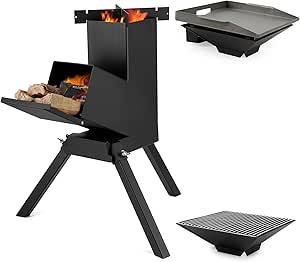 | Best for Wood-Fueled Off-Grid Cooking | Fuel type: Wood | Overall dimensions: 21.6 in W x 21.6 in L x 24.1 in H | Cooking surface area: 169 sq in | VIEW LATEST PRICE | See Our Full Breakdown |
| AMWBSR Manual Clothes Wringer with Adjustable Rollers |  | Best Value-Add for Manual Off-Grid Laundry | Operation: Manual hand crank | Rollers: Dual black rubber rollers | Frame material: Iron | VIEW LATEST PRICE | See Our Full Breakdown |
More Details on Our Top Picks
Jackery Solar Generator 1000 v2 with 200W Solar Panel
I put the Jackery Solar Generator 1000 v2 at the top because electrical power can support many different parts of an off-grid routine. Its 1,070Wh LFP battery, three pure sine wave AC outlets, USB-C ports, USB-A port, and car outlet give it more range than the wringer or rocket stove, both of which handle one specific task. A 1,500W AC output and 3,000W surge peak indicate capacity for compatible higher-draw devices, but buyers still need to check the requirements of each appliance rather than assume every load will work.
The included 200W solar panel adds a way to recharge without relying on a wall outlet, which makes this set more relevant to cabin stays and emergency use than a power station sold on its own. Solar production depends on conditions and setup, so it should not be treated as a guaranteed daily supply. Jackery lists emergency charging to a full charge in one hour when enabled in the app; its default charge time is 1.7 hours. I would regard that one-hour mode as a specific option, not the everyday expectation, especially for a buyer who prefers simple controls.
Compared with the Stanbroil stove, Jackery supports electrical gear but cannot provide indefinite power without recharging. Compared with the AMWBSR wringer, it offers broader utility at the cost of more weight, more setup decisions, and dependence on a finite battery. At 23.8 pounds, it remains portable for some users, but it is not a featherweight item for frequent long carries. Another practical wrinkle: the panel and power station ship separately, so a buyer should plan for separate deliveries rather than expect a single parcel.
The stated LFP battery lifespan—over 70% capacity after 4,000 charge cycles—helps distinguish it from a short-term emergency gadget, while the five-year warranty gives buyers a defined support period. Those figures do not remove the need to manage charge levels or match loads to capacity. I recommend this as the most versatile first purchase in the lineup for someone who needs power for several compatible devices and can make a realistic plan to recharge it. If the main requirement is cooking with locally available wood, the Stanbroil is the more direct tool; if the goal is laundry without electricity, the wringer is the leaner answer.
Pros:- 1,070Wh LFP battery and 1,500W AC output cover a wider range of compatible needs than the manual products here.
- Included 200W solar panel offers a grid-independent charging option when conditions allow.
- Multiple AC, USB-C, USB-A, and car ports let users connect different kinds of devices.
- App modes include emergency, quiet, and energy-efficient charging choices.
Cons:- The one-hour full-charge mode requires enabling emergency charging in the app; the default listed time is 1.7 hours.
- The power station and solar panel ship separately, requiring buyers to account for separate deliveries.
- Its battery is finite, and the 23.8-pound unit may be cumbersome for frequent long-distance carrying.
Best for: Off-grid cabin owners, campers, and emergency planners who need one rechargeable source for multiple compatible electronics and small appliances.
Not ideal for: Buyers who need continuous high-wattage power without regular recharging, want a very light carry, or do not want to manage charging settings and solar setup.
- Battery capacity:1,070Wh
- Battery type:LFP
- AC output:1,500W
- Surge peak:3,000W
- Solar panel:200W
- Weight:23.8 lbs
- AC outlets:3 pure sine wave
- Battery lifespan:Over 70% capacity after 4,000 charge cycles
- Warranty:5 years
Our verdict“I recommend the Jackery as the lineup’s most adaptable off-grid supply when you need stored electricity and have a credible way to recharge it.”
Stanbroil 3-in-1 Wood Burning Rocket Stove with Grill Grate & Griddle
The Stanbroil 3-in-1 Rocket Stove is my pick for buyers whose main gap is cooking rather than household electricity. It burns wood, so it does not need propane or a powered connection, and the cooking setup can accommodate pots, pans, and woks as well as the included stainless steel grill grate and non-stick griddle. Compared with Jackery, this stove turns available biomass into heat instead of drawing from a stored electrical reserve. That can be valuable in a cabin or camp where fuel is accessible, but it makes the stove less useful where gathering or storing dry wood is difficult.
Its 169-square-inch cooking surface and separate grate and griddle give it more cooking flexibility than a single-purpose burner. The inclined fuel inlet, large chamber, and air vent are intended to support a steady burn and longer cooking sessions. Those design details may help when tending a meal, but they do not remove the need to feed the fire, manage smoke and heat, or follow local fire rules. This is outdoor equipment, not a substitute for indoor cooking infrastructure.
Compared with the AMWBSR wringer, the Stanbroil addresses a more immediate daily necessity for many households—preparing food—but asks for considerably more setup and a suitable outdoor location. It is also less self-contained than Jackery: wood availability replaces electrical charging as the key resource question. Its heavy-gauge carbon steel body and stainless accessories suit a durable cooking station better than an ultralight pack, and the listed dimensions of 21.6 by 21.6 by 24.1 inches show why storage and transport deserve planning. Assembly of the legs and accessories can take time, another factor for buyers who want a quick, compact emergency kit.
I would choose this stove when you want multiple cooking methods from one wood-burning platform and have a safe place to operate it. I would skip it if your site has restrictions on open flames, dependable dry fuel is scarce, or compact transport matters more than cooking-surface versatility. Against the Jackery, it wins for direct, fuel-based outdoor cooking; against the wringer, it is the larger and more involved purchase, but one that serves a different core need.
Pros:- Wood fuel allows cooking without propane or electricity.
- A grill grate and griddle expand the cooking options beyond a basic pot support.
- The large chamber and inclined fuel inlet are designed for sustained outdoor cooking.
- Heavy-gauge carbon steel construction is paired with a stainless steel grate and non-stick griddle.
Cons:- Bulky dimensions make it less convenient to transport and store than the Jackery or wringer.
- Its usefulness depends on suitable dry wood or biomass being available.
- Leg and accessory assembly can take time before cooking.
Best for: Cabin residents and campers with a safe outdoor cooking area and reliable access to dry wood or suitable biomass.
Not ideal for: People with fire restrictions, limited fuel access, little storage space, or a need for a compact stove that is quick to assemble and carry.
- Fuel type:Wood
- Overall dimensions:21.6 in W x 21.6 in L x 24.1 in H
- Cooking surface area:169 sq in
- Grill cooking grate:13 x 13 in
- Griddle:14.8 x 14.5 in
- Material:Heavy-gauge carbon steel with stainless steel grate and non-stick griddle
- Cooking stand height:11 in
- Support legs height:9.2 in
Our verdict“I recommend the Stanbroil when wood-fired outdoor cooking is a priority and the buyer has room, fuel, and a safe place to use it.”
AMWBSR Manual Clothes Wringer with Adjustable Rollers
The AMWBSR Manual Clothes Wringer earns the most specialized spot in my ranking: it helps manage laundry without using electricity. The hand crank drives adjustable dual rubber rollers that press excess water from flexible clothing, towels, and cleaning cloths. In an off-grid routine, removing more water before hanging laundry can help items dry sooner, though the product is a wringer only—it does not wash clothes or replace a drying system. Unlike the Jackery, it has no battery or charging requirement; unlike the Stanbroil, it does not need fuel or a fire-safe cooking area.
Its adjustable tension knob is the feature that makes it more adaptable than a fixed-pressure roller. A buyer can adjust pressure for different fabric thicknesses, while clamp feet let the iron frame attach to a tabletop or workbench. That setup makes the tool more practical for a laundry corner, RV, or camp work surface than a loose handheld device. The tradeoff is that it needs a stable place to mount and a person to crank it. It also calls for some judgment about what can pass through the rollers without damage.
Compared with the other two picks, this wringer has the narrowest job and the smallest claim on household resources. That is its advantage for a buyer trying to reduce reliance on electricity, but also its limit: it contributes nothing to power supply or cooking. The maker advises against oversized comforters, thick coats, shoes, and rigid objects. Small and medium flexible items are a better match. If your laundry load regularly includes bulky bedding or heavy outerwear, the wringer could leave the hardest items untouched, while the Jackery might serve a wider range of other needs even though it does not solve hand-washing itself.
I see this as a useful supporting tool for households already committed to manual washing, rather than a first purchase for every off-grid home. Choose it when repeated wringing by hand is a frustrating part of laundry and you can mount it securely. Skip it if your priority is broader independence, since the Jackery covers more types of equipment and the Stanbroil covers meal preparation. Its role is modest but clear: reduce water in suitable laundry with no electrical input.
Pros:- Manual crank operation removes excess water without electricity.
- Adjustable roller pressure accommodates different fabric thicknesses.
- Clamp feet support attachment to a tabletop or workbench.
- Suitable for home, RV, camping, and off-grid laundry routines.
Cons:- Not recommended for oversized comforters, thick coats, shoes, or rigid items.
- Requires a suitable surface, secure mounting, and manual effort.
- It wrings laundry but does not wash or dry it.
Best for: People who wash small and medium flexible laundry items by hand and have a stable tabletop or workbench for clamping the wringer.
Not ideal for: Buyers seeking a complete laundry solution, handling bulky comforters or thick coats, or looking for one supply that serves multiple household needs.
- Operation:Manual hand crank
- Rollers:Dual black rubber rollers
- Frame material:Iron
- Dimensions:17.32 x 3.5 x 15.75 in
- Mounting:Clamp feet for tabletop or workbench
- Pressure adjustment:Adjustable tension knob
- Included components:Clothes wringer and hand crank
- Product care:Hand wash
Our verdict“I recommend the AMWBSR as a focused laundry aid for off-grid households that hand-wash manageable items and want to reduce water before line drying.”
How We Picked
I selected these three products around a practical question: what can keep working when grid power is unavailable? The lineup covers three distinct household needs—electricity, cooking, and laundry—rather than presenting several versions of the same tool. That matters for off-grid buyers because a supply can be useful on paper yet fail to match local fuel access, available space, or the tasks a household actually needs to handle.
My ranking weighs the breadth of the problem each product can address, the resources it requires, and the limits that affect day-to-day use. The Jackery leads because stored electricity is versatile: its AC outlets and USB ports can serve multiple compatible devices, while the included solar panel offers a charging route away from the grid. The Stanbroil ranks next for buyers who can source wood and want a purpose-built cooking surface without propane or electricity. The AMWBSR takes a narrower role, but earns a place because manually removing water can make hand laundry more manageable where electric drying is unavailable.
I also distinguish independence from convenience. Manual and wood-burning equipment can avoid electrical demand, but they require human effort, space, and an appropriate work area or fuel. A battery station reduces some of those constraints, yet its stored energy is finite and needs replenishing. Product details supplied for this roundup inform the comparisons; I do not treat listed capacity, charging times, or construction claims as a guarantee of performance in every setting. I also leave out claims about real-world runtime because that depends on the connected load, conditions, and use pattern.
Finally, I give each product a distinct role instead of suggesting that every option is equally suited to every buyer. The ranking is not a declaration that a stove is less valuable than a power station: it reflects the range of off-grid needs covered and the number of practical constraints a buyer must manage. I would choose the product that resolves your most pressing gap first, then build around it.
Factors to Consider When Choosing Best Off-grid Living Supplies
I would choose among these supplies by starting with the task that is hardest to manage when utilities are unavailable. The products address separate needs, so the best match depends less on a shared feature checklist and more on your site, routine, and available resources.Start with the need you cannot work around
If you need to run compatible electronics, lights, or appliances, the Jackery power station is the only product here that supplies stored electricity. Its range is broader than the other two picks, but its usable energy is finite and depends on recharging. If food preparation is your main concern, the Stanbroil is more direct: it uses wood for outdoor cooking instead of drawing from a battery. If you already have a manual washing routine, the AMWBSR can reduce excess water from suitable items. I would not buy all three automatically; prioritize the gap that most affects daily life.
Match the product to your available resources
Each item replaces dependence on a different resource, but none removes all resource needs. Jackery relies on stored charge and a way to recharge; the included 200W solar panel can help when conditions allow, but solar input varies. The Stanbroil relies on suitable wood or biomass and a safe outdoor place to burn it. The wringer avoids electricity, but requires physical effort and a stable surface. Before choosing, ask what you can replenish or provide reliably: sunlight and charging opportunities, dry fuel, or time and space for manual laundry.
Check capacity, not just the headline feature
For a power station, compare the 1,070Wh capacity and 1,500W AC output with the actual draw and intended duration of your devices. A listed surge peak does not mean every appliance can run indefinitely, and capacity alone cannot promise a particular runtime. For the stove, the 169-square-inch cooking surface helps indicate the room available for food, but the size also affects transport and storage. For the wringer, its stated small- and medium-item use is more informative than assuming every household textile will fit. Match the product to real tasks rather than a broad label such as “off-grid.”
Plan for setup and storage
The Jackery weighs 23.8 pounds, and the panel and station ship separately, so plan both storage and delivery. The Stanbroil has a larger footprint and requires assembly of legs and accessories; it is best suited to a location where it can be stored near the cooking area. The AMWBSR is narrower, but its clamp feet still need a suitable work surface. A tool that is hard to place or set up can become less useful, especially when you need it regularly rather than only during an emergency.
Account for safety and local conditions
Wood-burning cooking depends on weather, fuel condition, ventilation, and local fire restrictions. Use the rocket stove only in a suitable outdoor setting and follow its instructions and local rules. A battery power station avoids an open flame, but it still needs appropriate handling and load selection; keep the connected devices within its stated capabilities. For the wringer, secure the clamp feet and use the rollers only with flexible items that fit. Off-grid reliability comes from matching the tool to a safe, repeatable routine, not from assuming one supply covers every situation.
Think of these as parts of a system
These products are most useful when they fit into a wider plan. A power station can support selected electrical tasks, but it does not replace a complete generation or backup strategy. A rocket stove can handle some outdoor meals, while stored fuel and weather still shape when it can be used. A wringer can support hand laundry, but washing, rinsing, and drying remain separate jobs. I would buy a focused tool when it removes a recurring bottleneck, then add other supplies according to actual household needs rather than treating any single product as a full off-grid setup.
Frequently Asked Questions
Which product is the best first purchase for an off-grid household?
I would start with the Jackery if electrical access is the household’s biggest gap, since it supports more kinds of compatible devices than the stove or wringer. It is not automatically the right first choice for everyone: households with dependable wood and an urgent need for cooking may get more direct use from the Stanbroil, while someone already hand-washing clothes may benefit more from the AMWBSR. Choose based on the task that most limits your routine.
Can the Jackery run every household appliance?
No. Its listed 1,500W AC output and 3,000W surge peak describe limits, not a guarantee that every appliance is suitable or can run for a particular length of time. Check the power requirements of each device and compare them with both the station’s output and battery capacity. The station also needs recharging, so the included solar panel does not create an unlimited supply of electricity.
Is the Stanbroil rocket stove suitable for indoor cooking?
The product is described for outdoor cooking, camping, backyard grilling, and off-grid emergency use. I would not treat a wood-burning stove as indoor cooking equipment. Use it only in a suitable outdoor area, follow the manufacturer’s instructions, and check local rules on fires. Its fuel supply and safe operating location are central to whether it will be practical for your site.
Does the AMWBSR clothes wringer wash clothes?
No. It is a manual wringer that presses excess water from flexible laundry; it does not wash, rinse, or dry items. It can support a hand-laundry routine by removing water before clothes are hung to dry. The listed use is best suited to small and medium flexible items, not oversized comforters, thick coats, shoes, or rigid objects.
Which of these supplies is easiest to carry?
The Jackery has a specified weight of 23.8 pounds, while the wringer is a tabletop tool that needs clamping and the Stanbroil has a larger overall footprint and is described as bulky to transport. The details supplied do not include weights for the wringer or stove, so I would not assign a weight-based ranking between those two. For frequent movement, consider the stove’s assembled dimensions and the wringer’s mounting needs as well as the Jackery’s stated weight.
Conclusion
For the broadest coverage, I recommend the Jackery Solar Generator 1000 v2 to buyers who need power for multiple compatible devices and can plan how to recharge it. Choose the Stanbroil rocket stove if outdoor cooking is your priority, wood is available, and you have a safe place to use and store a larger cooking platform. Pick the AMWBSR clothes wringer if you already handle laundry by hand and want to remove excess water from suitable items without electricity. I rank Jackery first for versatility, not because it replaces the other jobs; the strongest choice is the one that solves your household’s most persistent off-grid problem.
Fall Picks
fall essentials
As an affiliate, we earn on qualifying purchases.