For preppers, reliable radio communication is essential for staying connected during emergencies and grid-down scenarios. The Baofeng UV-5R stands out as the best overall due to its versatility, long-range capabilities, and affordability. For those prioritizing durability, the EMP-Hardened Radios offer increased resilience against EMPs, while beginners might prefer simpler, user-friendly options like the Prepper Communications – The Easy Way. The main tradeoffs involve balancing range, complexity, durability, and cost. Keep reading for a detailed breakdown of these options to find the best fit for your prepping needs.

Get emergency and outdoor gear delivered free with Prime
- Fast, free delivery on millions of items
- Prime Video, Amazon Music and more included
- Member-only deals all year
Key Takeaways
- The top-ranked radios combine long-range performance with ease of programming, making them versatile for various prepping scenarios.
- Durability, especially EMP resistance, is a key consideration for off-grid and disaster preparedness, but often comes with a higher price.
- While many options support multiple frequency bands, simpler models tend to focus on a few, reducing complexity for beginners.
- Accessory compatibility and quick reference guides significantly enhance usability in emergency situations.
- Tradeoffs between power, size, and battery life influence suitability for different prepper profiles.
| Baofeng UV-5R Ham Radio (2 Pack) – Long Range Handheld Two-Way Radio with NOAA Weather Emergency Features and Programming Cable |  | Best Overall for Versatile Emergency Communications | Frequency Range: 108-520 MHz | Transmitting Frequency: 144-148 MHz, 420-450 MHz | Channels: 999 | VIEW ON AMAZON | See Our Full Breakdown |
| Prepper Communications – The Easy Way: Second Edition |  | Best for Communication Strategy and Planning | VIEW ON AMAZON | See Our Full Breakdown | |||
| Baofeng UV-5R Mini Communications Cards – HAM, GMRS, FRS, MURS Frequency Guide |  | Best Compact Reference for Field Use | Compatibility: Baofeng UV-5R Mini, UV-5R, BF-F8HP, and more | Material: Laminated, waterproof, tear-resistant | Size: Mini credit-card size | VIEW ON AMAZON | See Our Full Breakdown |
| The Prepper’s Ham Radio Manual: The Step-by-Step Guide to Grid-Down Emergency Communications, Tactical Handheld Radios, and Building an Off-Grid Network |  | Best Comprehensive Guide for Off-Grid Communications | VIEW ON AMAZON | See Our Full Breakdown | |||
| BAOFENG UV-5RM Accessories Frequency Quick Reference Card |  | Best Pocket Reference for Emergency Frequencies | Includes: SHTF frequencies list | Compatibility: Baofeng UV-5RM / UV-5RM | Material: Waterproof, tear-proof | VIEW ON AMAZON | See Our Full Breakdown |
| Baofeng UV-5R Reference Card – HAM, GMRS, FRS, MURS Frequency Guide |  | Best Reference Tool for Field Use | Water Resistance Level: Waterproof | Compatible Devices: Baofeng UV-5R, BF-F8HP | Connectivity Protocol: HAM, GMRS, MURS | VIEW ON AMAZON | See Our Full Breakdown |
| EMP-Hardened Radio Communications |  | Best for Extreme Resilience in Disasters | VIEW ON AMAZON | See Our Full Breakdown | |||
| Ham Radio Mini Reference Card – GMRS, FRS, MURS, Amateur Guide |  | Best Compact Reference for Everyday and Emergency Use | Material: Waterproof synthetic | Size: Credit card-sized | Includes: Split ring for attachment | VIEW ON AMAZON | See Our Full Breakdown |
| The Prepper’s Guide to Post-Disaster Communications: A Simplified Guide to Ham Radio |  | Best Educational Resource for Emergency Communication Planning | VIEW ON AMAZON | See Our Full Breakdown | |||
| Baofeng UV-5RM Ham Radio Handheld Walkie Talkies Long Range | 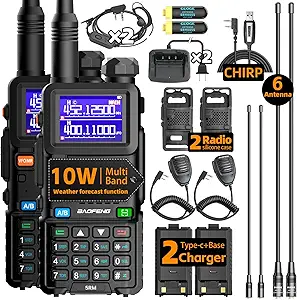 | Best for Versatile Outdoor and Emergency Use | Frequency Range: 108-520MHz (receiving), 144-148MHz & 420-450MHz (transmitting) | Display: 1.77-inch color | Memory Channels: 999 | VIEW ON AMAZON | See Our Full Breakdown |
| Tenway TP-900 PRO 10W Handheld Ham Radio with NOAA, GPS APRS, 27MHz Antenna |  | Best Overall for Versatile Emergency Communication | Power Output: 10W | Frequency Band: 27MHz FM | Supported Modes: AM, FM, SW, MW, LW | VIEW ON AMAZON | See Our Full Breakdown |
| Prepper Communications: The Easy Way |  | Best for Beginners and Simple, Practical Strategies | VIEW ON AMAZON | See Our Full Breakdown |
More Details on Our Top Picks
Baofeng UV-5R Ham Radio (2 Pack) – Long Range Handheld Two-Way Radio with NOAA Weather Emergency Features and Programming Cable
This pair of Baofeng UV-5R radios stands out for their impressive long-range capability, reaching up to 5 miles, which makes them suitable for outdoor survival scenarios where distance matters. Compared with the simpler GMRS-focused options, these radios offer a broad frequency range that includes amateur HAM and NOAA weather alerts, providing more flexibility for preppers who want both emergency alerts and hobbyist communication. However, their complex programming process can be a hurdle for beginners, and they lack water resistance, limiting outdoor durability. The inclusion of multiple charging options and a high channel capacity of 999 channels makes them a reliable, feature-rich choice for those willing to learn to operate them effectively. Still, limited battery life and no water resistance mean you need backup power sources and careful handling during extended use or adverse weather. This pick makes the most sense for preppers who prioritize long-distance, multi-use radios with emergency features but are comfortable with some setup effort.
Pros:- Long-range communication up to 5 miles
- Includes NOAA weather alerts for emergency preparedness
- Multiple charging options for convenience
- High channel capacity with 999 channels
Cons:- Not water resistant, limiting outdoor durability
- Battery life may be insufficient for extended use
- Complex programming process for beginners
Best for: Preppers who need reliable, long-range communication with emergency weather alerts and are prepared to learn basic radio programming.
Not ideal for: Beginners seeking plug-and-play radios or outdoor enthusiasts who require water-resistant models for rugged environments.
- Frequency Range:108-520 MHz
- Transmitting Frequency:144-148 MHz, 420-450 MHz
- Channels:999
- Battery:2 Lithium Ion batteries (2500mAh each)
- Charging Methods:USB-C, US Base Charger, 2500mAh Rechargeable Battery
- Maximum Range:Up to 5 miles
- Color:Black
- Water Resistance:Not water resistant
- Battery Life:Approximately 6 hours
Our verdict“This radio set is ideal for preppers wanting versatile, long-distance radios with emergency features, provided they are comfortable with some technical setup.”
Prepper Communications – The Easy Way: Second Edition
This book makes the list for its practical guidance on establishing effective communication methods during emergencies, emphasizing simple techniques that can be implemented quickly. Unlike the hardware-heavy options like the Baofeng UV-5R, this guide focuses on strategic understanding, making it ideal for preppers who are new to radio communication or want to complement their gear with solid planning. It does not offer technical details or device-specific instructions, which could leave more advanced users wanting deeper technical content. Nevertheless, its straightforward advice helps preppers develop a solid foundation in emergency communication, ensuring they understand when and how to use radios like the UV-5R or reference cards such as the BAOFENG UV-5RM Accessories Frequency Quick Reference Card. This makes it especially useful for those who prefer a mental framework before investing heavily in gear.
Pros:- Provides practical communication strategies for emergencies
- Suitable for both beginners and experienced preppers
- Includes easy-to-understand techniques
Cons:- No detailed technical content or device instructions
- Limited information on specific communication devices
Best for: Preppers seeking clear, actionable communication strategies and planning guidance, especially newcomers to emergency radio use.
Not ideal for: Experienced radio operators looking for technical manuals or detailed device-specific instructions.
Our verdict“This book is perfect for preppers wanting to understand the principles of emergency communication without technical complexity.”
Baofeng UV-5R Mini Communications Cards – HAM, GMRS, FRS, MURS Frequency Guide
This laminated, waterproof reference card provides quick access to essential radio frequencies, making it a handy tool for preppers, hikers, and outdoor enthusiasts. Compared to bulky manuals or digital apps, the UV-5R Mini Communications Cards offer instant, reliable information on GMRS, HAM, MURS, NOAA, and marine channels, which can be crucial during emergencies when quick decisions matter. Their compact size fits easily into wallets or gear, and their waterproof design withstands rugged outdoor conditions. However, these cards are strictly reference tools; they do not operate radios themselves and require prior knowledge to interpret the frequency codes properly. This limits their usefulness for complete beginners or those unfamiliar with radio protocols. They serve best as a backup or quick-reference in conjunction with a functioning radio like the UV-5R.
Pros:- Durable and waterproof for rugged outdoor use
- Provides instant access to critical radio frequencies
- Compact size fits in wallets or gear
- Tear-resistant material for field durability
Cons:- Limited to reference information, no radio functionality
- Requires prior knowledge to interpret frequencies
- May not include the latest frequency updates
Best for: Preppers and outdoor users who need quick, durable access to critical radio frequencies without the bulk of manuals or digital devices.
Not ideal for: Beginners with no radio operation experience or users seeking detailed technical instructions on radio setup.
- Compatibility:Baofeng UV-5R Mini, UV-5R, BF-F8HP, and more
- Material:Laminated, waterproof, tear-resistant
- Size:Mini credit-card size
- Use:Emergency radio frequency reference
Our verdict“This compact, waterproof reference card is ideal for preppers who want quick access to key frequencies in the field, paired with a suitable radio device.”
The Prepper’s Ham Radio Manual: The Step-by-Step Guide to Grid-Down Emergency Communications, Tactical Handheld Radios, and Building an Off-Grid Network
This manual earns its place by offering detailed, step-by-step instructions on setting up and maintaining emergency communication systems, including tactical radios and off-grid networks. Unlike the reference cards or strategy books, this guide dives into the technical aspects necessary for serious preppers who want their own resilient radio infrastructure. It covers tactical handheld radios and how to build a self-sufficient communication network, making it suitable for dedicated preppers and radio hobbyists willing to tackle complex content. However, it’s less accessible for beginners due to its detailed technical focus, and the absence of specific product specs might leave some readers wanting more practical, hands-on advice. This manual is best for those who want to develop a comprehensive, off-grid communication plan rather than just basic familiarity.
Pros:- Detailed step-by-step instructions for emergency communications
- Covers tactical radios and off-grid networking
- Suitable for serious preppers and radio enthusiasts
Cons:- No specific technical specifications provided
- Content can be complex for beginners
- No pricing or customer ratings included
Best for: Preppers interested in building a self-sufficient communication network and experienced with radio basics who want detailed guidance.
Not ideal for: Absolute beginners seeking simple, plug-and-play solutions or quick reference guides.
Our verdict“This manual is well-suited for preppers aiming to establish a resilient, off-grid radio communication system with technical depth.”
BAOFENG UV-5RM Accessories Frequency Quick Reference Card
This waterproof, tear-proof reference card offers quick access to essential frequencies including HAM, GMRS, FRS, MURS, CB, NOAA weather channels, and emergency codes. Its compact size allows it to fit easily in a wallet or gear kit, making it a practical backup for preppers, hikers, and campers relying on radios like the UV-5RM. Compared to larger manuals, this card provides immediate, at-a-glance information, which can be critical in high-pressure situations. However, it’s strictly a reference tool—no functionality or detailed instructions are included. Users must interpret the codes and frequencies independently, so it’s best suited for those already familiar with radio operation or as a quick aid alongside a functional radio like the UV-5RM. Its durability makes it reliable for outdoor conditions.
Pros:- Durable and field-ready waterproof design
- Provides quick access to multiple critical frequencies
- Compact, pocket-sized format
- Includes SHTF frequencies list
Cons:- Limited to reference information, no radio operation
- Requires prior knowledge to interpret codes
- May not have the latest frequency updates
Best for: Preppers and outdoor users needing a durable, portable quick-reference guide for radio frequencies and emergency channels.
Not ideal for: Beginners without prior radio knowledge or anyone seeking a comprehensive technical manual.
- Includes:SHTF frequencies list
- Compatibility:Baofeng UV-5RM / UV-5RM
- Material:Waterproof, tear-proof
- Size:Pocket-sized
Our verdict“This reference card is perfect as a durable, quick-access tool for preppers who already understand radio frequencies and need a reliable backup guide.”
Baofeng UV-5R Reference Card – HAM, GMRS, FRS, MURS Frequency Guide
This laminated, waterproof reference card stands out for preppers needing quick access to radio frequencies in emergency scenarios. Compared to the full radio models like the Baofeng UV-5RM, it doesn’t transmit but offers a durable, compact way to recall channels, making it ideal for field use where carrying a radio isn’t practical. It’s perfect for preppers who already have radios and want a reliable quick-reference, but it’s useless if you lack familiarity with radio frequencies or don’t own compatible radios. Its waterproof design and lightweight form fit easily into wallets or go-bags, ensuring accessibility when needed most. However, it doesn’t replace the need for actual radios and offers no functionality beyond reference. This pick makes the most sense for experienced preppers who want a durable, easy-to-carry frequency cheat sheet.Pros:- Durable and waterproof for rugged field conditions
- Compact and portable, easily fits in wallets or go-bags
- Provides quick access to critical radio frequencies
Cons:- Limited to reference information, not a functional radio
- Requires familiarity with radio channels and frequencies for effective use
Best for: Preppers who already own radios and need a rugged, quick-reference guide for field operations.
Not ideal for: Beginners or those without existing radios, as it provides reference info only and requires radio knowledge for effective use.
- Water Resistance Level:Waterproof
- Compatible Devices:Baofeng UV-5R, BF-F8HP
- Connectivity Protocol:HAM, GMRS, MURS
- Additional details:NOAA weather, PACE plan, CTCSS/DCS tones
Our verdict“This reference card is perfect for seasoned preppers who need quick, reliable frequency info in the field without extra bulk.”
EMP-Hardened Radio Communications
This EMP-hardened radio system offers unparalleled resilience compared to standard handhelds like the UV-5RM, making it essential for preppers concerned about electromagnetic disruptions. Its robust, EMP-resistant design ensures communication remains intact during power surges or nuclear events, but the lack of detailed specs and unfamiliarity with military-grade gear might make it daunting for casual users. The higher cost reflects its specialized build, which might be unnecessary for those only preparing for typical emergencies. If your priority is reliable communication under extreme conditions, this option provides peace of mind. However, it’s probably overkill for everyday outdoor activities or short-term disruptions. This device makes sense for preppers who need guaranteed operational capability in worst-case scenarios, even at a premium.Pros:- Durable and EMP-resistant design ensures operation in extreme conditions
- Reliable communication in blackout or disaster scenarios
Cons:- Limited information on features and specifications
- Higher price point may not be justified for standard prepper needs
Best for: Preppers focused on extreme resilience, military-grade preparedness, or industrial scenarios requiring EMP immunity.
Not ideal for: Casual outdoor enthusiasts or beginners seeking simple, affordable radio solutions, as it involves higher cost and limited accessible information.
Our verdict“Choose this for maximum durability and EMP resilience if your prep priorities include surviving electromagnetic threats.”
Ham Radio Mini Reference Card – GMRS, FRS, MURS, Amateur Guide
This credit card-sized, waterproof reference card provides quick access to key frequencies and tips, making it ideal for preppers who value portability. Unlike bulkier manuals or software guides like ‘The Prepper’s Guide to Post-Disaster Communications,’ this card offers immediate info during emergencies. It’s perfect for outdoor activities, everyday carry, or as part of a prepper’s go-bag. The small size limits the amount of detail, so advanced operators might find it insufficient, especially if their equipment has specific or advanced features. Its durability and ease of attachment make it a practical tool for quick reference, but it’s not a substitute for proper training or comprehensive manuals. This makes it best suited for prepper beginners or those who want a lightweight backup reference.Pros:- Waterproof and durable for outdoor conditions
- Compact and lightweight, easily carried everywhere
- Includes essential frequencies and tips at a glance
Cons:- Limited information, not a full manual
- May omit specific models or advanced settings
Best for: Preppers or outdoor enthusiasts who need a durable, quick-reference guide that fits easily into their gear.
Not ideal for: Advanced users or radio operators with complex setups who require detailed, model-specific info or technical instructions.
- Material:Waterproof synthetic
- Size:Credit card-sized
- Includes:Split ring for attachment
Our verdict“Ideal for casual preppers and outdoor users seeking a compact, reliable quick-reference card.”
The Prepper’s Guide to Post-Disaster Communications: A Simplified Guide to Ham Radio
This book distills ham radio communication into straightforward strategies, making it ideal for preppers who prefer learning through reading rather than technical setup. Unlike the more technical manuals like ‘The Prepper’s Ham Radio Manual,’ it emphasizes practical, easy-to-understand methods for staying connected during disasters. However, it offers limited technical detail, which could frustrate those looking to build or troubleshoot complex systems. Its value lies in providing a clear, approachable overview that helps preppers understand the basics of emergency communication without overwhelming them. It’s best for beginners or those seeking a mental framework before diving into hardware. This guide is perfect for preppers who want to grasp fundamental concepts without technical jargon.Pros:- Provides practical, easy-to-understand communication strategies
- Great for preppers without technical backgrounds
- Encourages confidence in emergency communication planning
Cons:- No detailed technical instructions
- Limited info on actual equipment setup or advanced methods
Best for: Beginner preppers and those seeking a clear, non-technical overview of post-disaster communication methods.
Not ideal for: Experienced operators or those wanting detailed technical instructions or equipment setup guidance.
Our verdict“A solid starting point for preppers looking to understand the principles of emergency radio communication without technical complexity.”
Baofeng UV-5RM Ham Radio Handheld Walkie Talkies Long Range
This dual-band handheld offers extensive frequency coverage, making it more versatile than simpler models like the UV-5R. Its large color display and 999 memory channels provide easy navigation and customization, which is valuable for preppers needing quick access to multiple channels during a crisis. The long-lasting 2500mAh battery and USB-C charging add to its practicality, though the setup can be complex for newcomers unfamiliar with programming. Its size and features make it less portable for quick carry but excellent for semi-permanent setups or vehicle use. While it excels in range and user-friendliness for more experienced users, beginners might find it overwhelming. This device makes the most sense for preppers with some radio experience or those who need a robust, multi-purpose communication tool.Pros:- Wide frequency range suitable for multiple applications
- Long-lasting 2500mAh battery with flexible charging options
- Includes NOAA weather alerts for emergency preparedness
- High-quality speaker microphone for demanding environments
Cons:- Complex setup for users without programming experience
- Bulkier design may reduce portability for quick carry
Best for: Preppers with basic radio knowledge seeking a versatile, long-range handheld with extensive features.
Not ideal for: Complete beginners or those seeking a simple, plug-and-play communication device due to its setup complexity.
- Frequency Range:108-520MHz (receiving), 144-148MHz & 420-450MHz (transmitting)
- Display:1.77-inch color
- Memory Channels:999
- Battery:2500mAh rechargeable
- Charging:USB-C, desktop charging base
- FCC ID:2AJGM-5RH
Our verdict“This radio is ideal for preppers who want a feature-rich, long-range device with flexible operation, provided they can handle some setup complexity.”
Tenway TP-900 PRO 10W Handheld Ham Radio with NOAA, GPS APRS, 27MHz Antenna
The Tenway TP-900 PRO stands out for its combination of high power, multiple features, and outdoor readiness, making it an excellent choice for preppers who need reliable long-range communication. Compared with the Baofeng UV-5R, this model offers a more powerful 10W output, which translates to better range in challenging conditions. Its built-in GPS and APRS make location tracking and data sharing straightforward, a significant advantage during crises. NOAA weather alerts add an extra layer of situational awareness. However, its FM-only operation on the 27MHz band means it lacks the versatility of dual-band models, and its bulkier design may be less convenient for carry. This pick makes the most sense for preppers who prioritize extended range and integrated outdoor tools over compact size or simpler operation.
Pros:- High 10W power output ensures extended communication range
- Built-in GPS and APRS facilitate location tracking and data sharing
- Multi-band reception captures diverse signals, enhancing reliability
- NOAA weather alerts keep users informed of severe weather conditions
Cons:- Limited to FM operation on 27MHz, restricting some communication modes
- Bulkier design reduces portability for everyday carry
- Complex features may be daunting for less tech-savvy users
Best for: Preppers who want a rugged, feature-rich handheld capable of long-range communication and outdoor navigation
Not ideal for: Beginners or those seeking a simple, lightweight radio for casual use, as the complexity and size may be overwhelming
- Power Output:10W
- Frequency Band:27MHz FM
- Supported Modes:AM, FM, SW, MW, LW
- GPS:Yes
- APRS:Yes
- NOAA Weather Alerts:Yes
- Bluetooth:Yes
- Spectrum Analyzer:Yes
Our verdict“This radio is ideal for preppers seeking a powerful, multi-functional device for outdoor and emergency use, despite its size and complexity.”
Prepper Communications: The Easy Way
This book, Prepper Communications: The Easy Way, makes effective emergency communication accessible for preppers who prefer straightforward, no-fuss methods. Unlike the more technical Prepper’s Ham Radio Manual, it offers clear, step-by-step advice suitable for those new to radio communication or those who want reliable strategies without technical jargon. It emphasizes practical tactics like using basic handhelds, understanding simplex channels, and maintaining simple emergency plans. The main tradeoff is that it lacks detailed technical insights or advanced setup instructions found in more comprehensive guides. It’s best suited for preppers who prioritize quick, easy-to-understand guidance over deep technical knowledge, especially in immediate survival scenarios.
Pros:- Simple, accessible language makes it easy for beginners to understand
- Practical advice focused on real-world emergency scenarios
- Provides clear communication strategies with minimal technical setup
Cons:- Limited technical details for more advanced users
- Focuses mainly on basic methods, not on sophisticated radio setups
- Does not cover specific equipment models or technical specs
Best for: Preppers new to radio communication who need practical, easy-to-implement strategies
Not ideal for: Experienced hobbyists or technical users seeking in-depth technical details or advanced setups
Our verdict“This book is perfect for preppers who want straightforward, reliable communication tips without technical complexity, though it lacks depth for experienced hobbyists.”

How We Picked
I evaluated each product based on performance, durability, ease of use, versatility, and value. Priority was given to radios that support multiple frequency bands, have long-range capabilities, and are reliable in emergency conditions. Durability features like EMP-hardening and battery life also played a significant role. I compared user reviews and technical specs to identify which models balance functionality with affordability. The ranking reflects a combination of practical features, build quality, and overall readiness for off-grid communication scenarios.Factors to Consider When Choosing Radio Communication For Preppers
Choosing the right radio communication device for prepping involves understanding several key factors. Beyond basic features, preppers should consider durability, range, ease of programming, and power options. Making the right choice depends on your specific emergency plans, geographic location, and technical comfort level. Avoid common pitfalls like overspending on unnecessary features or choosing overly complex models that won’t be used in high-stress situations. A balanced approach ensures your communication system remains reliable when it matters most.Range and Power
Range is often the most talked-about feature, but it depends on terrain, antenna quality, and power output. Higher wattage radios generally provide longer communication distances, especially in open areas. However, increased power can reduce battery life and increase size. For prepping, a balance between range and portability is key. Think about your typical environment—mountains, urban, or rural—and choose accordingly to avoid overpaying for unnecessary power or risking inadequate coverage.
Durability and EMP Resistance
Preppers need radios that withstand harsh conditions, including potential EMP events. EMP-hardened radios are built with shielding and robust components to survive electromagnetic pulses, making them ideal for long-term off-grid survival. Many standard handhelds lack this resilience, so weigh the importance of EMP resistance against budget constraints. Remember, durability isn’t just about shock resistance; it also includes weatherproofing and rugged construction to handle extreme environments.
Ease of Use and Programming
Preppers often operate radios under stress, so intuitive controls and straightforward programming are critical. Some models offer USB or cable-based programming, which simplifies setup, while others require more technical know-how. Consider whether you want a device with pre-set channels or the ability to customize frequencies easily. Simpler models might lack advanced features but excel in quick setup, whereas more complex radios offer flexibility at the expense of a steeper learning curve.
Battery Life and Power Options
Long-lasting batteries are essential for extended emergency scenarios. Some radios support rechargeable batteries, while others have replaceable AA or AAA options. Solar chargers and external power sources can extend usability, especially in prolonged disruptions. Be mindful of the tradeoff: more powerful radios may drain batteries faster or require larger, less portable batteries. For off-grid use, prioritize models with efficient power consumption and multiple charging methods.
Frequency Support and Compatibility
Most preppers look for radios supporting multiple bands—HAM, GMRS, FRS, and MURS—for flexibility. Dual or multi-band radios expand communication options and ensure compatibility with other devices. However, licensing requirements vary by band; HAM radios often need licensing, while FRS and GMRS are more user-friendly for quick deployment. Understanding the legal considerations and ensuring your chosen radio supports the necessary frequencies is vital for effective preparedness.
Frequently Asked Questions
Do I need a license to operate a ham radio for prepping?
Whether a license is required depends on the frequency bands your radio uses. Ham radios operating on amateur bands generally require an FCC license, which involves passing an exam. GMRS radios typically need a license, but it’s straightforward to obtain and covers your entire family. FRS and MURS channels are usually license-free and ready to use right out of the box. Consider your legal obligations and choose a radio that fits your licensing willingness and technical expertise.
What is the best type of radio for off-grid emergency communication?
For off-grid scenarios, EMP-hardened, handheld radios with long battery life and multi-band support make the most sense. These radios are designed to withstand harsh conditions and operate independently of grid power. Portable models with solar or hand-crank charging options further enhance reliability during extended outages. Keep in mind that good antenna quality and sufficient power output are crucial to maintain effective communication over longer distances in remote areas.
How important is durability versus range in choosing a prepper radio?
Durability and range serve different but equally critical roles in prepping. Durability ensures your radio remains operational under physical stress, weather, and EMP events, while range determines how far your signals can reach. For remote or disaster-prone areas, durability might take precedence, especially if you expect rough handling or environmental exposure. Conversely, if you live in a densely populated area, a radio with a longer range might be more valuable, but it should still be rugged enough to survive field use.
Can I use a consumer walkie-talkie for prepping purposes?
Consumer walkie-talkies, like those supporting FRS or MURS, are suitable for short-range communication and easy to operate, making them good for initial prepping steps. However, they often lack the power, frequency flexibility, and durability needed for serious emergency use. For comprehensive prepping, investing in a HAM or GMRS radio that supports longer ranges and multiple channels is advisable. These devices offer greater reliability and adaptability in critical situations.
What additional accessories should I consider for my radio?
Key accessories include extra batteries, high-gain antennas, and external microphones for better audio clarity. Programming cables and reference guides can simplify setup and operation. Weatherproof cases and belt clips improve portability and durability. For off-grid scenarios, solar chargers and portable power banks help maintain battery life. Investing in these accessories ensures your radio remains functional, accessible, and easy to operate when it matters most.