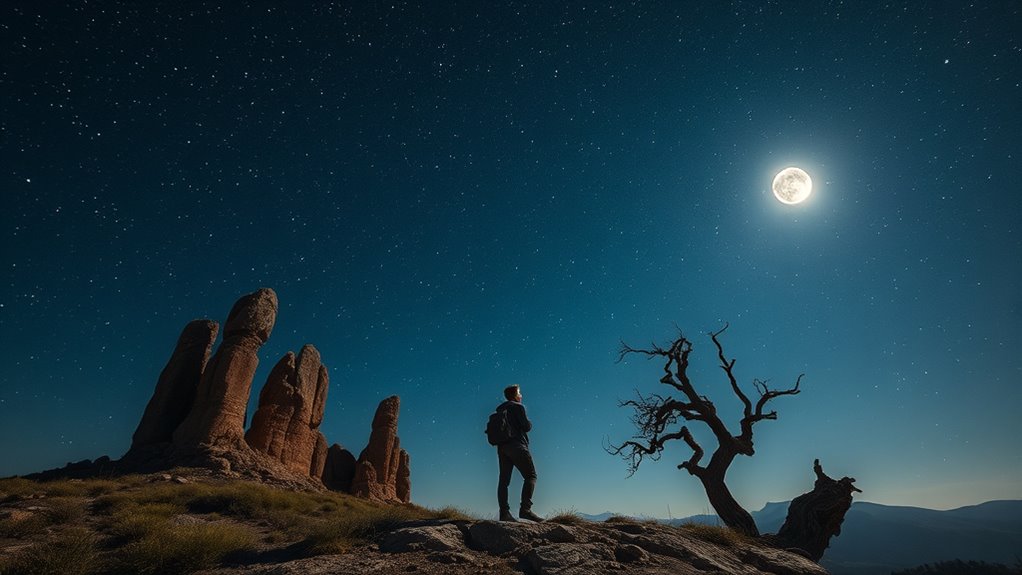

To navigate using stars and natural landmarks, you focus on key constellations like Polaris for north and observe how stars move across the sky at night. During the day, rely on familiar features such as mountains, rivers, or coastlines to create mental maps and maintain your course. Combining celestial cues with landmark recognition helps you stay oriented and guarantees safe travel. Keep exploring, and you’ll discover more ways to master these timeless navigation skills.
Key Takeaways
- Use Polaris to find true north at night, guiding overall directional orientation.
- Recognize prominent constellations and star patterns to determine cardinal directions.
- Identify natural landmarks like mountains and rivers for consistent reference points during travel.
- Combine celestial cues with landmark observations to improve navigation accuracy.
- Practice keen observation of the night sky and environment to develop reliable natural navigation skills.

Have you ever wondered how travelers and explorers found their way before GPS? Long before smartphones and digital maps, people relied on the natural world and the stars to navigate unfamiliar terrain. They mastered the art of celestial navigation, which involves using the positions of stars to determine your location and direction. This method requires understanding how stars move across the night sky and recognizing key constellations. By noting the positions of specific stars at different times of the year, you can figure out where you are and which way to go. It’s a skill that takes practice, but it’s incredibly effective when no modern tools are available.
Before GPS, explorers used stars and natural landmarks to navigate unfamiliar terrain effectively.
Landmark orientation is another essential technique. When you’re traveling through a landscape, recognizable natural features like mountains, rivers, and coastlines serve as reference points. By remembering the landmarks you see on your route, you create a mental map that guides you forward. For example, if you see a distinctive mountain peak to your east and a river flowing south, you can use that information to maintain your course. This method works best when landmarks are prominent and stable over time, giving you a reliable way to stay oriented. As you move, keeping track of these features helps prevent disorientation and keeps you on the right path.
Combining celestial navigation with landmark orientation makes your navigation more accurate. During the night, you can use stars to determine your general direction, then confirm that with nearby landmarks. Conversely, during the day, landmarks become your primary clues, but at night, the stars take over. To do this effectively, you need to learn how to identify key stars and constellations, such as Polaris, the North Star, which always sits roughly above the North Pole. Knowing where Polaris is located allows you to find true north easily, even in unfamiliar territory. This knowledge is especially useful in open landscapes or at sea, where landmarks can be sparse or absent.
In essence, navigation using stars and natural landmarks requires keen observation and an understanding of your environment. You don’t need fancy technology—just your eyes and a bit of knowledge. With practice, you’ll develop an intuition for reading the night sky and recognizing features around you. This skill connects you to centuries of explorers who relied on the natural world to chart their journeys. Whether you’re lost in a forest, sailing across the ocean, or hiking in the mountains, mastering celestial navigation and landmark orientation can help you find your way safely and confidently, reconnecting you with the ancient art of exploration.
Frequently Asked Questions
How Do Weather Conditions Affect Star and Landmark Navigation?
Weather conditions can markedly impact your ability to navigate using stars and landmarks. Atmospheric interference, like fog, clouds, or heavy rain, reduces visibility, making it hard to see stars or natural landmarks clearly. Visibility challenges mean you might lose your way or misjudge distances. You should check weather forecasts before heading out and be prepared with alternative navigation methods, especially in poor weather, to stay safe and on track.
Can Natural Landmarks Be Used to Navigate at Night?
Yes, natural landmarks can be used to navigate at night because their significance remains visible through their shapes and positions, even in low light. You can rely on landmarks like large trees, cliffs, or distinctive formations to guide your way, practicing natural navigation. By memorizing key landmarks and their significance in your surroundings, you improve your ability to orient yourself accurately even when stars aren’t visible.
What Tools Complement Traditional Star and Landmark Navigation?
You can complement traditional star and landmark navigation with tools like a compass and GPS for more accuracy. Digital maps help you visualize your route, while altimeters provide elevation data, enhancing your orientation. Using these tools together guarantees you stay on track, especially in challenging conditions or unfamiliar terrain. They serve as reliable backups or enhancements, giving you confidence and precision when steering using natural cues.
How Do Different Cultures Interpret Natural Landmarks for Navigation?
Like a guiding star in the night, different cultures interpret natural landmarks through rich cultural symbolism and mythological significance. You might see a mountain as a sacred ancestor’s home or a river as a divine pathway. These interpretations shape navigation, connecting people to their history and beliefs. By understanding these cultural meanings, you can appreciate how diverse societies find direction and purpose in the natural world around them.
Are There Modern Apps That Simulate Star and Landmark Navigation?
Yes, there are modern apps that simulate stellar navigation and landmark recognition. These apps help you practice celestial navigation, teaching you how to identify stars and constellations, just like ancient navigators did. They often include augmented reality features, making it easier to recognize landmarks and stars in real-time. Whether you’re an astronomy enthusiast or preparing for outdoor adventures, these tools enhance your skills in stellar navigation and landmark recognition effectively.
Conclusion
By mastering the art of navigation using stars and natural landmarks, you reveal the ancient secrets that have guided explorers for centuries. Trust in the night sky and nature’s clues—they’re your most reliable compass when all else fails. With these skills, you could navigate through the wilds faster than a lightning bolt streaks across the sky. Keep practicing, and soon, you’ll be able to chart a course through the wilderness with the confidence of a seasoned explorer.