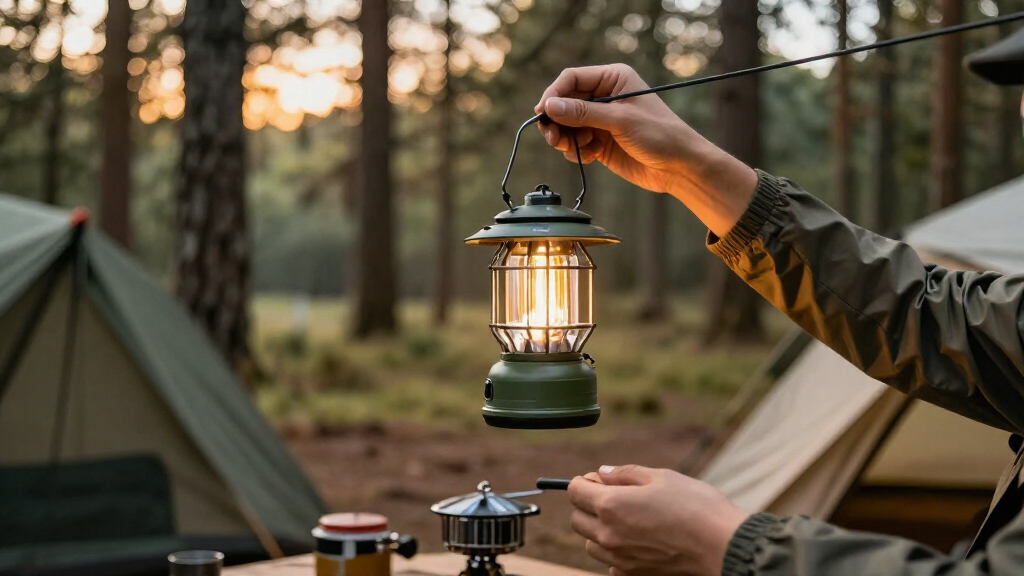
When you’re searching for solar powered camping lanterns, the real tradeoff is between solar panel efficiency, battery capacity, and portability. The LuminAID Nova Inflatable Solar LED Lantern stands out as the best overall pick for its packable inflatable design and dependable solar charging. If you want maximum value for car camping, the Nova Ridge Rechargeable 2-pack delivers two solid lanterns at a budget-friendly cost. For those who need more than light, the SZJIEIFR model with fan and phone charger transforms a lantern into a multi-tool for off-grid comfort. Continue reading for the full breakdown of 11 top contenders, ranked by charging speed, brightness, durability, and real-world usability.

Get emergency and outdoor gear delivered free with Prime
- Fast, free delivery on millions of items
- Prime Video, Amazon Music and more included
- Member-only deals all year
Key Takeaways
- The best solar lanterns balance panel efficiency with battery capacity; many budget models have tiny panels that require 8+ hours of direct sun to fully charge.
- Inflatable designs like the LuminAID Nova pack down smaller than rigid lanterns but sacrifice battery capacity and durability in exchange.
- Multi-function lanterns with fans and power banks add weight and cost, but they can replace separate gear items for campers who want to minimize their load.
- IP ratings matter: a lantern with IP65 can handle rain and splashes, but many budget options lack any waterproofing and should be kept under cover.
- Multi-pack options (4-packs) are cost-effective for group camping, but they often use lower-quality LEDs with uneven light distribution compared to premium single units.
| Nova Ridge Rechargeable Solar Camping Lanterns, 2 Pack |  | Best Two-Lantern Set | Set size: 2 lanterns | Charging: Solar or USB-C | Light modes: Dimmable warm light and white flashlight | VIEW LATEST PRICE | See Our Full Breakdown |
| SZJIEIFR Solar Camping Lantern with Fan and Phone Charger |  | Best for Warm-Weather Campsites | Power sources: Solar and batteries | Battery requirement: 3 AAA alkaline batteries, sold separately | Battery life: 8 hours | VIEW LATEST PRICE | See Our Full Breakdown |
| d.light S3 Solar-Powered LED Lantern with Adjustable Stand |  | Best Solar-Only Simplicity | Model: S3 | Power source: Solar | Battery: 450 mAh lithium-ion | VIEW LATEST PRICE | See Our Full Breakdown |
| Glocusent 400H Rechargeable Camping Lantern with Solar Charging |  | Best for Long Runtime and Lighting Control | Battery capacity: 5000 mAh | Charging: USB-C and solar | USB-C charging time: 3.5 hours | VIEW LATEST PRICE | See Our Full Breakdown |
| LuminAID Nova Inflatable Solar LED Lantern |  | Best Compact, Packable Lantern | Maximum light output: 75 lumens | Power sources: Solar or micro-USB | Battery life: Up to 24 hours | VIEW LATEST PRICE | See Our Full Breakdown |
| Westinghouse 1000-Lumen Solar Camping Lantern |  | Best for Bright, Simple Camp Lighting | Maximum output: 1000 lumens | Color temperature: 5000 K | Lighting modes: High, medium, low, SOS | VIEW LATEST PRICE | See Our Full Breakdown |
| Xynover 4-Pack Solar Camping Lanterns with USB Charging and Power Bank | 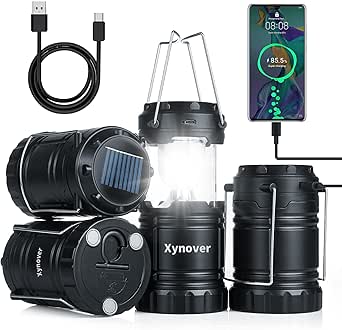 | Best for Group Campsites | Pack quantity: 4 lanterns | Maximum output: 100 lumens per lantern | Beam angle: 360 degrees | VIEW LATEST PRICE | See Our Full Breakdown |
| SAMUUN Rechargeable Solar Camping Lantern, 5000mAh, 2000 Lumens, IP65 |  | Best for High-Output Versatility | Model: C30 | Battery capacity: 5000mAh | Charging: Solar and USB | VIEW LATEST PRICE | See Our Full Breakdown |
| d.light A2 Portable Solar Lantern |  | Best Compact Solar-Only Pick | Model: A2 | Power source: Solar | Battery capacity: 300mAh | VIEW LATEST PRICE | See Our Full Breakdown |
| SAMUUN Rechargeable Solar Camping Lantern, 5000mAh, 2000 Lumens, IP65 Waterproof |  | Best for Long Eco-Mode Use | Model: C30 | Battery capacity: 5000mAh | Battery type: Lithium-ion polymer | VIEW LATEST PRICE | See Our Full Breakdown |
| Mesqool Solar Camping Lanterns, 4-Pack, Rechargeable with Flashlight |  | Best Multi-Pack for Group Camping | Pack count: 4 | Maximum light output: 350 lumens | Battery capacity: 1600 mAh per unit | VIEW LATEST PRICE | See Our Full Breakdown |
| solar powered camping lantern | Water resistance | Weight | Dimensions |
|---|---|---|---|
| Nova Ridge Rechargeable Solar | Waterproof | 7.76 oz per lantern | 3 × 3 × 6 in per lantern |
| SZJIEIFR Solar Camping Lantern | Not water resistant | Approximately 13.6 oz | 3.9 × 3.9 × 6.9 in |
| d.light S3 Solar-Powered LED L | Water resistant; rating not specified | 4.64 oz | 4.53 × 3.74 × 7.68 in |
| Glocusent 400H Rechargeable Ca | IPX5 | 5.4 oz | — |
| LuminAID Nova Inflatable Solar | IP67 waterproof | 5.3 oz | 4.75 × 4.75 × 4.75 in |
| Westinghouse 1000-Lumen Solar | IPX4 | — | 4.54 × 4.04 × 7.95 in |
| Xynover 4-Pack Solar Camping L | Described as waterproof | — | — |
| SAMUUN Rechargeable Solar Camp | — | 8.8 ounces | — |
| d.light A2 Portable Solar Lant | Water resistant; dust and splash resistant | 100 g | 3.93 × 3.15 × 3.74 in |
| SAMUUN Rechargeable Solar Camp | IP65 | 250g | — |
| Mesqool Solar Camping Lanterns | Waterproof | — | — |
More Details on Our Top Picks
Nova Ridge Rechargeable Solar Camping Lanterns, 2 Pack
The two-lantern bundle is the clearest reason to choose Nova Ridge: it gives a pair of campers, or a tent and picnic table, separate lights without relying on one brighter central lantern. Each unit combines dimmable 3000 K warm light with a separate white flashlight, so it handles both camp ambience and focused checks around the site. Solar and USB-C charging add flexibility, while the listed 40-hour low-setting runtime favors long, modest-light use over sustained high output. Compared with the single d.light S3, this set offers more placement options and a flashlight mode; compared with the LuminAID Nova, it is less compact when carrying both lanterns and does not collapse. The tradeoffs are a roughly four-hour runtime on high warm light and about ten hours for solar charging, making USB-C the more dependable way to replenish it between outings.
Pros:- Two lanterns let campers light separate areas at once
- Solar and USB-C charging offer two ways to replenish the battery
- Dimmable warm light and a separate white flashlight cover ambient and focused lighting
- Lightweight, waterproof bodies include hanging straps
Cons:- High warm-light mode runs for about four hours
- Solar charging takes about ten hours
- The two lanterns take more packed space than a single collapsible LuminAID Nova
Best for: Two-person camping trips and families who want separate warm lanterns for a tent and shared campsite area.
Not ideal for: Campers who need strong light for long stretches or expect to recharge quickly from sunlight; high mode lasts about four hours and solar charging takes about ten.
- Set size:2 lanterns
- Charging:Solar or USB-C
- Light modes:Dimmable warm light and white flashlight
- Maximum light output:100 lumens
- Maximum battery life:Up to 40 hours on low
- Water resistance:Waterproof
- Dimensions:3 × 3 × 6 in per lantern
- Weight:7.76 oz per lantern
Our verdict“Choose Nova Ridge when having two waterproof, versatile lanterns matters more than high-output endurance or a compact one-piece design.”
SZJIEIFR Solar Camping Lantern with Fan and Phone Charger
The SZJIEIFR earns its place through a feature most lanterns in this lineup do not offer: a foldable fan with 180-degree adjustment. That makes it more useful than a basic light during warm, still nights, while its 360-degree illumination spreads light around a small campsite. Its power setup needs careful interpretation, though: the listed operating batteries are three AAA cells, sold separately, and the supplied details do not state how solar charging works in relation to them. Compared with the solar-only d.light S3, the AAA option may be easier to manage when sunlight is limited, but the d.light is much lighter and water resistant. At 13.6 ounces and with no water resistance, this is a less suitable choice for exposed or weight-conscious trips. I would choose it for sheltered, hot-weather camping, not as the most dependable all-weather lantern.
Pros:- Combines a lantern with a foldable, 180-degree adjustable fan
- 360-degree lighting covers the surrounding campsite
- Compact form folds for storage and transport
Cons:- Requires three AAA batteries, which are sold separately
- Not water resistant, limiting use in wet or exposed campsites
- At approximately 13.6 ounces, it is heavier than the d.light S3 and LuminAID Nova
Best for: Car campers in warm, sheltered conditions who want a campsite light with an adjustable fan and are willing to pack AAA batteries.
Not ideal for: Backpackers and campers expecting rain exposure; it is heavier than the d.light S3 and is listed as not water resistant.
- Power sources:Solar and batteries
- Battery requirement:3 AAA alkaline batteries, sold separately
- Battery life:8 hours
- Lighting coverage:360°
- Fan adjustment:Up to 180°
- Water resistance:Not water resistant
- Dimensions:3.9 × 3.9 × 6.9 in
- Weight:Approximately 13.6 oz
Our verdict“Pick the SZJIEIFR for sheltered warm-weather camping where its fan is useful enough to justify extra weight and battery planning.”
d.light S3 Solar-Powered LED Lantern with Adjustable Stand
The d.light S3 is the straightforward pick for campers who want a lantern that charges from the sun without depending on a USB cable. Its adjustable metal handle is more than a carrying loop: it lets the light sit on a table or floor, hang from a hook, or be positioned against a wall. At just 4.64 ounces, it is also lighter than the Nova Ridge lanterns and the SZJIEIFR fan-lantern, which favors simple packing. The limit is its 12-hour maximum runtime and the lack of a stated water-resistance rating beyond “water resistant.” Compared with the USB-C-equipped Nova Ridge set, it offers less charging flexibility and no separate flashlight, but its two-year warranty is longer than Nova Ridge’s one year. This is a practical, uncomplicated solar light rather than a high-output or feature-packed choice.
Pros:- Solar-powered design does not require a USB charging cable
- Adjustable metal handle supports tabletop, floor, wall, or hook placement
- Lightweight at 4.64 ounces
- Listed runtime reaches up to 12 hours per full charge
Cons:- 12-hour maximum runtime is shorter than the Nova Ridge lanterns’ low-setting claim
- Water resistance is stated without a specific rating
- Solar is the only listed power source
Best for: Minimalist campers who want a lightweight solar-only lantern with flexible hanging and tabletop placement.
Not ideal for: Trips needing multiple nights of long runtimes, a focused flashlight beam, or clearly specified protection against heavy rain.
- Model:S3
- Power source:Solar
- Battery:450 mAh lithium-ion
- Battery life:Up to 12 hours
- Water resistance:Water resistant; rating not specified
- Dimensions:4.53 × 3.74 × 7.68 in
- Weight:4.64 oz
- Warranty:2 years
Our verdict“Choose the d.light S3 for a light, solar-only campsite lantern with versatile placement, provided its runtime and unspecified water-resistance level suit your trip.”
Glocusent 400H Rechargeable Camping Lantern with Solar Charging
The Glocusent 400H is the most adjustable option here for campers who want to tailor light to different tasks. It offers five brightness levels, three white color temperatures, and a red SOS mode, while its stated maximum runtime of up to 120 hours gives low-setting use an advantage over the d.light S3 and LuminAID Nova. The main caveat is the role of solar: a 40-hour solar recharge makes it a backup method, not a quick way to refill the battery during a short stop. USB-C charging takes 3.5 hours, so that is the practical primary option. Compared with Nova Ridge, the Glocusent adds color-temperature choices, emergency signaling, and device charging, but it is a single lantern rather than a two-pack. Its specifications list both 120 and 1,200 lumens as maximum output, so I would not base a purchase on the higher figure without clarification.
Pros:- Five brightness levels and three color temperatures adapt light to different campsite tasks
- Listed maximum runtime reaches up to 120 hours
- Red SOS mode and emergency device charging add backup utility
- IPX5 water resistance, one-meter drop protection, and 5.4-ounce weight suit portable camping use
Cons:- Solar charging takes about 40 hours, so it is best treated as supplementary
- The product data lists conflicting maximum outputs of 120 and 1,200 lumens
- USB-C charging is required for a practical 3.5-hour recharge
Best for: Campers who prioritize long low-mode runtime, adjustable white light, and emergency signaling, and can recharge mainly by USB-C.
Not ideal for: Buyers relying on sunlight for fast turnaround or those who need an unambiguous brightness specification before choosing a lantern.
- Battery capacity:5000 mAh
- Charging:USB-C and solar
- USB-C charging time:3.5 hours
- Solar charging time:40 hours
- Maximum runtime:Up to 120 hours
- Brightness levels:5; listed range 15–250 lm
- Color temperatures:3000 K, 4500 K, and 6000 K
- Water resistance:IPX5
- Weight:5.4 oz
Our verdict“Pick the Glocusent if adjustable lighting and long stated runtime matter more than fast solar charging or a clearly stated peak brightness.”
LuminAID Nova Inflatable Solar LED Lantern
The LuminAID Nova is the easiest choice in this group to pack away: its inflatable, collapsible body compresses for travel and weighs just 5.3 ounces. That makes it a better fit for campers trying to save space than the rigid Nova Ridge pair or the adjustable-frame d.light S3. It produces up to 75 lumens with multiple brightness settings and runs for up to 24 hours, enough for tent lighting and modest campsite use rather than lighting a large shared area. Its IP67 waterproof, dustproof, and shatterproof construction gives it a clear advantage over the non-water-resistant SZJIEIFR, especially in wet conditions. Solar charging takes about ten hours in direct sunlight; micro-USB is much faster at one to two hours, though it is an older connector than the USB-C used by Nova Ridge and Glocusent.
Pros:- Inflatable, collapsible construction packs down for travel
- Lightweight at 5.3 ounces
- IP67-rated waterproof and dustproof design is more weather-ready than the SZJIEIFR
- Solar and micro-USB charging with up to 24 hours of battery life
Cons:- Maximum output of 75 lumens is modest for lighting a large campsite
- Solar charging takes about ten hours in direct sunlight
- Micro-USB is less current than the USB-C charging used by Nova Ridge and Glocusent
Best for: Backpackers and space-conscious campers who want a lightweight lantern that packs flat and can handle wet, dusty conditions.
Not ideal for: Campers needing high-output area lighting or a modern USB-C connection; this model is limited to 75 lumens and uses micro-USB.
- Maximum light output:75 lumens
- Power sources:Solar or micro-USB
- Battery life:Up to 24 hours
- Recharge time:About 10 hours in direct sunlight or 1–2 hours via micro-USB
- Water resistance:IP67 waterproof
- Construction:Inflatable, collapsible, dustproof, and shatterproof
- Dimensions:4.75 × 4.75 × 4.75 in
- Weight:5.3 oz
Our verdict“Choose the LuminAID Nova when packability and strong stated water protection matter more than high brightness or USB-C charging.”
Westinghouse 1000-Lumen Solar Camping Lantern
The Westinghouse is a practical pick for campers who want a bright, straightforward lantern rather than a wide menu of color effects. Its 1000-lumen maximum and daylight-white output can light a shared campsite more forcefully than the d.light A2, whose compact design and four-hour runtime suit shorter, closer-range use. Solar and USB-C charging give you two ways to replenish the 4000mAh battery, while SOS mode adds a useful emergency signal. The tradeoff is limited protection: IPX4 handles splashes and light rain, not immersion or sustained downpours. Runtime is also unspecified, so I would not choose it when a known overnight burn time matters. The carry handle and compact body keep it easy to move, but this is a simple lighting tool, not the phone-charging option offered by the Xynover pack.
Pros:- Up to 1000 lumens for illuminating a larger campsite
- Solar and USB-C charging provide two replenishment options
- SOS mode adds an emergency signaling function
- Integrated carry handle and IPX4 splash protection
Cons:- IPX4 protection is limited to splashes and light rain
- Battery runtime is not specified
- No phone-charging function is listed
Best for: Campers who want a bright, portable lantern for a shared campsite and can recharge by USB-C when sunlight is limited.
Not ideal for: Campers expecting heavy-rain protection, a published runtime, or a lantern that doubles as a phone power bank.
- Maximum output:1000 lumens
- Color temperature:5000 K
- Lighting modes:High, medium, low, SOS
- Power sources:Solar and USB-C
- Battery:4000mAh lithium-ion, included
- Water resistance:IPX4
- Dimensions:4.54 × 4.04 × 7.95 in
- Warranty:1-year limited
Our verdict“Choose the Westinghouse for bright, uncomplicated camp lighting with flexible charging, but skip it if you need verified runtime or stronger weather protection.”
Xynover 4-Pack Solar Camping Lanterns with USB Charging and Power Bank
The Xynover set is built around quantity and placement flexibility: four collapsible lanterns can be spread among tents, a cooking area, and a table instead of relying on one central light. Each provides 100 lumens of 360-degree illumination, so it is better for nearby tasks and tent interiors than the Westinghouse’s much brighter 1000-lumen beam. Solar, USB, or three AA batteries offer backup choices, although AA batteries are not included. A built-in power bank, magnetic base, and hanging hook add useful versatility, but the listing does not state the power-bank capacity, which makes phone-charging expectations hard to judge. The stated 12-hour runtime is helpful for planning, yet these are not substitutes for a high-output lantern when a broad, bright campsite needs lighting.
Pros:- Four lanterns make it easy to light several areas at once
- Solar, USB-rechargeable, and AA battery power options
- Collapsible design with magnetic base and hanging hook
- Built-in power bank can provide emergency device charging
Cons:- 100-lumen output is modest beside the Westinghouse lantern
- AA batteries are not included
- Power-bank capacity is not specified
Best for: Families or group campers who want several low-output lights to distribute around tents and shared areas, plus multiple backup power options.
Not ideal for: Solo campers seeking one powerful lantern, or buyers who need a clearly specified phone-charging capacity and included AA batteries.
- Pack quantity:4 lanterns
- Maximum output:100 lumens per lantern
- Beam angle:360 degrees
- Power sources:Solar, USB rechargeable, or 3 AA batteries
- Listed battery life:12 hours
- Features:Power bank, collapsible design, magnetic base, hanging hook
- Material:ABS and metal
- Water resistance:Described as waterproof
Our verdict“Pick the Xynover set for distributed, low-level lighting around a group campsite, not as a replacement for a single high-output lantern.”
SAMUUN Rechargeable Solar Camping Lantern, 5000mAh, 2000 Lumens, IP65
Among these options, this SAMUUN C30 pairs the lineup’s highest stated output, 2000 lumens, with white, warm, natural, and red light, five brightness levels, and an SOS strobe. That gives it more control over campsite mood and task lighting than the single-color Westinghouse, while its stated IP65 rating and 1.5m drop resistance offer a tougher outdoor profile. At 8.8 ounces, it is also a light carry for a lantern with a 5000mAh battery and emergency phone-charging capability. The cost of that versatility is some specification uncertainty: the listing gives over nine hours at maximum output and over 85 hours in eco mode, but also includes inconsistent battery information referring to one AA battery. I would treat the runtime figures as listed estimates rather than assume every charging detail is settled.
Pros:- Up to 2000 lumens with five dimming levels
- White, warm, natural, red, and SOS strobe lighting
- IP65 rating and stated drop resistance up to 1.5m
- Solar and USB charging with emergency phone-charging capability
Cons:- Battery information is inconsistent, listing 5000mAh and one AA battery
- Maximum-brightness runtime is listed as over nine hours
- Plastic construction may feel less rugged than a more substantial lantern
Best for: Campers who want adjustable, high-output lighting, several color choices, and a lightweight lantern for varied outdoor conditions.
Not ideal for: Buyers who need unambiguous battery specifications or a dependable maximum-brightness runtime for planning long nights.
- Model:C30
- Battery capacity:5000mAh
- Charging:Solar and USB
- Maximum output:2000 lumens
- Lighting modes:White, warm, natural, red, and SOS strobe
- Dimming:5 levels
- Runtime:Over 9 hours at 2000 lumens; over 85 hours in eco mode
- Water and drop resistance:IP65; stated drop resistance up to 1.5m
- Weight:8.8 ounces
Our verdict“Choose this SAMUUN for feature-rich, bright lighting and stronger stated protection, provided you can accept uncertainty in the battery details.”
d.light A2 Portable Solar Lantern
The d.light A2 earns its place as the smallest, simplest solar-only option in this group. At 100 g, it is easy to carry as a backup or set on a table using its stand, and the adjustable handle supports carrying or hanging. That portability comes with a clear limit: its 300mAh battery provides up to four hours of light, far less than the stated eco-mode runtimes of the SAMUUN C30 lanterns. It also has no USB charging option, so recharging depends on sunlight. The 0.3-watt light is better suited to close-range reading or basic emergency illumination than lighting a whole campsite. Compared with the Westinghouse, it gives up brightness and charging flexibility in exchange for a notably compact, low-complexity design.
Pros:- Lightweight at 100 g and compact enough for a small kit
- Solar powered without disposable batteries
- Adjustable handle and stand support carrying, hanging, and tabletop use
- Water-, dust-, and splash-resistant design is suited to basic outdoor use
Cons:- Up to four hours of runtime is short beside the SAMUUN models
- Solar is the only listed power source
- Low 0.3-watt light output is better for close-range use than broad campsite lighting
Best for: Minimalist campers and emergency-kit owners who want a lightweight solar lantern for brief, close-range lighting.
Not ideal for: Campers needing all-night illumination, bright shared-area lighting, or USB charging when reliable sunlight is unavailable.
- Model:A2
- Power source:Solar
- Battery capacity:300mAh
- Runtime:Up to 4 hours
- Light source wattage:0.3 watts
- Color temperature:6500 K
- Weight:100 g
- Dimensions:3.93 × 3.15 × 3.74 in
- Water resistance:Water resistant; dust and splash resistant
Our verdict“Choose the d.light A2 for lightweight, short-duration solar lighting, but select a brighter rechargeable option for longer or group camping trips.”
SAMUUN Rechargeable Solar Camping Lantern, 5000mAh, 2000 Lumens, IP65 Waterproof
This SAMUUN C30 is the better fit for campers who prioritize extended low-brightness use over a verified run time at full power. It lists up to 96 hours in eco mode, along with five brightness levels and white, warm, natural, and red light, so it can serve for both basic campsite illumination and more focused lighting needs. Like the other SAMUUN C30 in this lineup, it reaches 2000 lumens, has an IP65 rating, and can charge a phone in an emergency; its stated 250g weight makes it heavier than that 8.8-ounce version. A key limitation is solar replenishment: the listing says sunlight adds only about 20% per day. It also contains an apparent “96 years” battery-life error, so I would rely on the stated 96-hour eco-mode figure rather than that conflicting wording.
Pros:- Listed maximum runtime of 96 hours in eco mode
- Five brightness levels and multiple light colors, including red SOS strobe
- IP65-rated design for water and dust resistance
- Emergency phone charging and detachable handle
Cons:- Solar charging is listed as replenishing only about 20% per day in sunlight
- Product details contain a conflicting “96 years” battery-life statement
- At 250g, it is heavier than the other SAMUUN C30 listed here
Best for: Campers who favor long-lasting eco-mode lighting, adjustable color and brightness, and an emergency phone-charging function.
Not ideal for: Buyers relying on solar alone for quick recharging, or anyone who needs consistent, clearly verified battery-life specifications.
- Model:C30
- Battery capacity:5000mAh
- Battery type:Lithium-ion polymer
- Maximum output:2000 lumens
- Lighting modes:White, warm, natural, red, and red SOS strobe
- Brightness levels:5
- Maximum runtime:96 hours in eco mode
- Water resistance:IP65
- Weight:250g
Our verdict“Pick this SAMUUN for its stated long eco-mode runtime and adaptable lighting, but plan on USB charging if you need faster replenishment.”
Mesqool Solar Camping Lanterns, 4-Pack, Rechargeable with Flashlight
If you’re outfitting a family tent or a group site, the Mesqool 4-pack delivers more practical light per dollar than any single-lantern option here. Each unit collapses flat, so the whole set tucks into a stuff sack that rivals the footprint of the Glocusent 400H alone — that’s four light sources for roughly the same pack space. The dual lantern/flashlight modes make it easy to hang one overhead while pointing another down a trail, and the 350-lumen output is plenty for a 6-person tent. The tradeoff is that solar charging is slow and finicky; you’ll want to rely on the USB-C port for reliable top-ups, especially on overcast trips. Compared with the Xynover 4-pack, the Mesqool set offers a simpler, more robust build with fewer gimmicks, but it lacks a power-bank feature. The 1600 mAh battery is modest — expect around 35 hours only on the lowest setting — so this is a convenience pack, not a long-expedition workhorse.
Pros:- Four lanterns in one purchase — great value for group camping
- Collapsible design saves significant pack space
- Dual lantern and flashlight modes add versatility
- USB-C charging is quick and universal
Cons:- Solar charging is slow and angle-dependent — USB-C is the practical primary
- 1600 mAh battery is small; maximum runtime only at dimmest setting
- Cool 6500K light can feel harsh in close quarters
Best for: Families or small groups who need multiple light sources for a weekend trip and want the flexibility to switch between hanging lanterns and handheld flashlights.
Not ideal for: Solo backpackers or anyone who needs a single high-capacity light with fast solar charging — the small battery and finicky solar panel make the Glocusent 400H or LuminAID Nova better choices for that.
- Pack count:4
- Maximum light output:350 lumens
- Battery capacity:1600 mAh per unit
- Power sources:USB-C and solar
- Maximum runtime:Up to 35 hours
- Modes:Lantern and flashlight
- Beam angle:360 degrees
- Water resistance:Waterproof
- Warranty:2 years
Our verdict“Buy the Mesqool 4-pack if you need to light up multiple tents or a campsite without blowing your budget — just don’t expect solar to be your main charging method.”
How We Picked
To rank these 11 solar powered camping lanterns, I evaluated each model on five core criteria: solar panel efficiency (how quickly it recharges in real sunlight), battery capacity and runtime, light output and beam quality, durability and weather resistance, and portability and extra features. I prioritized lanterns that could realistically charge in a day of camping and provide useful light through the night, rather than models that technically have a solar cell but take days to fill.
The ranking logic also weighs value per dollar and intended use. A lantern that excels for backpackers may not be ideal for basecamp, so I assigned each product a specific role—best overall, best value, best for off-grid power, etc.—and judged it against peers in that role. I penalized models with flimsy panels, poor light diffusion, or misleading lumen claims. The result is a list where every lantern has a clear purpose, and the tradeoffs between them are explicit.
Factors to Consider When Choosing Solar Powered Camping Lanterns
Choosing the right solar camping lantern goes beyond picking the brightest or cheapest option. The following factors will help you match a lantern to your camping style, climate, and power needs.
Solar Panel Efficiency vs. Charging Time
The size and quality of the solar panel determine how long it takes to charge the battery. A high-efficiency monocrystalline panel can fully charge a 2000mAh battery in 4-6 hours of direct sun, while a cheap polycrystalline panel might need 10 hours. For camping in cloudy climates or under tree cover, prioritize a lantern with a larger panel or one that supports USB charging as a backup. Don’t assume a bigger battery is always better—if the panel can’t fill it in a day, you’ll be left with a dead lantern.
Battery Capacity and Runtime
Battery capacity (measured in mAh) directly affects how long the lantern will run on a full charge. A 3000mAh battery might give you 8-12 hours on low, but only 2-3 hours on high. Consider your typical usage: if you need all-night lighting, look for a lantern with a low-power mode that stretches runtime. Also check if the lantern has a battery indicator—many budget models don’t, so you won’t know when it’s about to die. For multi-day trips, a lantern that doubles as a power bank to charge your phone is a smart investment.
Brightness and Beam Quality
Lumens tell you total light output, but they don’t tell you how the light is distributed. A lantern with a diffuser or frosted globe spreads light evenly across a tent or picnic table, while a bare LED creates harsh hot spots. Look for a lantern with multiple brightness settings and a warm color temperature (2700-3000K) for a cozy glow. High-lumen models (1000+ lumens) are great for lighting up a large campsite, but they drain batteries fast. For most campers, 200-400 lumens with a good diffuser is the sweet spot.
Durability and Weather Resistance
Camping lanterns get dropped, rained on, and exposed to dust. An IP rating (like IP65) means the lantern is protected against water jets and dust, making it safe to use in light rain. Without a rating, you risk damaging the electronics with moisture. Also check the housing material—rubberized or ABS plastic bodies survive drops better than thin, glossy shells. If you camp in wet environments, don’t skip a waterproof model; if you’re a fair-weather car camper, a basic splash-resistant design may suffice.
Portability and Design
Inflatable lanterns like the LuminAID Nova collapse flat and weigh just a few ounces, making them ideal for backpackers. Rigid lanterns with built-in handles are easier to hang and carry but take up more space. Consider how you’ll use the lantern: hanging from a tent ceiling, setting on a table, or carrying on a night hike. A lantern with a folding hook or a magnetic base adds versatility. If you’re packing for a group, a multi-pack of smaller lanterns might be more practical than one large unit.
Extra Features: Fans, Power Banks, and Flashlights
Some solar lanterns integrate a cooling fan, a USB power bank, or a separate flashlight mode. These features can replace multiple pieces of gear, but they also add weight and cost. A fan is a godsend in hot climates, but it drains the battery quickly. A power bank is useful for emergency phone charging, but it increases the size of the lantern. Before paying extra for these features, ask yourself if you’ll actually use them. A dedicated power bank is often more efficient than a lantern with a built-in one.
Frequently Asked Questions
How long does a solar camping lantern take to charge in direct sunlight?
Charging time varies widely by panel size and battery capacity. A typical solar lantern with a 2000-3000mAh battery and a high-efficiency panel needs 4-6 hours of direct, unobstructed sunlight to reach a full charge. Budget models with smaller panels can take 8-12 hours. To speed up charging, place the panel perpendicular to the sun and avoid shading from trees or tent fabric. Many lanterns also support USB charging, which takes 2-3 hours from a wall outlet—useful when solar isn’t an option.
Can I use a solar lantern while it’s charging?
Yes, most solar lanterns allow pass-through charging, meaning you can use the light while the solar panel is connected. However, using the lantern on high brightness while charging will slow the charging process because the battery is being drained at the same time. It’s more efficient to charge the lantern during the day and use it at night. If you need light during the day, use a lower brightness setting to let the panel keep up.
What’s the difference between lumens and perceived brightness?
Lumens measure the total amount of light emitted, but perceived brightness depends on how that light is distributed. A 200-lumen lantern with a frosted diffuser can light up a tent more evenly than a 400-lumen lantern with a bare bulb that creates a hotspot. Pay attention to beam angle and diffusion, not just the lumen number. For reading or close tasks, a focused beam is better; for ambient lighting, a wide, even spread is more pleasant.
How do I know if a solar lantern is waterproof?
Look for an IP (Ingress Protection) rating. An IP65 rating means the lantern is dust-tight and protected against low-pressure water jets, so it can handle rain and splashes. IPX4 or IPX5 ratings are also common and indicate water resistance. If a product doesn’t list an IP rating, assume it’s not waterproof and keep it in a dry spot. Even with a high rating, avoid submerging the lantern in water—IP ratings don’t guarantee full submersion unless they’re IP68.
Are solar lanterns worth it compared to battery-powered ones?
Solar lanterns are worth it if you want to reduce battery waste, have reliable access to sunlight, or need a sustainable light source for extended trips. They cost more upfront than battery-powered lanterns but save money over time since you don’t need to buy batteries. The downside is that solar charging is slower and weather-dependent. If you camp in rainy or heavily forested areas, a battery-powered lantern with a long runtime might be more practical. Many campers carry a solar lantern as a backup and use a battery-powered one as the primary light.
Conclusion
After comparing all 11 solar powered camping lanterns, the LuminAID Nova remains the best overall choice for most campers—it’s lightweight, charges efficiently, and provides a warm, even glow. For budget-conscious buyers, the Nova Ridge 2-pack offers the best value without sacrificing basic performance. If you want premium brightness and durability, the Westinghouse 1000-Lumen model is the best premium pick, though it’s heavier and pricier. Beginners should start with the d.light S3 for its simple operation and low cost, while those who need off-grid power will appreciate the SZJIEIFR with fan and phone charger. For group camping, the Xynover 4-pack spreads light across multiple tents, but be prepared for shorter battery life per unit. Match your pick to your camping style, and you’ll never be left in the dark.