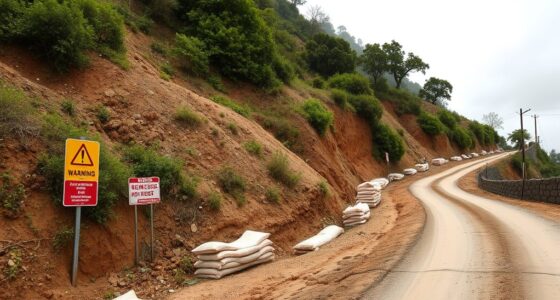
Earthquake science shows that plate tectonics cause the shifts along fault lines, releasing energy that leads to quakes. As plates move, stress builds up until it suddenly releases, causing seismic waves detectable worldwide. Studying these waves helps you understand where and how earthquakes might happen, informing risk assessment and urban planning. By exploring more, you’ll discover how seismic data and fault mapping improve safety strategies and reduce earthquake danger in vulnerable areas.

Get emergency and outdoor gear delivered free with Prime
- Fast, free delivery on millions of items
- Prime Video, Amazon Music and more included
- Member-only deals all year
Key Takeaways
- Plate tectonics explain earthquake causes through fault movements and stress accumulation along boundaries.
- Seismic wave analysis reveals fault types, epicenters, and magnitudes, aiding risk assessment.
- Fault line mapping identifies active zones and stress hotspots critical for urban planning and hazard mitigation.
- Advances in seismic technology and AI improve detection speed, enabling quicker response and better risk prediction.
- Combining seismic data with geological surveys enhances understanding of earthquake patterns and informs risk management strategies.

Have you ever wondered what causes earthquakes and how scientists study these powerful natural events? When tectonic plates shift, they release energy that travels through the Earth’s crust, generating seismic waves. To understand these events better, scientists rely heavily on seismic wave analysis, which involves examining how seismic waves move through the Earth’s interior. By studying the speed, direction, and intensity of these waves, researchers can pinpoint where an earthquake originated and how it propagated. This process helps uncover the underlying fault structures responsible for seismic activity. Fault line mapping plays a essential role in this effort, allowing scientists to identify specific zones where stress has built up and where future quakes might occur. Using detailed maps of fault lines, researchers can assess regions that are most at risk, providing critical information for disaster preparedness and urban planning.
Seismic wave analysis is a sophisticated technique that involves deploying seismometers worldwide. When an earthquake strikes, these sensitive instruments record the seismic waves that ripple through the Earth. By analyzing the data from multiple seismometers, scientists can determine the earthquake’s epicenter, depth, and magnitude with increasing precision. This analysis also reveals the nature of the fault movement—whether it’s a strike-slip, thrust, or normal fault—and helps to understand the mechanics behind the quake. Over time, this data accumulates into a detailed picture of seismic activity along various fault lines, helping to identify patterns and potential triggers for future earthquakes. Additionally, advances in AI Security have improved the accuracy and speed of seismic data interpretation, enabling more rapid responses to emerging risks.
Fault line mapping complements seismic wave analysis by providing a visual representation of where stress tends to concentrate. These maps are created using geological surveys, satellite imagery, and historical data on past earthquakes. They show the locations of active faults and highlight areas where stress is accumulating, indicating spots more prone to rupture. When combined with seismic wave analysis, fault line mapping allows scientists to refine their models of earthquake risk, making predictions more reliable. This integrated approach is essential for urban development, especially in densely populated areas near active fault zones, where knowing fault locations can save lives.
As an affiliate, we earn on qualifying purchases.
Frequently Asked Questions
How Do Scientists Predict the Exact Timing of Earthquakes?
You can’t predict the exact timing of earthquakes because they’re part of the seismic cycle, which varies widely. Scientists study fault slip rates and past activity to estimate when stress might build enough for a quake, but they can’t pinpoint the precise moment. Instead, they focus on evaluating the likelihood of future events based on fault behavior, understanding that earthquakes happen when accumulated stress exceeds fault strength.
What Are the Latest Technological Advancements in Earthquake Early Warning Systems?
Like a watchful guardian, recent advancements in earthquake early warning systems harness seismic sensors and real-time monitoring to detect shaking moments before they hit. These innovations enable quicker alerts, giving you precious seconds to seek safety. Cutting-edge technology now integrates AI algorithms for better prediction accuracy and faster data analysis. This progress helps communities prepare more effectively and potentially save lives when the earth trembles unexpectedly.
How Do Different Types of Plate Boundaries Influence Earthquake Severity?
You’ll notice that fault types, such as transform, divergent, and convergent boundaries, greatly influence earthquake severity. Transform faults often produce strike-slip earthquakes with moderate to high seismic activity, while convergent boundaries can generate the most powerful quakes due to intense seismic activity from subduction zones. Divergent boundaries typically cause less severe earthquakes, although they still contribute to seismic activity. Understanding fault types helps predict the potential strength and impact of earthquakes in different regions.
Can Human Activities Trigger Significant Earthquakes?
Yes, human activities can trigger significant earthquakes through induced seismicity. When you engage in activities like mining, reservoir-induced seismicity from large dams, geothermal energy extraction, or injecting fluids into the ground, you alter subsurface pressures and stresses. These changes can cause faults to slip unexpectedly, leading to earthquakes. While usually smaller than natural quakes, some induced events have been powerful enough to cause damage and pose risks to communities.
What Are the Most Effective Community Preparedness Strategies for Earthquakes?
You can effectively prepare for earthquakes by participating in community drills, which help you practice safety procedures and stay calm during a quake. Keep emergency kits in accessible locations, stocked with essentials like water, food, medications, and first aid supplies. Educate yourself and your neighbors about safe spots and evacuation routes. Regularly reviewing and practicing these strategies fosters resilience and ensures everyone knows what to do when an earthquake strikes.
Conclusion
You now understand how plate tectonics shape earthquakes, how stress builds until it’s released, and how risk varies with location. You see the patterns beneath your feet, the forces that move the Earth’s crust, and the importance of preparedness. With this knowledge, you can recognize the signs, assess the dangers, and take action. By understanding the science, you empower yourself to stay informed, stay safe, and adapt to a world constantly in motion.
Fall Picks
fall essentials
As an affiliate, we earn on qualifying purchases.