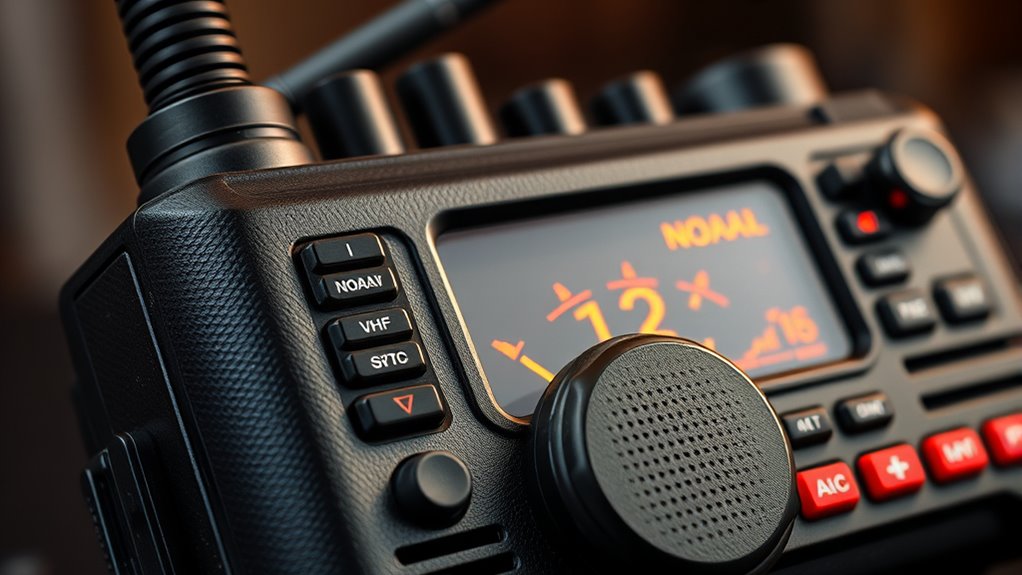
Emergency radios come with buttons that control power, volume, channels, and push-to-talk functions, making it easy to stay connected during emergencies. NOAA radios provide weather alerts and warnings, often with a scan button to cycle through channels automatically. VHF radios let you communicate on specific frequencies for short or medium-range contact. Knowing what each button does helps you operate your device confidently—continue discovering how these features can keep you safe and informed in crises.
Key Takeaways
- NOAA radios receive weather alerts, warnings, and updates, often featuring automatic scanning and solar or hand-crank power options.
- VHF radios operate on specific frequencies for short to medium-range emergency communication, ideal for remote or outdoor areas.
- Common radio buttons include power, volume, channel selector, and push-to-talk (PTT), each essential for device operation.
- Understanding button functions enables quick, effective use of emergency radios during stressful situations.
- Regularly maintaining and practicing with your radio ensures readiness and reliable communication during emergencies.
Have you ever wondered how to stay safe during a disaster when power and communication lines go down? One of the best tools you can have on hand is an emergency radio. These devices are designed to keep you connected to essential information even when traditional channels are offline. Understanding the different types, especially NOAA radios and VHF radios, along with what their buttons do, can make a big difference in your preparedness.
NOAA radios are a staple for emergency communication. They pick up broadcasts from the National Oceanic and Atmospheric Administration, which provide timely weather alerts, warnings, and updates. These radios are often equipped with NOAA weather scan feature, so they automatically cycle through various channels to alert you about severe weather events, hurricanes, or other hazards. When disaster strikes, having a NOAA radio means you won’t miss critical alerts telling you to seek shelter, evacuate, or take other safety measures. Many NOAA radios also include features like a hand-crank or solar charging, so you can power them without batteries, which is especially useful during prolonged outages.
NOAA radios provide critical weather alerts with features like NOAA scan and solar charging during outages.
VHF radios, on the other hand, are versatile and widely used by emergency responders and hobbyists alike. They operate on specific frequencies that can cover short to medium distances, making them ideal for communicating with rescue teams or other nearby sources. If you’re in a remote area, a VHF radio allows you to reach out for help or coordinate with others in your community. These radios often have multiple channels, which you can switch between depending on your needs. The buttons on a VHF radio typically include power, volume, channel selector, and sometimes a push-to-talk (PTT) button. The PTT button is essential because it allows you to transmit your voice when pressed, so you need to familiarize yourself with its location and function to avoid accidental transmissions.
Understanding what these buttons do is fundamental for effective operation. The power button turns the device on or off. The volume control adjusts the sound level, so you can hear alerts clearly without distortion. The channel selector lets you choose different frequencies, which is important if you need to switch between weather alerts and communication channels. The PTT button, usually located on the side or front, is what you press to speak. Releasing it allows others to reply. Some models also include additional buttons for scanning channels or locking settings to prevent accidental changes. Additionally, choosing a device with user-friendly controls can greatly improve your ability to operate it confidently during stressful situations.
In an emergency, your goal is to receive alerts and communicate efficiently. Knowing how to operate your emergency radio, what each button does, and the differences between NOAA and VHF radios puts you in a stronger position to stay safe. Keep your devices charged and within reach, and practice using them so that, when disaster strikes, you can operate them instinctively. These radios are indispensable tools that help you stay informed and connected when it matters most.

Anker SOLIX C1000 Gen 2 Portable Power Station, 2,000W (Peak 3,000W) Solar Generator, Full Charge in 49 Min, 1,024Wh LiFePO4 Battery for Home Backup, Power Outages, and Camping (Optional Solar Panel)
49 Min UltraFast Recharging: With upgraded HyperFlash tech, fully recharge at 1,600W—for outage prepping, camping trips, or tailgating...
As an affiliate, we earn on qualifying purchases.
Frequently Asked Questions
Can Emergency Radios Work Without Batteries?
Emergency radios generally need batteries to operate, especially portable models. Without power, they won’t function unless they have a hand-crank or solar panel. Some radios, like certain NOAA models, include a crank or solar option that lets you generate power manually or from sunlight. So, if your radio only relies on batteries, it won’t work without them. Consider a model with alternative power sources for reliable emergency use.
How Long Do Emergency Radio Batteries Typically Last?
Your emergency radio batteries usually last between 8 to 24 hours of continuous use, depending on the model and features. You might find it surprising how quickly power drains during critical moments, so it’s wise to keep spare batteries handy. Remember, a well-maintained radio can be your lifeline. By regularly checking and replacing batteries, you guarantee it’s ready when you need it most, turning preparedness into peace of mind.
Are NOAA Weather Alerts Available Internationally?
Noaa weather alerts are primarily available within the United States and its territories. If you’re outside this region, you might not receive these alerts directly. However, some international radios can pick up similar weather alerts from other countries or use global alert systems. Check your radio’s capabilities and regional broadcasting options to guarantee you stay informed about weather emergencies wherever you are.
What Is the Range of VHF Emergency Radios?
VHF emergency radios typically have a range of 2 to 20 miles, depending on terrain and obstacles. In open water or flat terrain, you might reach up to 20 miles, but in urban environments or hilly areas, expect a shorter range. To maximize communication, guarantee your antenna is in good condition and operate on the correct frequency. Keep in mind that weather and interference can also affect your radio’s effective distance.
How Do I Properly Store My Emergency Radio?
You should store your emergency radio in a cool, dry place, away from direct sunlight and extreme temperatures. Did you know that batteries can lose up to 50% of their capacity if stored improperly? To keep it ready, remove the batteries if you’re not using it for long periods, and periodically check for any corrosion or damage. Keep it in an accessible spot so you’re prepared when emergencies arise.

Retevis RT95 Dual Band Mobile Radio, Long Range Ham Radio with Antenna, 180 Degree Rotatable LCD Display, Mic Gain, Chirp, DTMF, 2m 70cm Mini Mobile Transceiver for RV Camping
Mini mobile two way radio; 1.54"D x 4.88"W x 6.42"H; easy to install on trucks; jeeps; RVs and...
As an affiliate, we earn on qualifying purchases.
Conclusion
Now that you understand how NOAA, VHF, and their buttons work, you’re better prepared for emergencies. Imagine the calm confidence you’ll feel, knowing you’re connected when it matters most. Unlike everyday gadgets that fade into the background, these radios become your lifeline in chaos. With just a few familiar controls, you can navigate storms or other crises. Stay informed, stay safe—because in emergencies, being prepared makes all the difference.

AnyTone AT-778UVII Transceiver Mobile Radio Dual Band 25W VHF/UHF VOX Vehicle Car Radio w/Cable
1.Upgrade AT-778UV Mobile Transceiver Radio, VOX Function, Two Mode for different operation requirement Distribute buttons reasonably, Convenient for...
As an affiliate, we earn on qualifying purchases.

Radioddity DB50 Dual Band Mobile Radio Transceiver, UHF VHF 50W High Power Amateur Ham Radio, Multi-Band Receiver with Detachable Front Panel, Programming Cable, CTCSS/DCS, Chirp Programmable
50W High Power: With the 50W output power, it ensures long-distance transmission for clear and reliable communication over...
As an affiliate, we earn on qualifying purchases.