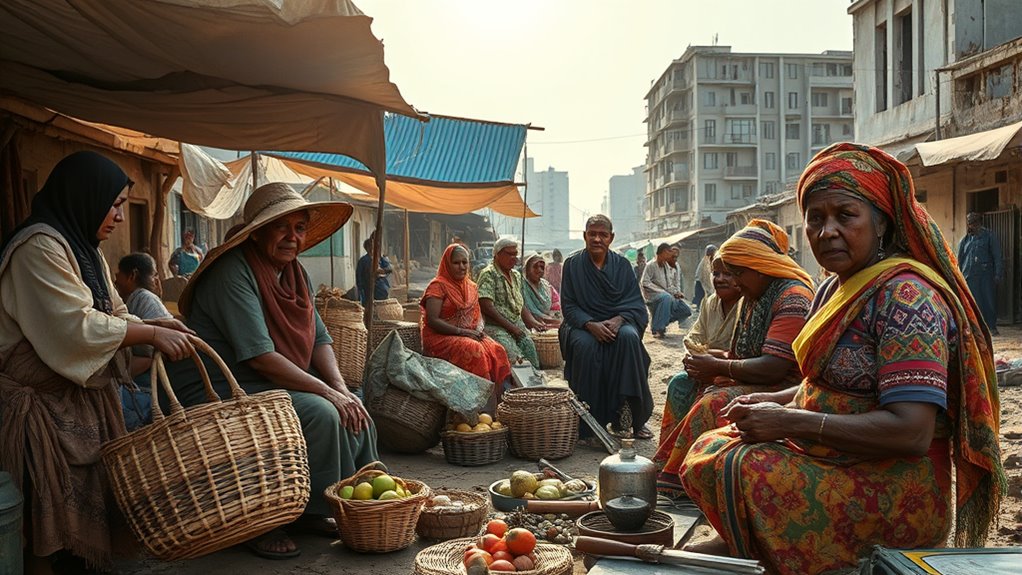
In post-disaster economies, you often see communities relying heavily on bartering and informal trade networks when markets collapse and official currencies lose value. People exchange goods like food, clothing, and tools directly, building trust and strengthening social bonds. These markets are flexible, quick to adapt, and sometimes introduce local currencies or vouchers to stabilize trade. If you want to understand how these resilient systems function and support community survival, there’s more to uncover.
Key Takeaways
- Informal markets emerge rapidly post-disaster, facilitating essential trade when official currency systems collapse.
- Bartering becomes the primary exchange method due to currency instability or unavailability.
- These markets strengthen community bonds and foster cooperation amid shortages and economic disruptions.
- Local currencies or vouchers are often introduced temporarily to stabilize trade and enhance trust.
- Challenges include unstandardized pricing and quality verification, prompting adaptive strategies like reputation systems.
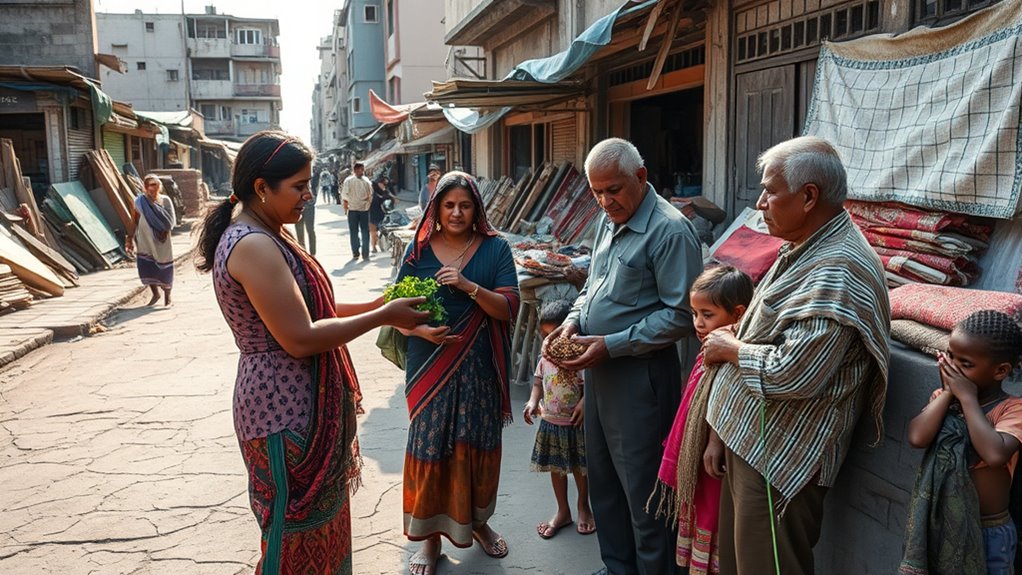
After a disaster strikes, traditional markets often collapse, leaving communities to rely on bartering and direct trade to meet their basic needs. In these situations, the local currency may become worthless or difficult to access, forcing you to find alternative ways to exchange goods and services. Informal markets spring up quickly, serving as essential hubs where residents trade items directly without the need for banks or official currency systems. These markets are usually unregulated, flexible, and responsive to immediate community needs, making them indispensable during times of crisis.
In crises, informal markets and barter become vital for community survival and resilience.
You’ll notice that in these informal markets, people trade everything from food and clothing to tools and medicines. Since the local currency might be unstable or unavailable, barter becomes the default method of exchange. You might trade a bag of rice for a pair of shoes or exchange your labor for fresh vegetables. This system relies on mutual trust and familiarity, which helps communities sustain themselves when official financial institutions are inaccessible. It’s a practical approach, especially when inflation or hyperinflation renders currency almost useless.
In these environments, bartering is more than just a means of trade; it’s a way to rebuild social bonds. As you participate in informal markets, you often develop relationships with neighbors and other community members, fostering cooperation and collective resilience. These connections are essential, as they help you navigate shortages and uncertainties. Since formal financial systems are down, you learn to value resourcefulness and adaptability, negotiating trades that meet your immediate needs while also supporting others. Building local knowledge about goods quality and trustworthy trading partners becomes crucial for successful exchanges.
However, trading in informal markets isn’t without challenges. You might face issues like lack of standardized pricing or difficulties verifying the quality of goods. Still, these markets tend to adapt quickly, with community members establishing informal agreements or reputation systems to facilitate fair exchanges. Over time, some communities introduce small, community-backed local currencies or vouchers to stabilize trade and motivate participation. These local currencies, often issued by community groups, act as a temporary store of value, enabling smoother transactions within the informal market ecosystem.
Frequently Asked Questions
How Do Post-Disaster Economies Prevent Barter-Based Fraud?
You can prevent barter-based fraud in post-disaster economies by strengthening community trust and implementing transaction validation methods. By fostering transparency and encouraging open communication, you reduce the risk of deception. Using simple verification techniques, like community witnesses or digital records, helps confirm trades. These measures build confidence among participants, ensuring fair exchanges and reducing the chances of fraud in barter systems.
What Role Do Digital Currencies Play in Post-Disaster Trade?
Digital currencies drive disaster recovery by democratizing direct, decentralized exchanges. You adopt cryptocurrencies confidently, knowing blockchain verification guarantees transparency and trust. This technology simplifies secure, swift transactions, circumventing traditional systems’ struggles. As digital currencies become more prevalent, they promote prompt, practical trade, powering post-disaster economies with precision and protection. Your participation in cryptocurrency adoption helps stabilize and strengthen communities, fostering resilience amid chaos.
How Do Barter Systems Adapt to Large-Scale Disasters?
You adapt barter systems through resilience and flexibility, ensuring they meet urgent needs. You might swap goods directly or develop adaptive trade strategies, like establishing local exchange networks or using community currencies. These methods help maintain economic activity during crises, allowing you to exchange essentials efficiently. By staying creative and responsive, you strengthen your community’s resilience, making your barter system more effective even in large-scale disaster situations.
What Are the Legal Implications of Barter Transactions Post-Disaster?
You need to understand that barter transactions after a disaster can face legal challenges, especially around legal compliance and contract enforcement. Without formal currency, establishing clear agreements becomes tricky, so make certain both parties agree on the terms and document the exchange. This helps protect your rights and makes enforcement easier. Staying aware of local laws and maintaining transparent records can prevent disputes and support legal compliance in your barter dealings.
How Can Communities Establish Trusted Barter Networks Quickly?
You can establish trusted barter networks quickly by fostering community trust through transparent communication and clear agreements. Encourage resource sharing by organizing local meetups or digital platforms where neighbors can list available goods and needs. Establishing community-led rules and involving respected leaders helps build credibility. Regular interactions and shared goals strengthen bonds, making the network more reliable and efficient for everyone involved.
Conclusion
In the aftermath of disaster, bartering becomes your lifeline—a fragile bridge over turbulent waters. As currency falters, you find strength in resourcefulness, weaving a tapestry of survival from what’s available. Remember, trade isn’t just exchange; it’s a dance of resilience, where each barter rebuilds hope’s fragile flame. In this chaos, your ingenuity sparks a new dawn, proving that even in ruin, human spirit can forge paths toward renewal and light.