For most households, I’d start with the Midland WR400: its SAME county alerts and battery backup make it a strong choice for a fixed home listening station. The Midland ER310PRO suits buyers who want a portable radio with Bluetooth, while the Midland WR120B offers a simpler route to location-specific alerts. The main choice is between a desk-style radio built to receive alerts reliably and a portable model with crank, solar, or phone-charging features. Those extra power options can help during an outage, but they do not replace spare batteries or a charged backup source. Read on for how the 14 radios differ and which tradeoffs matter most.

Get emergency and outdoor gear delivered free with Prime
- Fast, free delivery on millions of items
- Prime Video, Amazon Music and more included
- Member-only deals all year
Key Takeaways
- Alert targeting separates home radios from portable ones: The Midland WR400 and WR120B list SAME county alerts, a useful distinction for households that want alerts tailored to their area rather than a general weather-band receiver.
- Portable power features vary widely: Several models list 12,000mAh batteries plus hand-crank and solar charging, while the FosPower A1 lists a 7400mWh power bank; those figures and charging methods are not directly interchangeable.
- The Midland choices serve different jobs: The WR400 and WR120B are fixed-location alert radios, while the ER10VP and ER310PRO are portable options with flashlight or other field-use features.
- Extra features can add complexity: Bluetooth, color displays, dual alarms, and USB charging may help with everyday use, but buyers focused on emergency alerts should put reception, alert setup, and backup power first.
- Not every radio is a full household charging station: The compact Midland ER10VP emphasizes a flashlight and SOS strobe, while radios advertising larger batteries and multiple charging methods are better suited to broader outage support.
| Emergency Weather Radio with 12,000mAh Battery and Solar Panel | 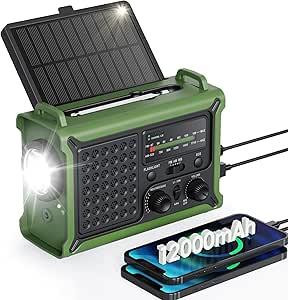 | Best Overall for Off-Grid Readiness | Battery capacity: 12,000mAh | Radio bands: AM, FM, and 7 NOAA bands | Charging options: Built-in battery, USB-C, solar panel, hand crank, or 3 AAA batteries | VIEW LATEST PRICE | See Our Full Breakdown |
| Midland ER10VP AM/FM Weather Radio with Flashlight and SOS Strobe |  | Best Compact, Simple Emergency Radio | Radio bands: AM/FM | Power source: 3 AA batteries, included | Emergency lighting: Built-in flashlight and SOS strobe | VIEW LATEST PRICE | See Our Full Breakdown |
| Emergency Radio with Hand Crank, Solar Charging, NOAA Weather Band, and 12,000mAh Battery |  | Best for Clear Reception and Outdoor Use | Battery capacity: 12,000mAh | Radio bands: NOAA weather band, AM, and FM | Charging options: Rechargeable battery, hand crank, solar, and USB-C | VIEW LATEST PRICE | See Our Full Breakdown |
| Supersonic SC-1078ERN Guardian Multi-Powered Emergency Radio |  | Best for Built-In Lantern Lighting | Radio bands: AM, FM, and NOAA weather | NOAA frequency range: 162.400–162.550 MHz | Listed rechargeable battery: 4,000mAh; product information also lists one CR5 battery | VIEW LATEST PRICE | See Our Full Breakdown |
| NOAA Weather Radio with S.A.M.E. County Alerts, 12,000mAh Battery, Hand Crank and Solar Charging |  | Best for County-Specific Weather Alerts | Weather bands: 7 NOAA channels | Radio bands: NOAA weather and FM; AM not supported | S.A.M.E. county capacity: Up to 25 counties | VIEW LATEST PRICE | See Our Full Breakdown |
| Midland ER310PRO Portable Emergency Weather Radio with Bluetooth |  | Best for Phone Backup and Signaling | Radio bands: AM, FM, and NOAA weather | Battery capacity: 10,000 mAh | Power sources: Solar panel, hand crank, internal battery | VIEW LATEST PRICE | See Our Full Breakdown |
| Raynic Portable NOAA Weather Radio with FM, Bluetooth, Color Display, and Dual Alarms |  | Best for Everyday Listening | Radio bands: FM and NOAA Weather Band; AM not supported | Battery capacity: 3,000 mAh | Charging interface: USB Type-C | VIEW LATEST PRICE | See Our Full Breakdown |
| 12000mAh Emergency NOAA Weather Radio with Hand Crank, Solar Charging, Flashlights, and SOS Alarm |  | Best for High-Capacity Lighting | Battery capacity: 12,000 mAh | Power options: USB-C, solar panel, hand crank, or 3 AAA batteries | Radio bands: AM, FM, and 7 NOAA weather channels | VIEW LATEST PRICE | See Our Full Breakdown |
| NOAA Emergency Weather Radio with 12,000mAh Battery, Hand Crank and Solar Charging | 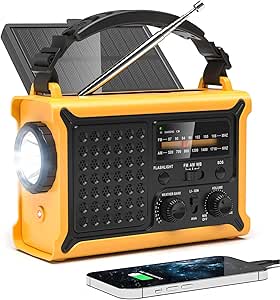 | Best for Detailed NOAA Tuning | Radio bands: 7 NOAA weather channels, AM, and FM | NOAA frequencies: 162.400, 162.425, 162.450, 162.475, 162.500, 162.525, and 162.550 MHz | Battery capacity: 12,000 mAh | VIEW LATEST PRICE | See Our Full Breakdown |
| ASHATA Emergency Solar Hand-Crank Weather Radio with AM/FM, NOAA Alerts, 3-LED Flashlight, and USB Charging |  | Best Compact Kit Backup | Radio bands: AM, FM, and NOAA weather | Charging methods: Solar, hand crank, and USB input | Power source: Built-in battery and solar | VIEW LATEST PRICE | See Our Full Breakdown |
| Solar Hand Crank AM/FM/NOAA Emergency Radio with SOS Alarm, Yellow |  | Best Multi-Power Handheld | Radio bands: AM, FM, NOAA weather band | NOAA frequencies: 162.400–162.550 MHz; 7 frequencies | Battery capacity: 2500mAh | VIEW LATEST PRICE | See Our Full Breakdown |
| Midland WR400 Deluxe NOAA Weather Radio with SAME Alerts and Battery Backup |  | Best for Detailed Home Alerts | Radio bands: AM, FM, NOAA Weather Radio | NOAA weather channels: 10 | SAME county programming: Up to 25 counties | VIEW LATEST PRICE | See Our Full Breakdown |
| Midland WR120B NOAA Weather Radio with SAME Alerts and Battery Backup |  | Best Simple Local-Alert Desk Radio | Radio bands: NOAA weather channels | Alert filtering: County-level SAME | Power: AC power and battery backup | VIEW LATEST PRICE | See Our Full Breakdown |
| FosPower A1 NOAA Emergency Weather Radio with Solar and Hand-Crank Charging, 7400mWh Power Bank, Orange |  | Best Compact Water-Resistant Pick | Radio bands: AM, FM, weather band | Power bank capacity: 7400mWh (2000mAh) | Power sources: Solar, hand crank, AAA batteries, rechargeable battery | VIEW LATEST PRICE | See Our Full Breakdown |
| emergency weather radio | Radio bands | Dimensions | Battery capacity |
|---|---|---|---|
| Emergency Weather Radio with 1 | AM, FM, and 7 NOAA bands | — | 12,000mAh |
| Midland ER10VP AM/FM Weather R | AM/FM | Listed as 1 × 1 × 1 in | — |
| Emergency Radio with Hand Cran | NOAA weather band, AM, and FM | — | 12,000mAh |
| Supersonic SC-1078ERN Guardian | AM, FM, and NOAA weather | 6.02 × 1.85 × 3.03 in | — |
| NOAA Weather Radio with S.A.M. | NOAA weather and FM; AM not supported | — | 12,000mAh |
| Midland ER310PRO Portable Emer | AM, FM, and NOAA weather | 8.1 × 2.8 × 3.4 inches | 10,000 mAh |
| Raynic Portable NOAA Weather R | FM and NOAA Weather Band; AM not supported | 6.65 × 1.85 × 3.62 inches | 3,000 mAh |
| 12000mAh Emergency NOAA Weathe | AM, FM, and 7 NOAA weather channels | 4.7 × 2.9 × 6.8 inches | 12,000 mAh |
| NOAA Emergency Weather Radio w | 7 NOAA weather channels, AM, and FM | 4.7 × 2.9 × 6.8 inches | 12,000 mAh |
| ASHATA Emergency Solar Hand-Cr | AM, FM, and NOAA weather | 5.04 × 5.04 × 5.04 inches as listed | — |
| Solar Hand Crank AM/FM/NOAA Em | AM, FM, NOAA weather band | 7.87 x 3.93 x 1.96 in | 2500mAh |
| Midland WR400 Deluxe NOAA Weat | AM, FM, NOAA Weather Radio | — | — |
| Midland WR120B NOAA Weather Ra | NOAA weather channels | 2 x 5.3 x 6.1 in | — |
| FosPower A1 NOAA Emergency Wea | AM, FM, weather band | — | — |
More Details on Our Top Picks
Emergency Weather Radio with 12,000mAh Battery and Solar Panel
This is my strongest all-around pick for buyers who want one emergency radio to cover alerts, lighting, and basic phone backup. Its 12,000mAh battery and five power options give it more ways to stay useful during a prolonged outage than the Midland ER10VP, which runs on three AA batteries and has no solar or hand-crank charging. The AM/FM and seven NOAA bands add everyday listening and weather access, while the adjustable flashlight, reading lamp, and SOS alarm make it more than a receiver. Its IPX6 water resistance suits rainy outdoor use, though it is not a substitute for a sealed waterproof device. The tradeoff is that solar and crank charging are slower backup methods, and using AAA power requires three separate batteries.
Pros:- 12,000mAh battery can run the radio and provide backup USB power for compatible devices.
- Five power options include USB-C, solar, hand crank, and three AAA batteries.
- AM/FM and seven NOAA bands cover weather broadcasts as well as regular radio.
- IPX6 water resistance, flashlight, reading lamp, and SOS alarm suit emergency and outdoor use.
Cons:- Solar and hand-crank charging depend on sunlight or sustained manual effort.
- AAA backup requires three batteries, which are an additional power supply to keep on hand.
- No S.A.M.E. county-specific alert capability is listed.
Best for: Households and campers who want NOAA alerts, multiple backup power methods, emergency lighting, and occasional phone charging in one unit.
Not ideal for: Buyers who want county-specific alert filtering or a lightweight pocket radio; this model lacks listed S.A.M.E. alert support and weighs more than a compact battery-only option.
- Battery capacity:12,000mAh
- Radio bands:AM, FM, and 7 NOAA bands
- Charging options:Built-in battery, USB-C, solar panel, hand crank, or 3 AAA batteries
- Solar panel area:8,500mm²
- Lighting:5W adjustable-beam flashlight and 12-LED reading lamp
- Water resistance:IPX6
- Alerts:NOAA alert alarm and SOS alarm
- Phone charging:USB output for compatible devices
Our verdict“Choose this for a versatile home or outdoor emergency kit when battery capacity and several backup charging methods matter more than county-specific alerts.”
Midland ER10VP AM/FM Weather Radio with Flashlight and SOS Strobe
The Midland ER10VP is the simplest grab-and-go choice here: it pairs AM/FM listening with a flashlight and SOS strobe in a lightweight design, without the larger battery and charging features of the 12,000mAh radios. Three AA batteries are included, so it can be ready without setting up solar charging or learning a hand-crank routine. A headphone jack helps with private listening, and the built-in AM antenna adds convenience for ordinary radio use. That simplicity comes with a clear limitation for a weather-focused kit: the listed bands are AM and FM only, not NOAA weather channels. Unlike the Supersonic SC-1078ERN, it also has no listed lantern or multiple charging methods, and it is not water resistant. I’d treat it as a compact secondary radio, not the main severe-weather alert source.
Pros:- Compact, lightweight design is easier to carry than the larger 12,000mAh emergency radios.
- Three AA batteries are included for straightforward battery-powered operation.
- Built-in flashlight and SOS strobe combine basic illumination and signaling.
- Headphone jack supports private listening.
Cons:- AM/FM-only reception means it does not provide NOAA weather broadcasts.
- Not water resistant, limiting use in rain or wet outdoor conditions.
- No solar, hand-crank, or rechargeable battery option is listed.
Best for: Drivers, walkers, or households seeking a small battery-powered AM/FM radio with a flashlight and signaling light for basic emergency use.
Not ideal for: Anyone buying specifically for NOAA weather alerts, rain-exposed use, or extended outages; it has no listed NOAA band, is not water resistant, and relies on AA batteries.
- Radio bands:AM/FM
- Power source:3 AA batteries, included
- Emergency lighting:Built-in flashlight and SOS strobe
- Connectivity:Headphone jack
- Display:LCD or LED
- Water resistance:Not water resistant
- Weight:1.6 oz
- Dimensions:Listed as 1 × 1 × 1 in
Our verdict“Pick the ER10VP as a small, simple AM/FM backup, but choose a NOAA-capable model such as the Emergency Weather Radio with 12,000mAh Battery for weather alerts.”
Emergency Radio with Hand Crank, Solar Charging, NOAA Weather Band, and 12,000mAh Battery
This model earns a distinct place for buyers who want a substantial backup battery and a stated reception aid: DSP processing is intended to help provide clearer radio reception. It covers NOAA, AM, and FM, like the Emergency Weather Radio with 12,000mAh Battery, and shares that model’s 12,000mAh capacity, solar panel area, and IPX6 water resistance. Its listed 120dB SOS alarm and USB phone output add practical emergency functions, while the 57mm speaker gives it a defined audio specification. Compared with the Midland ER10VP, this is far more prepared for off-grid weather use, but it is also a much larger, heavier device at 1.6 pounds. NOAA broadcasts still require the radio to be on and tuned to a NOAA station, so the listed details do not describe a standby alert function.
Pros:- 12,000mAh battery supports radio operation and backup USB charging for phones or small devices.
- Solar, hand-crank, and USB-C charging provide alternatives when mains power is unavailable.
- NOAA, AM, and FM reception with stated DSP processing offers broad listening options.
- IPX6 water resistance, flashlight, reading lamp, and SOS alarm suit outdoor emergencies.
Cons:- At 1.6 pounds, it is less convenient to carry than the Midland ER10VP.
- NOAA broadcasts require the radio to be powered on and tuned to a NOAA station.
- Solar charging depends on available sunlight.
Best for: Campers and emergency-kit planners who want a rechargeable, water-resistant radio with NOAA, AM/FM reception and multiple ways to restore power.
Not ideal for: People seeking a pocketable radio or a clearly specified automatic alert receiver; it weighs 1.6 pounds and NOAA listening requires tuning to a station.
- Battery capacity:12,000mAh
- Radio bands:NOAA weather band, AM, and FM
- Charging options:Rechargeable battery, hand crank, solar, and USB-C
- Solar panel area:8,500mm²
- Water resistance:IPX6
- Lighting:5W LED flashlight and 12-LED reading lamp
- SOS alarm:120dB
- Dimensions and weight:6.81 × 2.91 × 4.76 in; 1.6 lb
- Phone charging:USB output for phones or small USB devices
Our verdict“Choose this model for a sturdy-feeling, multi-power outdoor kit where battery capacity and the stated DSP reception feature outweigh portability.”
Supersonic SC-1078ERN Guardian Multi-Powered Emergency Radio
The Supersonic SC-1078ERN is a sensible middle ground for someone who wants NOAA reception and useful lighting without carrying the 12,000mAh Emergency Weather Radio or the similarly sized B0F5PQJMK9. Its flashlight and lantern serve different jobs: one helps direct light, while the other can illuminate a nearby area. Solar, hand-crank, USB Type-C, and AAA options also give it more backup flexibility than the battery-only Midland ER10VP. The central tradeoff is capacity: its listed rechargeable battery is 4,000mAh, well below the 12,000mAh units, so I would not choose it primarily for extended phone charging. There is also conflicting battery information in the supplied specifications: the description states 4,000mAh, while product information lists one CR5 battery. Buyers should verify the power configuration before relying on it.
Pros:- Receives NOAA weather broadcasts as well as AM and FM.
- Flashlight and lantern offer both directed and area lighting.
- Solar, hand-crank, USB Type-C, and AAA power options add flexibility.
- SOS alarm with flashing light and a 3.5mm headphone jack support signaling and private listening.
Cons:- The stated 4,000mAh capacity is much lower than the 12,000mAh models in this roundup.
- Supplied battery information conflicts: the description says 4,000mAh rechargeable battery, while product information lists one CR5 battery.
- The three AAA batteries are not included.
Best for: Households wanting a compact NOAA-capable emergency radio with both a flashlight and area lantern, plus several backup power choices.
Not ideal for: Buyers who need a clearly documented high-capacity power bank or dependable battery details; its listed capacity is lower and the supplied battery information conflicts.
- Radio bands:AM, FM, and NOAA weather
- NOAA frequency range:162.400–162.550 MHz
- Listed rechargeable battery:4,000mAh; product information also lists one CR5 battery
- Power options:Rechargeable battery, solar, hand crank, USB Type-C, or 3 AAA batteries (not included)
- Display:LED
- Lighting and alarm:LED flashlight, lantern, and SOS alarm with flashing light
- Audio jack:3.5mm headphone jack
- Dimensions:6.02 × 1.85 × 3.03 in
Our verdict“Choose the SC-1078ERN if its lantern and flexible power options fit your kit, but verify its battery configuration before depending on it for backup power.”
NOAA Weather Radio with S.A.M.E. County Alerts, 12,000mAh Battery, Hand Crank and Solar Charging
This is the alert-focused choice in this group. Its S.A.M.E. support for up to 25 counties can narrow alerts to selected areas, a more targeted setup than the general NOAA alert features listed for the Emergency Weather Radio with 12,000mAh Battery. The color screen separates voice, display, and tone alert modes, while seven NOAA channels, 86 alert events, and up to 40 FM presets make it the most information-rich option here. Its 12,000mAh battery, solar, hand crank, USB-C input, and AAA backup also suit outages. The key compromise is that it has no AM reception, unlike the other multi-band radios in this batch. It is also a heavier, feature-dense choice than the Midland ER10VP, and the supplied guidance says to fully charge it before first use.
Pros:- S.A.M.E. alerts can be configured for up to 25 counties and 86 alert events.
- Seven NOAA channels and voice, display, and tone alert modes support detailed weather monitoring.
- 12,000mAh battery and five power options support use during outages.
- Color screen, flashlight, reading lamp, SOS siren, and USB-A and USB-C outputs add emergency utility.
Cons:- Does not support AM radio.
- At 1.7 pounds, it is heavier than the compact Midland ER10VP.
- Should be fully charged before first use.
Best for: People in areas prone to localized severe weather who want county-selective NOAA alerts, multiple alert modes, and substantial backup power.
Not ideal for: Listeners who need AM radio or want a minimal, lightweight device; this model omits AM and weighs 1.7 pounds.
- Weather bands:7 NOAA channels
- Radio bands:NOAA weather and FM; AM not supported
- S.A.M.E. county capacity:Up to 25 counties
- Alert events and modes:86 events; voice, display, and tone
- Battery capacity:12,000mAh
- Power options:Rechargeable battery, solar, hand crank, USB-C input, or 3 AAA batteries
- Display:2.4-inch color screen
- Charging outputs:USB-A and USB-C
- Dimensions and weight:6.8 × 2.9 × 4.7 in; 1.7 lb
Our verdict“Choose this radio if county-specific alerts matter more than AM reception or compact size.”
Midland ER310PRO Portable Emergency Weather Radio with Bluetooth
The ER310PRO suits buyers who want a weather radio to do more than receive alerts: its 10,000 mAh battery can also provide emergency power for a phone, while the SOS beacon and rescue siren add signaling options. It scans seven NOAA channels and locks onto the strongest signal, a useful shortcut when setting up the radio. Compared with the larger-capacity 12,000mAh emergency radios in this roundup, it gives up some stated battery capacity but adds Bluetooth audio and a more compact listed size. Solar and hand-crank charging offer alternatives when outlets are unavailable, though solar depends on direct sun and cranking is a backup rather than a substitute for a full recharge. Its plastic enclosure also calls for more care than a ruggedized design.
Pros:- Scans seven NOAA weather channels and locks onto the strongest signal.
- 10,000 mAh battery can charge external devices.
- Solar and hand-crank options provide backup charging paths.
- SOS flashlight beacon and rescue siren add emergency signaling.
Cons:- Plastic enclosure may be less durable than a rugged housing.
- Solar charging depends on access to direct sunlight.
- Does not match the stated 12,000 mAh capacity of two other radios in this group.
Best for: Preparedness buyers who want NOAA reception, phone charging, Bluetooth listening, and emergency signaling in one portable radio.
Not ideal for: People who need a highly rugged enclosure or expect solar charging to keep the radio fully powered in low-light conditions.
- Radio bands:AM, FM, and NOAA weather
- Battery capacity:10,000 mAh
- Power sources:Solar panel, hand crank, internal battery
- Weather reception:Scans 7 NOAA channels and locks onto the strongest signal
- Flashlight:130-lumen CREE LED with SOS Morse code beacon
- Additional signaling:Ultrasonic rescue dog siren
- Connectivity:Bluetooth
- Dimensions:8.1 × 2.8 × 3.4 inches
Our verdict“Choose the ER310PRO if phone backup and signaling matter more to you than the larger stated battery capacity of the 12,000mAh models.”
Raynic Portable NOAA Weather Radio with FM, Bluetooth, Color Display, and Dual Alarms
The Raynic is the everyday-listening pick: alongside NOAA weather broadcasts, it offers Bluetooth and microSD playback, stereo sound, a color screen, and dual alarms. Those features make it easier to keep in regular rotation than a radio built mainly around emergency lighting and hand-crank power. Compared with the Midland ER310PRO, it has a smaller 3,000 mAh battery and lacks AM reception, solar charging, and a hand crank. Its USB-C charging and clock make it a better fit for a bedside or desk than for an extended power outage without access to charging. The stated microSD playback time ranges from up to 10 hours at maximum volume to 18 hours at 50%, so louder use shortens listening time. The SOS alarm is useful, but this is not the strongest choice for off-grid power resilience.
Pros:- Receives FM and NOAA weather broadcasts.
- Bluetooth and microSD playback provide flexible audio options.
- USB-C charging, color display, clock, and dual alarms support everyday use.
- Stereo audio and six EQ modes offer more listening control than a basic alert radio.
Cons:- Does not support AM reception.
- 3,000 mAh capacity is smaller than the batteries in several other radios here.
- Playback time varies with volume and use, and the listed maximum-volume microSD time is up to 10 hours.
Best for: Listeners who want a compact bedside radio for NOAA broadcasts, FM, Bluetooth or microSD audio, and daily alarms.
Not ideal for: People preparing for long outages who need AM reception, hand-crank or solar charging, or a larger battery.
- Radio bands:FM and NOAA Weather Band; AM not supported
- Battery capacity:3,000 mAh
- Charging interface:USB Type-C
- Display:2.4-inch color display
- Audio playback:Bluetooth and microSD
- Playback time:Up to 10 hours at maximum volume or 18 hours at 50% volume for microSD playback
- Alarms:Dual alarms and SOS alarm
- Dimensions:6.65 × 1.85 × 3.62 inches
Our verdict“Pick the Raynic for everyday listening and bedside features, but choose a hand-crank model if outage endurance is your priority.”
12000mAh Emergency NOAA Weather Radio with Hand Crank, Solar Charging, Flashlights, and SOS Alarm
This radio is the strongest fit here for buyers who want a high-capacity emergency kit centerpiece with substantial lighting. Its 12,000 mAh battery, four power options, 300-lumen flashlight, and 250-lumen reading light cover more practical outage tasks than the compact ASHATA radio. It also receives AM, FM, and seven NOAA channels, with auxiliary and USB connectivity. The stated up to 60 hours of FM listening at 50% volume gives a useful reference point, though real runtime depends on use. A key limitation for alert-focused buyers: NOAA alerts require the radio to be on and tuned to a weather band, rather than relying on a separate standby alert function. The plastic body and missing wall adapter also temper its appeal; plan to supply a compatible USB-C adapter and do not treat solar or cranking as effortless primary charging.
Pros:- 12,000 mAh battery and four power options support flexible outage use.
- Receives AM, FM, and seven NOAA weather channels.
- 300-lumen flashlight and 250-lumen reading light serve different lighting needs.
- 115 dB SOS siren adds an audible emergency signal.
Cons:- NOAA alerts require the radio to be on and tuned to a weather band.
- Wall adapter is not included.
- Plastic enclosure may be less suited to rough handling.
Best for: Households building an outage kit that need a large stated battery, multiple charging options, and both task and area lighting.
Not ideal for: Buyers who need unattended NOAA alert standby or want a radio with a supplied wall adapter.
- Battery capacity:12,000 mAh
- Power options:USB-C, solar panel, hand crank, or 3 AAA batteries
- Radio bands:AM, FM, and 7 NOAA weather channels
- FM listening time:Up to 60 hours at 50% volume
- Flashlight:300 lumens; range up to 70 meters
- Reading light:250 lumens
- SOS siren:115 dB
- Dimensions:4.7 × 2.9 × 6.8 inches
Our verdict“Choose this model for battery capacity and versatile lighting, provided you are comfortable monitoring NOAA broadcasts with the radio tuned on.”
NOAA Emergency Weather Radio with 12,000mAh Battery, Hand Crank and Solar Charging
This model shares a familiar emergency-radio setup with the other 12,000mAh radio in this batch: AM/FM/NOAA reception, four power options, a 300-lumen flashlight, a reading light, and a 115 dB siren. Its clearest distinction is the more explicit frequency information, including all seven NOAA frequencies, which may appeal to buyers who want to know exactly what the radio receives. Compared with the Raynic, it is much better equipped for off-grid use, but it gives up that model’s color screen, dual alarms, and Bluetooth playback. NOAA alerts still require the radio to be on and tuned to the weather band, so this is not a substitute for a dedicated alert standby receiver. The solar panel and hand crank are backup sources, and the wall adapter is not included.
Pros:- Lists all seven NOAA frequencies alongside AM and FM reception.
- 12,000 mAh battery with USB-C, solar, hand-crank, and AAA power options.
- 300-lumen flashlight and 250-lumen reading light support outage tasks.
- 115 dB siren provides an audible signaling option.
Cons:- NOAA alerts require the radio to be on and tuned to a weather band.
- Wall adapter is not included.
- Solar and hand-crank charging are backup methods rather than convenient replacements for USB charging.
Best for: Preparedness-minded buyers who want AM/FM reception, the listed NOAA frequency set, and several backup power options.
Not ideal for: People who need automatic alert standby, everyday Bluetooth listening, or an included wall adapter.
- Radio bands:7 NOAA weather channels, AM, and FM
- NOAA frequencies:162.400, 162.425, 162.450, 162.475, 162.500, 162.525, and 162.550 MHz
- Battery capacity:12,000 mAh
- Power options:USB-C, solar panel, hand crank, or 3 AAA batteries
- USB-C input:5V/2A
- Lighting:300-lumen flashlight and 250-lumen reading light
- SOS siren:115 dB
- Dimensions:4.7 × 2.9 × 6.8 inches
Our verdict“Choose this radio if its clearly specified NOAA frequencies and flexible backup power matter more than the Raynic’s display and everyday audio features.”
ASHATA Emergency Solar Hand-Crank Weather Radio with AM/FM, NOAA Alerts, 3-LED Flashlight, and USB Charging
The ASHATA is a straightforward backup for a small emergency kit: it receives AM, FM, and NOAA broadcasts, includes a three-LED flashlight, and can draw power from its battery, solar charging, hand cranking, or USB input. At a listed 0.26 kg, it is lighter than the larger 12,000mAh radios, making it easier to pack alongside other essentials. The tradeoff is a thinner feature set: unlike the Midland ER310PRO, it has no listed Bluetooth, SOS beacon, or rescue siren, and unlike the high-capacity models, no battery capacity or listening runtime is supplied. Its USB output can provide emergency phone charging, but the description frames that as a backup function, not a dependable way to keep a phone topped up. The equal-sided listed dimensions are also unclear, so check the physical size before relying on a specific storage fit.
Pros:- Receives AM, FM, and NOAA weather broadcasts.
- Battery, solar, hand-crank, and USB power options offer flexibility.
- Three-LED flashlight provides basic built-in illumination.
- Listed weight is 0.26 kg, lighter than the larger 12,000mAh radios.
Cons:- No battery capacity or listening runtime is specified.
- USB phone charging is intended for emergency use, not regular charging.
- No SOS siren or beacon is listed, unlike the Midland ER310PRO.
Best for: Campers and kit builders who want a light, basic AM/FM/NOAA radio with several backup power methods and a small flashlight.
Not ideal for: Buyers who need a stated high-capacity battery, strong lighting, SOS signaling, or dependable phone charging.
- Radio bands:AM, FM, and NOAA weather
- Charging methods:Solar, hand crank, and USB input
- Power source:Built-in battery and solar
- Flashlight:3 LEDs
- LED lifespan:100,000 hours
- USB compatibility:Smartphone emergency charging
- Dimensions:5.04 × 5.04 × 5.04 inches as listed
- Weight:0.26 kg
Our verdict“Choose the ASHATA as a lightweight, basic kit radio, but select a higher-capacity model if phone charging, lighting, or signaling will be central to your plan.”
Solar Hand Crank AM/FM/NOAA Emergency Radio with SOS Alarm, Yellow
For a grab-and-go kit, I’d choose this radio for its four power options: solar, hand crank, Micro USB, and three AA batteries. Its 2,500mAh built-in battery adds another reserve, though charging results can vary with conditions, so I wouldn’t treat it as a guaranteed long-term phone power source. It covers AM, FM, and all seven NOAA frequencies, with a flashlight, reading light, USB output, and SOS alarm in one compact package. Compared with the desktop-focused Midland WR120B, this model is easier to carry outdoors but lacks county-level alert filtering. The tradeoff is versatility over targeted warnings: it suits travel and power outages, while buyers seeking a set-and-forget alert system for one area should choose the Midland instead.
Pros:- Solar, hand-crank, Micro USB, and three-AA power options provide flexibility during outages.
- Receives AM, FM, and seven NOAA weather frequencies.
- Combines a 1W flashlight, 2W reading light, USB output, and SOS alarm.
- Compact body and wrist strap suit travel and portable kits.
Cons:- Three AA batteries are not included in the listed package details.
- Battery performance and replenishment vary with charging conditions and use.
- No county-level SAME alert filtering is listed.
Best for: Campers and emergency-kit builders who want a portable radio with several ways to recharge and built-in lighting.
Not ideal for: People who need county-specific automatic alerts or dependable phone charging for extended outages; its listing does not specify SAME alert filtering, and charging output depends on conditions.
- Radio bands:AM, FM, NOAA weather band
- NOAA frequencies:162.400–162.550 MHz; 7 frequencies
- Battery capacity:2500mAh
- Power options:Solar, hand crank, Micro USB, 3 AA batteries
- Lighting:1W LED flashlight and 2W reading light
- USB output:5V/2A
- Dimensions:7.87 x 3.93 x 1.96 in
- Additional features:SOS alarm, wrist strap
Our verdict“Choose this compact radio for flexible backup power and useful lighting, but pick the Midland WR120B if localized alert filtering matters more than portability.”
Midland WR400 Deluxe NOAA Weather Radio with SAME Alerts and Battery Backup
I’d put the Midland WR400 near a home’s main living area when alert precision matters more than portability. Its SAME programming can cover up to 25 counties, and it scans 10 NOAA channels to find the strongest signal. The choice of an 85 dB siren, voice alert, or visual LED flasher gives households options for different rooms and hearing needs. Compared with the Midland WR120B, the WR400 adds AM/FM reception, USB output, and more alert modes; the WR120B is the simpler desktop alternative. This model’s tradeoffs are its dependence on a wall outlet for normal operation and its lack of water resistance. Four AA batteries provide backup, but they are not included, so I’d set up that reserve before an outage rather than leave it for later.
Pros:- SAME programming supports alerts for up to 25 counties.
- Scans 10 NOAA weather channels and locks onto the strongest signal.
- Offers siren, voice, and visual LED alert choices.
- Adds AM/FM radio, clock, alarm, and USB output to its weather-alert functions.
Cons:- Four AA backup batteries are required and are not included.
- Not water resistant, limiting use in wet outdoor conditions.
- Corded electric power is the primary source, so it is less portable than the FosPower A1.
Best for: Households that want county-level alert filtering, multiple warning styles, and a radio intended to stay plugged in at home.
Not ideal for: Campers or anyone needing a water-resistant handheld radio; this model is designed for indoor use and is not water resistant.
- Radio bands:AM, FM, NOAA Weather Radio
- NOAA weather channels:10
- SAME county programming:Up to 25 counties
- Emergency alert options:85 dB siren, voice alert, or visual LED flasher
- Emergency alert types:80
- Power:Corded electric or 4 AA batteries
- Connectivity and display:USB output; LCD and LED
- Water resistance:Not water resistant
Our verdict“Choose the WR400 for a home alert station with flexible, county-targeted warnings, but choose the FosPower A1 for portable, weather-resistant emergency use.”
Midland WR120B NOAA Weather Radio with SAME Alerts and Battery Backup
The Midland WR120B is a straightforward choice for people who want NOAA warnings filtered for their county without a portable radio’s extra charging features. Its SAME alert filtering helps keep warnings relevant to the programmed area, while spoken alerts, a siren, and a flashing indicator offer more than one way to notice them. The multilingual menu and backlit LCD can make initial setup and nighttime checks easier. Compared with the WR400, it gives up AM/FM reception, USB output, and the WR400’s selectable 85 dB siren and visual-alert options; in return, it keeps the focus on basic desktop weather alerts. Its AC power and six-AAA backup also make it less suited to travel, and the batteries must be sourced separately.
Pros:- County-level SAME programming helps focus warnings on the selected area.
- Audible, spoken, and flashing alert signals provide several notification options.
- Battery backup can keep the radio running during a power outage.
- Backlit LCD and English, Spanish, and French menus support setup and use.
Cons:- Six AAA batteries are required for backup and are not listed as included.
- Desktop design is less useful for travel than the portable FosPower A1.
- The listed specs do not include AM/FM reception or USB output, unlike the WR400.
Best for: Households that want a dedicated desktop NOAA alert radio with county-level filtering and accessible spoken or visual notifications.
Not ideal for: Travelers and campers who need a handheld radio with solar or hand-crank charging; this model is designed for desktop use and needs AC power or six AAA batteries.
- Radio bands:NOAA weather channels
- Alert filtering:County-level SAME
- Power:AC power and battery backup
- Battery requirement:6 AAA batteries
- Display:Backlit LCD
- Languages:English, Spanish, French
- Dimensions:2 x 5.3 x 6.1 in
- Weight:16 ounces
Our verdict“Pick the WR120B for a focused home alert station with county filtering, but choose the WR400 if you also want AM/FM reception and USB output.”
FosPower A1 NOAA Emergency Weather Radio with Solar and Hand-Crank Charging, 7400mWh Power Bank, Orange
The FosPower A1 is the more weather-ready portable choice in this group: its water-resistant housing, compact dimensions, and 14.8-ounce weight make it easier to pack for outdoor emergencies than either desktop Midland. Solar, hand-crank, rechargeable-battery, and four-AAA power options give it several ways to stay available, while its 2,000mAh power bank can provide limited backup for a small device. I’d treat that USB charging feature as an emergency reserve, not a substitute for a larger battery pack. Compared with the RUCPUC radio, the FosPower is smaller and specifically listed as water resistant, but its listed battery capacity is lower and its power-bank role is modest. It also has a flashlight, four-LED reading light, and SOS alarm, though it lacks the Midlands’ SAME county filtering.
Pros:- Water-resistant construction and compact size suit outdoor emergency kits.
- Solar, hand-crank, rechargeable-battery, and four-AAA power options offer flexibility.
- Receives NOAA weather broadcasts plus AM and FM stations.
- Includes a flashlight, four-LED reading light, SOS alarm, and USB charging.
Cons:- The 2,000mAh power bank is intended for small-device backup rather than extended charging.
- Four AAA batteries are required when using battery power.
- No SAME county-level alert filtering is listed, unlike the Midland WR120B and WR400.
Best for: Campers and travelers who want a small, water-resistant weather radio with several power sources and a modest phone backup.
Not ideal for: Households that need county-specific warnings or substantial device charging; the listing gives no SAME filtering and describes a 2,000mAh power bank.
- Radio bands:AM, FM, weather band
- Power bank capacity:7400mWh (2000mAh)
- Power sources:Solar, hand crank, AAA batteries, rechargeable battery
- Battery requirement:4 AAA batteries
- Lighting:1W flashlight and 4-LED reading light
- Additional features:SOS alarm, USB charging
- Water resistance:Water resistant
- Dimensions and weight:6.2 x 2.1 x 2.9 in; 14.8 ounces
Our verdict“Choose the A1 for compact, water-resistant outdoor use and basic device backup, but choose a Midland if county-targeted alerts are your priority.”
How We Picked
I compared the 14 radios around the jobs buyers need them to do during severe weather: receive useful weather broadcasts, deliver alerts, remain usable when household power is out, and make sense under stress. I gave extra weight to SAME alert support where listed, since location-specific alerts can make a home radio more useful than a basic receiver. I also looked at the stated power choices—battery backup, USB charging, solar panels, and hand cranks—and whether a model’s form and features favor a fixed home station or portable use.
The ranking reflects those differences rather than treating every feature as equal. Home alert radios such as the Midland WR400 rank well for households prioritizing alert setup, while portable choices such as the Midland ER310PRO are more compelling when mobility and extra functions matter. Models with many power claims are not automatically ranked above simpler units: solar and crank charging can be slow or dependent on conditions, and the listed battery capacities do not by themselves show how long a radio will run. Where the product name supplies limited detail, I avoid assuming performance or build advantages that are not stated.
Factors to Consider When Choosing Emergency Weather Radios
I’d choose an emergency weather radio by deciding what role it must fill before comparing feature lists. A home alert station, a portable outage companion, and a small backup receiver solve different problems. These checks can help prevent paying for features that do not match your plan.
Choose Between Targeted Alerts and Portable Listening
A radio that stays plugged in at home has a different job from one carried in a go-bag. For a bedroom or kitchen alert station, check whether the radio supports SAME county alerts and whether its alert setup matches the areas you need to monitor. A portable weather-band radio may still let you tune in manually, but that is not the same as receiving a programmed alert while you are away from it. If you need both roles, plan for two radios or accept that one device may be less convenient in one setting. Avoid assuming that every NOAA-band radio offers the same alert functions just because the band is listed.
Treat Solar and Hand-Crank Charging as Backups
Solar panels and hand cranks can provide another way to add power, but they are best treated as emergency supplements, not a guaranteed primary charging plan. Solar charging depends on access to suitable light, and a small built-in panel may take a long time to replenish a battery. Cranking requires effort and may provide limited listening time relative to the work involved. Keep the radio charged before a storm and check whether it can run on replaceable batteries or USB power as well. A common mistake is buying a crank-equipped model and then leaving it uncharged until an outage begins.
Read Battery Claims in Context
Battery capacity figures help compare advertised storage, but they do not tell you exactly how long a radio will operate. Runtime depends on volume, display brightness, flashlight use, alert standby, battery condition, and the device’s power management. Also check whether the stated capacity is for the radio’s internal battery or a power-bank output, and whether the maker specifies which devices it can charge. A larger battery may suit a household that expects to top up a phone, while a radio used mainly for listening may not need that extra bulk. Keep a separate phone power bank if communication is a priority and the radio’s USB output is not clearly specified.
Plan for Setup Before Severe Weather
Alert features are only useful if the radio is configured correctly and placed where its signal can reach it. Before an emergency, set the correct county or counties, test the alert function according to the manual, and confirm how the unit signals at night. Reception can vary with location, walls, terrain, and antenna placement, so test the radio in the room where you plan to keep it. A radio left in a drawer with an incorrect location setting can be less useful than a simpler model that is set up and checked. Keep the instructions and any necessary backup batteries nearby.
Decide Which Extras Earn Their Space
Flashlights, SOS strobes, Bluetooth, displays, alarms, and phone charging can make one radio more useful after power fails, but each extra can add controls, charging needs, or bulk. Prioritize a clear alert method and easy radio tuning if multiple household members may need to operate it. A flashlight is useful when the radio is carried, while Bluetooth may matter more for everyday listening than for receiving warnings. For a fixed station, a readable display and straightforward alert programming may be more helpful than portability features. Match the extras to the people who will use the radio, not to the longest feature list.
Choose a Power Plan You Can Maintain
An emergency radio is part of a preparedness routine, not a one-time purchase. Pick a model whose charging method you will remember to maintain, then set a calendar reminder to check charge, batteries, and alert settings. If a radio uses replaceable batteries, store a fresh set nearby and check their condition periodically. Rechargeable models also need occasional checks because a battery can lose charge during long storage. The best backup plan is one you can verify before storm season, rather than a collection of charging methods you have never tested.
Frequently Asked Questions
Should I buy a SAME alert radio or a basic NOAA weather-band radio?
If you want a home radio to alert you for warnings in a selected county, a model listing SAME alerts is the clearer fit. A basic weather-band receiver can still be useful for listening to broadcasts, but you may need to tune in yourself rather than rely on location-specific alert setup. Check how many locations the radio can store and how its alert mode behaves before choosing. For travel, remember to update the location settings when you move beyond your usual area. If you mainly want a portable radio for listening during an outage, a simpler receiver may meet the need.
Can a hand-crank or solar radio keep my phone charged during a long outage?
It may provide some emergency charging, but I would not count on a small radio panel or hand crank as a full phone-charging plan. The output and recharge time depend on the radio design, sunlight, and how much energy remains in its internal battery. Phone charging can also drain power that you might need for listening or alerts. Check the product details for USB output and charging guidance rather than inferring capability from a large battery claim. For an extended outage, keep a separately charged power bank as well.
Is a portable radio a good replacement for a home alert station?
It can receive weather broadcasts, but portability and alert automation are separate capabilities. A portable unit is useful in a go-bag or when moving around the home, while a desk radio with SAME setup may be easier to leave on as a dedicated warning station. If you want one radio for both jobs, confirm that it supports the alert behavior you need and that it can stay powered where you will hear it. Test reception in the intended room, since a portable radio in a drawer may not provide dependable notice. Buyers with different needs at home and outdoors may be better served by separate devices.
Are advertised battery capacities enough to compare emergency radios?
No. A capacity number is a useful clue, but it does not reveal listening runtime, alert standby time, or how much energy remains after charging another device. Product listings may also describe battery capacity in different units, so figures such as mAh and mWh should not be compared as if they were identical. Look for manufacturer runtime information and note which functions affect consumption. If that information is missing, treat the capacity as a rough specification rather than a promise of outage duration. Keep backup power separate when long runtimes matter.
What should I test after buying a weather radio?
Set the correct alert location, check that the radio can receive a local weather broadcast, and follow the manual’s steps for testing its warning function. Try it in the place where you plan to keep it, with doors closed and normal household equipment running, since reception can change by room. Confirm how to switch between power sources and how to replace or recharge the battery. If the radio has a flashlight, SOS signal, or USB output, check those functions before an emergency too. Repeat the checks periodically and after changing locations or settings.
Conclusion
For most households seeking a dedicated alert station, I’d choose the Midland WR400 as the best overall fit because its listed SAME alerts and battery backup focus on home warning needs. For a portable setup with added functions, the Midland ER310PRO is my pick for buyers who value Bluetooth alongside emergency use; the Midland WR120B is a simpler option for beginners who want county alert support without making portability the priority. Buyers seeking a compact light-and-radio combination can look at the Midland ER10VP, while those who want multiple charging methods and a larger advertised battery should compare the 12,000mAh crank-and-solar models carefully. For best value, I’d favor the least complicated radio that still matches your alert and power needs rather than paying for extras you will not use. Before deciding, confirm the alert settings, power details, and reception plan that fit your household.