Home emergency water filters come in three broad flavors — gravity-fed systems that purify gallons per day for a household, personal filter straws that keep individuals hydrated on the move, and purification tablets that serve as lightweight backup. The Outback Water Emergency Drinking Water Filter System earns my best overall pick because its 24-gallon-per-day gravity output is the only option here sized for a whole family sheltering at home. For budget-minded preppers, the LifeStraw 5 Pack covers multiple people for the cost of one large system, while Aquatabs tablets make a smart secondary layer since no single filter handles every contaminant. The core tradeoff you will face throughout this roundup is household capacity versus portability: big gravity units can’t go in a go-bag, and pocket straws can’t fill a cooking pot quickly. Read on for the full breakdown of all 14 options and who each one suits best.

Get emergency and outdoor gear delivered free — and shop member deals
- Fast, free delivery on millions of items
- Access to Prime Big Deal Days deals on October 6–7
- Prime Video, Amazon Music and more included
Key Takeaways
- Gravity-fed systems dominated the household-readiness tier: the Outback 24 GPD and the Pureday 3-Gallon Stainless unit were the only picks that could realistically supply a family of four without hours of manual pumping or straw-sipping.
- Filter straws clustered around similar specifications, so the real differentiators were pack counts and extras — the LifeStraw 5 Pack and the Practical Survival 5-Pack won on per-person cost efficiency, while whistle-equipped 3-packs added marginal value for bug-out use.
- Aquatabs appeared twice at different doses (397 mg versus 49 mg), and the dose gap matters more than the brand: the stronger tablets treat larger volumes of questionable stored water, while the lighter ones suit small containers and short trips.
- The Outback system with extra filters was a better long-haul buy than the base Outback despite doing the same job, because replacement filter availability during a multi-week emergency is the failure point most buyers overlook.
- Hand-pump filters like the Purewell filled a middle niche — faster than straws and more portable than gravity bags — but demand physical effort that makes them a poor primary choice for households with children or older adults.
| Outback Water Emergency Drinking Water Filter System, Gravity-Fed, 24 GPD |  | Best Overall for Family Emergency Preparedness | Purification method: Nanofiltration, 4 stages | Capacity: 24 gallons per day | Power source: Gravity-powered (no electricity) | VIEW LATEST PRICE | See Our Full Breakdown |
| Purewell Portable Hand-Pump Water Filter |  | Best Manual Pump for Fast On-Demand Filtering | Filtration method: Hollow-fiber ultrafiltration, activated carbon, PP cotton | Filter pore size: 0.01 micron | Maximum flow rate: 1,400 ml/min | VIEW LATEST PRICE | See Our Full Breakdown |
| Waterdrop Gravity Water Filter Straw with 1.5-Gallon Bag | 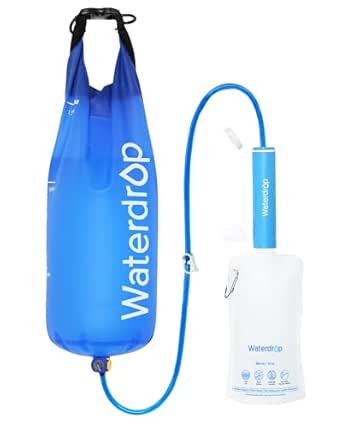 | Best Value Gravity Kit for Small Households | Filtration method: Hollow-fiber ultrafiltration membrane | Water bag capacity: 1.5 gallons | Filter capacity: Up to 1,400 gallons | VIEW LATEST PRICE | See Our Full Breakdown |
| Aquatabs Water Purification Tablets, 397 mg, 100 Pack |  | Best Backup Layer and Viral Coverage | Form: Water purification tablets | Tablet strength: 397 mg | Pack size: 100 tablets | VIEW LATEST PRICE | See Our Full Breakdown |
| Membrane Solutions S1 Personal Water Filter Straw |  | Best Certified Personal Straw | Filtration stages: 5 | Pore size: 0.1 microns | Filter capacity: Up to 1,320 gallons (5,000 liters) | VIEW LATEST PRICE | See Our Full Breakdown |
| Outback Emergency Water Filter System with Extra Filters |  | Best Bulk Capacity for Households | Filtration capacity: Up to 24 gallons per day | Operation: Gravity-fed; no power required | Compatible water sources: Lakes, rivers, streams, and stored rainwater | VIEW LATEST PRICE | See Our Full Breakdown |
| Practical Survival Reusable Emergency Water Filter Straws, 5-Pack |  | Best Multi-Filter Value for Go-Bags | Pack size: 5 filters | Filter capacity: 1,800 gallons per filter | Filtration method: Hollow fiber membrane, 0.1 micron | VIEW LATEST PRICE | See Our Full Breakdown |
| 3-Pack Water Filter Straws with Emergency Whistles |  | Best for Vehicle and Trail Kits | Pack size: 3 filters | Filtration method: 0.1-micron hollow fiber membrane | Capacity per filter: Up to 1,600 gallons | VIEW LATEST PRICE | See Our Full Breakdown |
| Uzima UZ-2 Portable Gravity-Fed Camping Water Filter |  | Best Gravity Pick for Camp and Home | Filter type: Hollow-fiber | Operation: Gravity-fed, manual | Power source: None required | VIEW LATEST PRICE | See Our Full Breakdown |
| LifeStraw Personal Water Filter, 5 Pack, Blue |  | Most Trusted Brand Backup | Quantity: 5 filters | Bacteria removal: 99.999999% | Parasite removal: 99.999% | VIEW LATEST PRICE | See Our Full Breakdown |
| LifeStraw Personal Water Filter for Hiking, Travel, and Emergencies |  | Best-Known Personal Straw | Filter capacity: 4,000 liters (1,000 gallons) | Bacteria removal: 99.999999% | Parasite removal: 99.999% | VIEW LATEST PRICE | See Our Full Breakdown |
| Aquatabs 49 mg Water Purification Tablets, 100 Count |  | Best Ultralight Backup | Quantity: 100 tablets | Tablet strength: 49 mg | Water treated per tablet: 0.75–2 liters | VIEW LATEST PRICE | See Our Full Breakdown |
| Pureday 3-Gallon Stainless Steel Gravity Water Filter with 4 Filters |  | Best for Whole-Household Preparedness | Capacity: 3 gallons | Material: 304 food-grade stainless steel | Filtration standards: NSF/ANSI 42, 53, and 401 | VIEW LATEST PRICE | See Our Full Breakdown |
| Reusable Emergency Water Filter Straws, 2-Pack |  | Best Value Multi-Person Kit | Pack size: 2 filters | Weight: 2 oz each | Length: 8 inches | VIEW LATEST PRICE | See Our Full Breakdown |
| home emergency water filter | Weight |
|---|---|
| Outback Water Emergency Drinki | 6 pounds |
| Purewell Portable Hand-Pump Wa | 1 pound |
| Waterdrop Gravity Water Filter | 4.64 ounces |
| Aquatabs Water Purification Ta | — |
| Membrane Solutions S1 Personal | 2 ounces |
| Outback Emergency Water Filter | — |
| Practical Survival Reusable Em | 56.7 g per straw |
| 3-Pack Water Filter Straws wit | — |
| Uzima UZ-2 Portable Gravity-Fe | — |
| LifeStraw Personal Water Filte | — |
| LifeStraw Personal Water Filte | — |
| Aquatabs 49 mg Water Purificat | 9.07 g |
| Pureday 3-Gallon Stainless Ste | — |
| Reusable Emergency Water Filte | 2 oz each |
More Details on Our Top Picks
Outback Water Emergency Drinking Water Filter System, Gravity-Fed, 24 GPD
When the goal is keeping a whole household hydrated through an outage, most filter straws simply can’t keep up. This option stands out for its four-stage nanofiltration and a rated output of 24 gallons per day — enough that a family won’t ration drinking water on day three of an emergency. Unlike the Membrane Solutions S1 or the Waterdrop straw, which filter one drink at a time, this bucket-style setup produces stored, dispensed water from a spigot, so kids and elderly family members aren’t sucking through a straw. The tradeoff is real, though: at 6 pounds and 12 × 12 × 24 inches, it’s a dedicated shelf in your emergency closet, not something that goes in a go-bag. You also have to manually fill the upper container, and the listing is thin on specific contaminant-removal claims compared with certified rivals.
Pros:- Up to 24 gallons per day of filtered water without electricity, pumps, or batteries
- Four-stage nanofiltration in a complete countertop system with spigot and containers included
- Gravity-powered operation means no fuel, charging, or physical pumping effort
- Enough output to supply a household rather than a single person
Cons:- Bulky countertop footprint and 6-pound weight rule it out for bug-out bags
- Requires manual filling of the upper container for every batch
- Manufacturer information is vague about specific contaminant removal compared with NSF-certified alternatives
Best for: Families of four or more building a shelter-in-place emergency kit with enough daily output for drinking and cooking
Not ideal for: Apartment dwellers or backpackers — the footprint and bucket-style containers make it impractical where storage space or portability matters
- Purification method:Nanofiltration, 4 stages
- Capacity:24 gallons per day
- Power source:Gravity-powered (no electricity)
- Maximum supported water TDS:500 ppm
- Dimensions:12 × 12 × 24 inches
- Weight:6 pounds
- Installation type:Countertop
- Included components:Filters, spigot, containers, connectors, gaskets, manual
Our verdict“If you’re preparing one home system to keep a family supplied during a water emergency, this delivers capacity no straw or tablet can match.”
Purewell Portable Hand-Pump Water Filter
There’s a moment in every emergency where you need clean water right now, not in 30 minutes — and that’s where this hand-pump earns its spot. With a stated flow of 1,400 ml per minute, it moves water roughly twice as fast as the Waterdrop gravity straw, and pumping works even when gravity setups can’t be hung or staged. Compared with passive straws like the LifeStraw, the advantage is versatility: you can pull water from a bucket, stream, or jug and fill bottles for multiple people. The cost is effort and maintenance. Pumping is physical work, filter life shrinks with silty source water, and the activated carbon stage needs replacement after the stated 793 gallons. This model makes the most sense for buyers who want active control over volume rather than the slow trickle of gravity bags.
Pros:- High stated flow rate of 1,400 ml per minute for fast bottle filling
- Triple filtration: hollow-fiber ultrafiltration, activated carbon, and PP cotton
- Works from almost any water source — buckets, streams, or containers
- Includes tubing, hose clip, and carry bag for a complete kit
Cons:- Manual pumping is labor-intensive for large volumes
- Carbon stage requires replacement after 793 gallons
- Filter lifespan shortens considerably with turbid source water
Best for: Campers and preparedness-minded users who need to fill multiple bottles quickly from varied water sources without electricity
Not ideal for: Households wanting set-and-forget household output — pumping every liter by hand gets tiring compared with the Outback’s 24 GPD gravity system
- Filtration method:Hollow-fiber ultrafiltration, activated carbon, PP cotton
- Filter pore size:0.01 micron
- Maximum flow rate:1,400 ml/min
- Stated capacity:793 gallons before carbon replacement
- Power source:Manual, non-electric
- Dimensions:8.2 × 5.1 × 2 inches
- Weight:1 pound
Our verdict“Choose this when speed and source flexibility matter more than passive convenience — just expect to work for every liter.”
Waterdrop Gravity Water Filter Straw with 1.5-Gallon Bag
This kit hits a sweet spot between single-person straws and full bucket systems: you get the hands-free convenience of gravity filtration at a fraction of the Outback system’s size and price class. Fill the 1.5-gallon bag, hang it, and water trickles through the 0.1-micron membrane at up to 700 ml per minute while you do something else — a clear step up in convenience from the Membrane Solutions S1, which is primarily a direct-drinking straw. The backwash function stretches the 1,400-gallon filter life, which is generous for this category. Where it falls short: 1.5 gallons doesn’t cover a family’s daily needs the way a 24 GPD system does, and the listing doesn’t specify which microorganisms the membrane actually removes — a gap buyers with serious contamination concerns should weigh against certified options.
Pros:- Includes a 1.5-gallon reservoir, so it works as a system out of the box
- Backwash function extends filter life toward the 1,400-gallon rating
- Ultra-light at 4.64 ounces for the straw itself
- Compatible with water bags and bottles for flexible use
Cons:- Small reservoir capacity limits it to one or two people
- No published specifics on which microorganisms or contaminants are removed
- Slower flow than pump-based options like the Purewell
Best for: Couples, solo preppers, and car-campers who want passive gravity filtration with a usable reservoir included
Not ideal for: Families needing daily household volumes — the 1.5-gallon bag means constant refilling compared with larger gravity systems
- Filtration method:Hollow-fiber ultrafiltration membrane
- Water bag capacity:1.5 gallons
- Filter capacity:Up to 1,400 gallons
- Maximum flow rate:700 ml/min
- Maximum supported TDS:300 ppm
- Weight:4.64 ounces
- Power source:Non-electric
Our verdict“A smart middle ground for one or two people who want gravity-fed convenience without committing to a full countertop system.”
Aquatabs Water Purification Tablets, 397 mg, 100 Pack
No filter in this lineup addresses every threat, and that’s exactly why tablets belong in a serious kit. Each 397 mg tablet treats 4 gallons in 30 minutes with reported effectiveness against bacteria, viruses, and Giardia cysts — notably viral protection that hollow-fiber straws like the Waterdrop or Membrane Solutions S1 don’t clearly claim. A 100-tablet pack covers roughly 400 gallons in a package smaller than a deck of cards, which is why this makes sense as the redundancy layer in a go-bag or car kit rather than a primary system. The limitations are structural: chemical treatment does nothing for sediment, turbid water needs pre-filtering through a cloth or straw first, and you’re waiting 30 minutes per batch versus the instant flow of a pump. Think of this as insurance that layers under any filter, not a replacement for one.
Pros:- Reported effectiveness against bacteria, viruses, and Giardia cysts — broader microbial coverage than most filter straws claim
- Each tablet treats 4 gallons in 30 minutes; 100 tablets cover about 400 gallons
- Extremely lightweight and shelf-stable for years in storage
- Described as adding no taste, color, or odor to treated water
Cons:- Does not remove sediment, debris, or turbidity — pre-filtering is required for dirty source water
- 30-minute wait time per batch versus instant filtration from straws or pumps
- Ongoing consumable — once tablets run out, protection ends
Best for: Preppers who want a lightweight viral-protection backup to layer under a physical filter, and anyone stocking car or office emergency kits
Not ideal for: Buyers facing cloudy or sediment-heavy water — tablets disinfect but don’t physically filter, so a straw or bag pre-filter is still needed
- Form:Water purification tablets
- Tablet strength:397 mg
- Pack size:100 tablets
- Treatment capacity:4 gallons per tablet in 30 minutes
- Reported removal:99.9999% bacteria, 99.99% viruses, 99.9% Giardia cysts
- Expiration date:February 2029
Our verdict“Not a standalone solution, but the cheapest, lightest way to add viral coverage on top of any filter you already own.”
Membrane Solutions S1 Personal Water Filter Straw
Among the filter straws in this roundup, this one stands apart for one reason: NSF/ANSI 42, 372, and 401 certification, which is more third-party validation than most rivals in this batch — including the Waterdrop straw — can point to. Its five-stage design targets bacteria, chlorine, lead, and microplastics while preserving beneficial minerals, a contrast with reverse-osmosis-style approaches that strip everything. The 1,320-gallon capacity is competitive, and the 28 mm threading means it screws directly onto standard bottles or drops into a gravity setup, giving it more configuration options than a fixed straw. Be clear-eyed about the limits, though: it explicitly does not reduce TDS, so dissolved solids, heavy salt, and chemical contamination pass through. Compared with the Purewell pump, you trade speed for simplicity — no moving parts, but no fast bottle-filling either.
Pros:- NSF/ANSI 42, 372, and 401 certified — rare third-party validation in this category
- Five-stage filtration addresses bacteria, chlorine, lead, and microplastics
- Long stated capacity of up to 1,320 gallons (5,000 liters)
- Threads onto 28 mm bottles and supports direct drinking, backflushing, or gravity-fed use
Cons:- Does not lower TDS or remove dissolved solids and minerals
- Moderate 500 ml/min flow rate is slower than pump options
- Single-person format — useless for filling large containers quickly
Best for: Hikers, travelers, and go-bag builders who want a certified straw for bacteria and lead concerns in reasonably clear water
Not ideal for: Anyone facing brackish, salty, or chemically contaminated water — the filter leaves dissolved solids and TDS untouched
- Filtration stages:5
- Pore size:0.1 microns
- Filter capacity:Up to 1,320 gallons (5,000 liters)
- Flow rate:Up to 500 ml/min
- Bottle compatibility:28 mm threaded bottles
- Certifications:NSF/ANSI 42, 372, and 401
- Weight:2 ounces
- TDS reduction:Does not lower TDS
Our verdict“The most credible straw pick in this lineup for individual use, as long as your water concern is biological rather than dissolved contaminants.”
Outback Emergency Water Filter System with Extra Filters
When the goal is keeping a whole household hydrated rather than one person, most straw filters fall short — and that’s where this gravity-fed bucket system earns its place. With a stated output of up to 24 gallons per day, it outproduces the Practical Survival 5-Pack and the LifeStraw 5 Pack combined, because nobody wants to sip directly from a bucket during a multi-day outage. It also runs without pumps, batteries, or electricity, which puts it in the same no-power category as the Uzima UZ-2 but with a clearer throughput figure. The bundled extra replacement filters extend usefulness well beyond a single emergency. The tradeoff: you must manually fill the upper chamber, and the listing is vague about exactly which contaminants are removed — a real gap if your concern is chemicals rather than bacteria and sediment.
Pros:- Filters up to 24 gallons per day for household-scale output
- Operates without electricity, batteries, or pumps
- Includes extra replacement filters for extended emergencies
- Portable bucket design stores and transports easily
Cons:- Requires manually filling the upper chamber, which is slow and labor-intensive
- No specific contaminant removal claims are published
Best for: Families or households preparing for multi-day emergencies who need high-volume drinking water without power
Not ideal for: Anyone worried about chemical or heavy metal contamination — the product makes no specific contaminant removal claims
- Filtration capacity:Up to 24 gallons per day
- Operation:Gravity-fed; no power required
- Compatible water sources:Lakes, rivers, streams, and stored rainwater
- Included:Extra replacement filters
- Design:Portable bucket system
- Power source:None
Our verdict“This is the pick for households that need volume, not individuals who need portability.”
Practical Survival Reusable Emergency Water Filter Straws, 5-Pack
This five-pack is built around one idea: distribution. Instead of one shared filter, every family member or vehicle gets a straw capable of up to 1,800 gallons — more per filter than the LifeStraw 5 Pack’s 1,000 gallons, and matched by a stated 10-year filter life. The 0.1-micron hollow fiber membrane claims over 99.99% removal of bacteria and parasites plus microplastics, which covers the biological risks that matter most in flood or wilderness scenarios. Each straw also ships with a backflushing plunger, something the Advenlution 3-Pack includes but many single-filter options omit entirely. The catch is practical: a 6-year shelf life versus a 10-year filter life means you’ll want to calendar a replacement cycle even if the filters never leave the go-bag.
Pros:- Removes over 99.99% of waterborne bacteria and parasites
- Filters microplastics down to 0.1 micron
- 1,800-gallon capacity per filter exceeds most straw competitors
- Includes a backflushing plunger per filter for maintenance
Cons:- 6-year shelf life is shorter than the 10-year filter life claim
- Straw format limits use to drinking, not cooking or filling containers
Best for: Preppers building multiple emergency kits — one per car, backpack, or family member
Not ideal for: Buyers who want a set-and-forget kit they never inspect; the 6-year shelf life demands eventual rotation
- Pack size:5 filters
- Filter capacity:1,800 gallons per filter
- Filtration method:Hollow fiber membrane, 0.1 micron
- Filter life:Up to 10 years
- Shelf life:6 years
- Weight:56.7 g per straw
- Material:BPA-free, FDA-compliant plastic
- Included:One backflushing plunger per filter
Our verdict“The smart buy for spreading coverage across several kits at a low cost per filter.”
3-Pack Water Filter Straws with Emergency Whistles
Compared with the Practical Survival 5-Pack, this Advenlution set trades quantity for a small but genuinely useful addition: a built-in emergency whistle on each straw. At 2 ounces per filter, these are the lightest full-capability options in this batch, which matters when every ounce counts in a hiking pack or glovebox kit. Each straw handles up to 1,600 gallons through a 0.1-micron hollow fiber membrane, reducing microplastics, sediment, and turbidity. The backflush plunger matches what Practical Survival offers. But the scope is narrower than it first appears — the product makes no broader contaminant removal claims beyond natural freshwater clarity, and like all straws, you must sip directly from the source, which is awkward for filling bottles or cooking pots.
Pros:- Ultra-light 2 oz straws fit anywhere without bulk
- Filters microplastics, sediment, and turbidity from freshwater
- Backflush plunger and emergency whistle included per straw
- Three-pack splits easily across car, pack, and home kits
Cons:- No claims beyond natural freshwater — unclear on bacteria and parasite log removal
- Direct-sip design prevents filling bottles or pots
Best for: Hikers and drivers who want an ultra-light straw plus a signaling whistle in every kit
Not ideal for: Anyone who needs to filter water into containers for cooking or storage — this is direct-sip only
- Pack size:3 filters
- Filtration method:0.1-micron hollow fiber membrane
- Capacity per filter:Up to 1,600 gallons
- Total stated capacity:4,800 gallons
- Weight per straw:2 oz
- Material:ABS, BPA-free, FDA-compliant
- Included:Backflush plunger, emergency whistle
Our verdict“A solid trail-and-glovebox pick if weight and signaling matter more than lab-backed claims.”
Uzima UZ-2 Portable Gravity-Fed Camping Water Filter
This option bridges the gap between sipping straws and bucket systems: the UZ-2 is gravity-fed and hands-free, so unlike the Advenlution straws you can hang it, walk away, and return to filtered water — yet it stays far more portable than the Outback bucket system. Its hollow-fiber filter claims 99.999% bacteria protection, and it needs no electricity, fitting neatly into both power-outage and backcountry plans. A nice touch is compatibility with water purification tablets, such as Aquatabs, for a layered approach against viruses that filters alone don’t address. The honest weakness is transparency: unlike the Practical Survival pack’s clearly stated 1,800-gallon capacity, Uzima publishes no filtration capacity or flow rate, making it hard to plan how long a filter lasts or how quickly it produces water.
Pros:- Gravity-fed operation frees your hands and filters while you do other tasks
- 99.999% bacteria protection with no electricity required
- Works alongside purification tablets for layered treatment
- Easy assembly straight out of the box
Cons:- No stated filtration capacity or flow rate
- Does not appear to address viruses or chemical contaminants on its own
Best for: Campers and home-prep buyers who want hands-free gravity filtration rather than sipping through a straw
- Filter type:Hollow-fiber
- Operation:Gravity-fed, manual
- Power source:None required
- Bacteria protection:99.999%
- Certification:Globally certified (as stated)
- Compatibility:Water purification tablets
Our verdict“The right middle ground if you want gravity convenience in a package that still fits in a pack.”
LifeStraw Personal Water Filter, 5 Pack, Blue
LifeStraw is the name most buyers already recognize, and this 5-pack leans on that reputation with the most rigorous removal claims in this batch: 99.999999% of bacteria and 99.999% of parasites, plus microplastics down to 1 micron and turbidity to 0.2 microns. Compared with the Practical Survival 5-Pack, the tradeoff is direct — 1,000 gallons per filter versus 1,800 — but you get established brand accountability and widely published testing standards in exchange. Like the Advenlution set, these split naturally across family members and vehicles. One honest caveat: the 4,000-liter lifetime depends on proper use and maintenance, including regular backflushing, so neglect the care routine and you’ll fall well short of the rated lifespan. It’s also direct-sip only, so it complements rather than replaces a gravity system like the Outback.
Pros:- Highest bacteria and parasite removal claims in this batch
- Filters microplastics down to 1 micron and turbidity to 0.2 microns
- 4,000 liters of drinking water per filter with proper maintenance
- Five units cover a whole family or multiple kits
Cons:- 1,000-gallon per-filter capacity trails cheaper straw multipacks
- Stated lifetime only achievable with diligent use and maintenance
Best for: Buyers who prioritize brand credibility and documented removal claims over raw capacity
Not ideal for: Households needing bulk water for cooking — direct-sip straws can’t fill pots or containers
- Quantity:5 filters
- Bacteria removal:99.999999%
- Parasite removal:99.999%
- Microplastic filtration:Down to 1 micron
- Turbidity reduction:Down to 0.2 microns
- Filter lifetime:4,000 liters (1,000 gallons)
- Color:Blue
Our verdict“Pick this when proven performance and brand track record matter more than maximum gallons per dollar.”
LifeStraw Personal Water Filter for Hiking, Travel, and Emergencies
This is the filter most people picture when they think of emergency water gear, and its reputation is built on verified microorganism removal rather than marketing claims. With 99.999999% bacteria and 99.999% parasite reduction plus microplastic filtration to 1 micron, it covers the contaminants that matter most in untreated surface water. Compared with the Reusable Emergency Water Filter Straws, 2-Pack, the LifeStraw offers a larger lifetime capacity at 1,000 gallons per unit, though it lacks a backflushing tool, so once flow slows, the filter is essentially finished. The bigger tradeoff for home preparedness: this is a drink-direct device with no storage component, so it can’t stock a household the way the Pureday 3-Gallon Gravity Filter can. It makes the most sense as a grab-and-go layer inside a larger emergency plan, not the plan itself.
Pros:- Removes 99.999999% of bacteria and 99.999% of parasites including Giardia and Cryptosporidium
- Filters microplastics down to 1 micron
- Large 1,000-gallon lifetime capacity for a personal straw
- BPA-free construction with a long track record of independent testing
Cons:- Requires drinking directly through the straw — no way to filter water into storage
- No backflushing tool, so clogging permanently ends its usable life early
Best for: Individuals building a bug-out bag or car kit who want a trusted single-person filter for drinking directly from streams and containers
Not ideal for: Households storing water for multiple people — there’s no way to fill jugs or cook with filtered water from a straw alone
- Filter capacity:4,000 liters (1,000 gallons)
- Bacteria removal:99.999999%
- Parasite removal:99.999%
- Microplastic removal:Down to 1 micron
- Materials:BPA-free
- Pack size:1 filter
- Color:Blue
Our verdict“A reliable personal straw for solo evacuation and outdoor use, but pair it with a bulk solution for real home preparedness.”
Aquatabs 49 mg Water Purification Tablets, 100 Count
Tablets solve a problem no straw can: treating water you’re not drinking right now. A single 49 mg Aquatabs tablet purifies up to 2 liters in 30 minutes, killing 99.9999% of bacteria, 99.99% of viruses, and 99.9% of Giardia cysts — virus coverage that physical filters like the LifeStraw Personal Water Filter simply don’t address. That makes tablets a smart complement rather than a competitor: filters clear sediment and improve taste, tablets neutralize viruses in stored water. The 100-count bag weighs under 10 grams, fitting in any kit where even the Reusable Emergency Water Filter Straws feel bulky. Tradeoffs are real, though: you wait 30 minutes before drinking, cloudy water needs prefiltration first, and unlike a filter, once the tablets are gone, they’re gone — a finite consumable with a shelf life around 900 days.
Pros:- Kills viruses, which most filter straws cannot remove
- Extremely compact and lightweight — 100 treatments in a pocket-sized bag
- Individually foil-sealed tablets stay fresh until needed
- Treated water has no unpleasant taste, color, or odor
Cons:- 30-minute wait before water is safe to drink
- Sediment-heavy or murky water requires prefiltration before treatment
Best for: Preppers and travelers who want featherweight virus protection to stash in vehicles, bags, and first-aid kits as a redundancy layer
Not ideal for: Anyone needing instant, sediment-free drinking water — the wait time and prefiltration requirement make it clumsy as a sole method
- Quantity:100 tablets
- Tablet strength:49 mg
- Water treated per tablet:0.75–2 liters
- Treatment time:30 minutes
- Microorganism reduction:99.9999% bacteria, 99.99% viruses, 99.9% Giardia cysts
- Container type:Bag
- Shelf life:900 days
- Weight:9.07 g
Our verdict“The cheapest, lightest insurance policy for your kit — buy it as a virus-killing backup, not your primary filter.”
Pureday 3-Gallon Stainless Steel Gravity Water Filter with 4 Filters
When the power is out and the tap runs dry, this is the only product in this batch that can keep a family hydrated without anyone sucking through a straw. The 3-gallon stainless steel reservoir sits on a counter and produces clean water by gravity alone, with four included filters split between carbon and dedicated PFOS/PFOA reduction elements — coverage that targets lead, chlorine, and forever chemicals, contaminants straw filters ignore entirely. Certification to NSF/ANSI 42, 53, and 401 puts it ahead of the Uzima UZ-2-class camping gravity units on chemical reduction. The compromises: it’s heavy, stationary, and its filter schedule is fussy — carbon elements last 6 months or 3,000 gallons while PFOS/PFOA elements need replacing at 3 months or 1,000 gallons. Unlike the Aquatabs tablets, there’s no virus kill, so source water quality still matters.
Pros:- Filters and stores 3 gallons at once — no drinking directly from a source required
- Two-stage filtration with dedicated PFOS/PFOA and lead reduction filters
- Certified to NSF/ANSI 42, 53, and 401 standards
- Corrosion-resistant 304 stainless steel body with a water level indicator
Cons:- Carbon and PFOS/PFOA filters have different replacement intervals, complicating maintenance
- No virus removal, so it can’t purify questionable viral-risk water the way chemical tablets can
Best for: Families of 4–6 who want a stationary, power-free countertop system that filters and stores drinking water in one unit
Not ideal for: Backpackers and people who might need to evacuate on foot — it’s far too heavy and bulky to carry compared with any straw or tablet option
- Capacity:3 gallons
- Material:304 food-grade stainless steel
- Filtration standards:NSF/ANSI 42, 53, and 401
- Filters included:2 carbon filters and 2 PFOS/PFOA reduction filters
- Carbon filter lifespan:6 months or 3,000 gallons each
- PFOS/PFOA filter lifespan:3 months or 1,000 gallons each
- Power:Gravity filtration; no electricity needed
- Stated household capacity:4–6 people
Our verdict“The clear pick if your emergency plan involves sheltering in place with a household to hydrate, not bugging out.”
Reusable Emergency Water Filter Straws, 2-Pack
Two filters, two backflush plungers, and 0.1-micron filtration — this bundle is built for couples or families who each need their own straw without paying twice. The 0.1-micron rating is finer than the LifeStraw Personal Water Filter’s 1-micron microplastic cutoff, and the included backflushing plunger directly addresses the flaw that shortens most straw lifespans: clogging. Restored flow means each unit can realistically approach its 1,800-gallon claim, nearly double the LifeStraw’s capacity. Each straw weighs just 2 ounces, so a pair still weighs less than one Purewell hand-pump filter. The honest downsides: the 10-year lifespan is conditional on regular backflushing and decent source water, and you must actually perform that maintenance — skip it and performance drops fast. Like all straws, it still can’t fill a pot or a bottle for storage, a gap only the Pureday gravity system fills here.
Pros:- Two full filters included, so each person gets their own
- Finer 0.1-micron filtration than most competing straws
- High 1,800-gallon capacity per filter
- Backflushing plungers included to restore clogged flow in the field
Cons:- Advertised 10-year lifespan depends heavily on use frequency and water conditions
- Requires regular backflushing to maintain flow — a maintenance step many owners skip
Best for: Couples and small families who want individual straws for each person plus the maintenance tools to keep them running long-term
Not ideal for: Anyone wanting a set-and-forget solution — performance genuinely depends on routine backflushing and reasonable source water
- Pack size:2 filters
- Weight:2 oz each
- Length:8 inches
- Filtration:Down to 0.1 micron
- Bacteria and parasite removal:Over 99.99%
- Capacity per filter:Up to 1,800 gallons
- Materials and compliance:BPA-free, FDA-compliant
Our verdict“The smart buy for two-person preparedness: finer filtration than LifeStraw, double the filters, and the tools to extend their life.”

How We Picked
I evaluated every option against the same question: what happens on day three of a real emergency? That meant scoring daily output capacity first — a filter that produces one liter of drinking water per hour of effort is not a household solution, no matter how well it filters. Second, I weighed contaminant coverage: whether a product addresses bacteria and protozoa only, or also handles viruses and sediment, since floodwater and post-disaster municipal supplies carry different risks. Third, I considered readiness and maintenance — shelf life, whether the filter ships ready to use, how many people it covers, and whether consumables like replacement filters or tablets are easy to stock.
The ranking also reflects role separation. Products were ordered by how completely they solve the stated problem, so full household systems like the two Outback units and the Pureday gravity filter sit at the top, multi-pack straws fill the mid-tier where per-person value peaks, and single-use or accessory-style options round out the list as supplements rather than primary plans. Where two products overlap almost exactly — the two Aquatabs packs, the two LifeStraw listings — the tiebreaker was format and total treated volume, which I call out in each entry.
Factors to Consider When Choosing Home Emergency Water Filters
A filter is only part of an emergency water plan, and the products above differ more in role than in raw quality. Before buying, it helps to understand the categories, the failure modes, and the mistakes that leave households under-prepared despite owning a filter.Match the Filter Type to Your Emergency Scenario
The most common mistake is buying for the wrong disaster. Shelter-in-place scenarios — storms, grid failures, boil-water notices — reward high-volume gravity systems because you have a roof, space, and time. Evacuation scenarios reward straws and tablets because weight and speed dominate. Many households buy a five-pack of straws and assume they are covered, then discover during a week-long outage that nobody wants to sip filtered water one mouthful at a time for cooking, coffee, or hygiene. The honest answer for most families is a layered setup: one gravity system as the primary, straws for mobility, and tablets as the never-fails backup. Decide which scenario worries you most before spending, because a premium in one category is wasted money if your real risk lives in the other.
Calculate Realistic Daily Volume, Not Marketing Numbers
Emergency planning guidelines suggest one gallon of drinking water per person per day as a floor, and double that once you count cooking and basic hygiene. A family of four therefore needs roughly eight gallons daily — a figure that instantly disqualifies personal straws as a primary solution and explains why gallons-per-day ratings matter more than filter pore size for home use. When a manufacturer quotes capacity like 24 GPD, check whether that assumes continuous operation with someone refilling the reservoir, because real-world output is usually lower. Also distinguish total lifetime capacity (how many gallons the filter processes before replacement) from daily throughput — a straw rated for 1,000 gallons still only delivers a few liters a day of actual drinking comfort. Buyers who skip this math are the ones caught short.
Know What Your Filter Does Not Remove
Nearly every product in this category handles bacteria and protozoa; far fewer handle viruses, which are the primary concern in floodwater and sewage-contaminated supplies, and almost none remove dissolved chemicals, heavy metals, or salt. This is where chemical tablets earn their place: purification tablets neutralize viruses that mechanical filters miss, while filters remove sediment and protozoa that chemicals handle poorly. The mistake to avoid is treating any single product as a complete purification system. If your likely emergency involves flooding or compromised municipal treatment, plan for filtration plus chemical treatment in sequence. Read the contaminant claims carefully — vague language like “improves taste and odor” signals a product meant for clear tap water, not murky creek water.
Plan for Consumables and Shelf Life
Filters clog, tablets expire, and both failures tend to surface exactly when you cannot buy replacements. Before committing to any system, check whether replacement filters are sold separately and how long the sealed units last in storage — hollow-fiber filters degrade over years even unused, and tablet packs carry firm expiration dates that should be logged and rotated like food stores. This is why buying a system bundled with extra filters beats buying the base unit and “getting spares later.” A useful rule: whatever total capacity you think you need for a two-week event, double the consumables, because silty or turbid source water clogs filters far faster than the clean lab water used for ratings. A cheap filter with no refill ecosystem is more expensive than a costlier system with abundant spares.
Weight, Effort, and Who Has to Use It
Readiness includes the human factor. Hand-pump filters are fast but physically demanding — fine for an adult on day one, miserable for a tired parent or an older relative on day five. Straws require no effort per sip but deliver almost no volume for cooking. Gravity systems need almost no labor, just periodic refilling, which makes them the safest choice when users vary in strength or patience. Consider also that children handle simple straw formats more reliably than multi-step pump or chemical protocols, and that chemical tablets require precise dosing and a wait time that impatient households may skip. The best filter is the one every member of the household can actually operate under stress.
Storage Footprint and Build Materials
Emergency gear lives in closets, basements, and car trunks for years before use, so durability in storage counts as much as performance in the field. Stainless steel gravity housings resist the cracking and UV degradation that plague thin plastic reservoirs, but they weigh far more and cost more up front — a reasonable trade for a permanent kitchen-counter backup, a poor one for a go-bag. Collapsible bags save space but are the component most likely to fail from folding fatigue, so inspect them during annual preparedness checks. Whatever you buy, store it away from freezing temperatures, because ice expansion destroys hollow-fiber membranes even in sealed packaging. A filter that fails in storage is the most expensive kind of failure because you never learn about it until it is needed.
Frequently Asked Questions
Can filter straws actually serve as a home emergency backup, or do I need a gravity system?
Straws work as a backup layer but not as a household primary. A straw filters one person’s direct drinking water adequately, but it cannot fill a pot for cooking, rinse dishes, or supply water for an infant’s formula at any practical speed — which is why multi-packs like the LifeStraw 5 Pack are framed here as per-person kits rather than home systems. If budget forces a choice, a single gravity system protects the whole household better than a drawer full of straws. The ideal arrangement is a gravity unit like the Outback at home, with a straw per person in each vehicle and go-bag. That way, shelter-in-place and evacuation needs are covered separately instead of compromised into one device.
Should I buy the 397 mg or 49 mg Aquatabs for home preparedness?
The dose determines volume: 397 mg tablets treat roughly larger containers of water in a single dose, while 49 mg tablets suit individual liters and smaller bottles. For home preparedness, the stronger tablets make more sense because post-emergency water treatment usually happens in bulk — filling jugs, coolers, or pots from a single questionable source — and dosing one tablet per large container is faster and harder to get wrong. The lighter dose shines for travel kits, hiking bottles, and children’s smaller containers where precision matters. Keep in mind that tablets require a waiting period, typically around 30 minutes, before the water is safe to drink, so they complement rather than replace a filter. Many preparedness plans stock both doses deliberately.
Is the Outback with extra filters worth it over the standard Outback system?
In almost every case, yes, and the reasoning comes down to failure modes rather than features. Both units filter identically out of the box, but during a multi-week emergency — or a regional disaster where resupply is impossible — filter clogging is the most likely thing to end your water security, especially if your source water is cloudy or silty. Having sealed spare filters on hand effectively multiplies your usable capacity without needing electricity, shipping, or stores being open. The standard system is the right call only if you already own spares or plan to add them immediately. Buyers who treat the filter count as an afterthought are the ones restarting from zero in week three.
Do these filters remove viruses, and does that matter for my emergency plan?
Most hollow-fiber filters in this roundup — the straws and gravity units alike — remove bacteria and protozoa but not viruses, because viruses are small enough to pass through mechanical filtration. Whether that matters depends on your water source: viruses are a genuine concern in floodwater, sewage contamination, and regions with poor sanitation, but a lower concern in clear backcountry surface water where bacteria and protozoa dominate. If your risk profile includes flooding or a compromised municipal plant, pair your filter with chemical tablets, since the two methods cover each other’s gaps. This pairing costs very little and closes the biggest hole in filter-only plans. Treating a filter as complete virus protection is one of the most common preparedness errors.
How many filters or straws does a family actually need?
A practical baseline is one personal straw per household member, one shared household gravity system, and one spare set of consumables on top of that. The reasoning: straws are personal-use items both for hygiene and because sharing one straw during an emergency is unappealing even among family, so multi-packs map neatly onto family size. The gravity system then handles all shared volume — cooking, cleaning, and drinking water by the gallon — which no quantity of straws can match. The spare filters or tablets account for the reality that emergencies rarely end on schedule and that turbid water shortens filter life. A two-person household might manage with a single system and a two-pack of straws; a family of five should be looking at the five-packs plus a full gravity unit.
Conclusion
For most households, the Outback Water Emergency Drinking Water Filter System (24 GPD) is the best overall choice — it is the only pick here that treats household drinking water at family scale with no electricity and no effort beyond refilling. The best value goes to the LifeStraw Personal Water Filter 5 Pack, which puts an individual filter in every hand and every go-bag for less than the cost of one large system. The best premium option is the Pureday 3-Gallon Stainless Steel Gravity Filter, whose durable steel housing and included filter set make it a permanent kitchen fixture rather than a closet-dwelling gadget. Beginners should start with the Waterdrop Gravity Filter Straw with 1.5-Gallon Bag, which bridges the straw and gravity worlds at low complexity, teaching the basics without a big commitment.
For specific needs: choose the Outback with Extra Filters if your emergency horizon is weeks rather than days, the Purewell hand-pump if you want speed in a portable format, the Aquatabs 397 mg pack as the virus-killing complement to any mechanical filter, and the lighter 49 mg tablets or multi-packs of budget straws for car kits and travel bags. Whatever you pick, the pattern across this roundup is clear: match the tool to the scenario, and layer rather than bet on one device. A gravity system at home, a straw per person, and a strip of tablets covers nearly every realistic emergency at a total cost most households can absorb.
Fall Picks
fall essentials
As an affiliate, we earn on qualifying purchases.