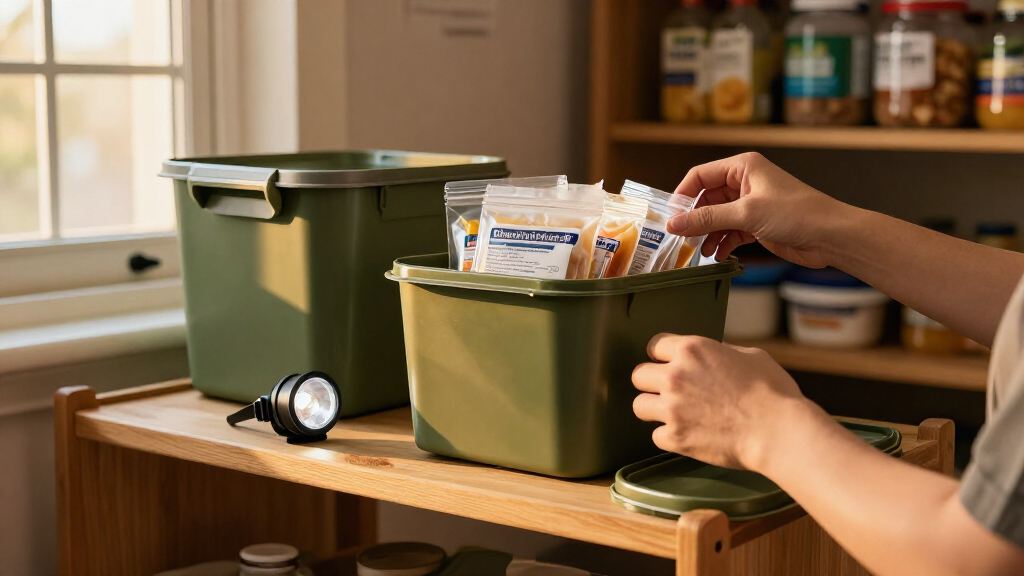

For a balanced emergency food storage setup, I’d start with Home Sensei 5-Gallon Mylar Bags: they pair oxygen absorbers with a light-blocking barrier, while ePackageSupply 5-Gallon Buckets suit buyers who want rigid, food-grade bulk storage. House Naturals Buckets with Screw-On Lids stand out when repeated access matters more than stacking a large number of sealed portions. The main tradeoff is between flexible bags that help protect dry goods from light and air, and sturdy buckets that are easier to stack and handle. Capacity, lid access, and whether a container is designed for direct food contact also affect the choice. Read on for the full comparison and guidance on matching containers to your storage plan.

Get emergency and outdoor gear delivered free with Prime
- Fast, free delivery on millions of items
- Prime Video, Amazon Music and more included
- Member-only deals all year
Key Takeaways
- Home Sensei’s Mylar bags include oxygen absorbers, making them a more ready-to-pack dry-food option than the reusable LOPUY bag set, which does not list absorbers.
- Food-grade status and closure style are separate decisions: ePackageSupply, EconoHome, Mumufy, and House Naturals identify their buckets as food-grade, while United Solutions emphasizes heavy-duty construction.
- Five-gallon buckets favor bulk storage and stacking, but Mumufy’s 3.5-gallon square format trades some capacity for a shape that may use shelf or floor space more efficiently.
- Screw-on lids suit repeated access better than snap-on lids, while a snap-on closure can be simpler when a bucket will stay closed between occasional checks.
- Shazo’s 9.5 L containers and LOPUY’s 30-piece bag set support smaller portions, but neither replaces the bulk capacity of a multi-bucket setup.
| Home Sensei 5-Gallon Mylar Food Storage Bags with Oxygen Absorbers, 10-Pack |  | Best Mylar Kit for Long-Term Dry Food Storage | Capacity: 5 gallons per bag | Quantity: 10 bags | Dimensions: 17 × 27 inches | VIEW LATEST PRICE | See Our Full Breakdown |
| United Solutions 5-Gallon Heavy-Duty Buckets with Snap-On Lids, 6-Pack, Black |  | Best for Nestable Bucket Storage | Quantity: 6 buckets and 6 lids | Capacity: 5 gallons per bucket | Material: BPA-free, food-grade plastic | VIEW LATEST PRICE | See Our Full Breakdown |
| Shazo Extra-Large Food Storage Containers with Airtight Lids, 9.5 L, Set of 2 |  | Best for Small, Frequently Used Food Reserves | Quantity: 2 containers | Capacity: 9.5 liters (321 fluid ounces) each | Dimensions: 8.1 × 6 × 12.5 inches each | VIEW LATEST PRICE | See Our Full Breakdown |
| ePackageSupply 5-Gallon Food-Grade Buckets with Lids, 6 Pack, White |  | Best for Gasketed Bulk Storage | Pack size: 6 buckets with lids | Capacity: 5 gallons (640 oz) each | Material: 90 mil HDPE plastic | VIEW LATEST PRICE | See Our Full Breakdown |
| EconoHome 5-Gallon Food-Grade Buckets with Lids, White, 6-Pack |  | Best for Straightforward Reusable Bucket Storage | Quantity: 6 buckets | Capacity: 5 gallons each | Material: BPA-free, food-grade plastic | VIEW LATEST PRICE | See Our Full Breakdown |
| Mumufy 3.5-Gallon Square Food-Grade Buckets with Lids, Set of 5 |  | Best for Space-Efficient Bulk Organization | Quantity: 5 buckets | Capacity: 3.5 gallons each | Dimensions: 8.27 x 8.27 x 11.22 inches (listed; product description notes differing dimensions) | VIEW LATEST PRICE | See Our Full Breakdown |
| House Naturals 5-Gallon Food-Grade Plastic Buckets with Blue Screw-On Lids, Pack of 3 |  | Best for Airtight Bulk Storage | Quantity: 3 buckets | Capacity: 5 gallons each | Material: Plastic | VIEW LATEST PRICE | See Our Full Breakdown |
| LOPUY Reusable Mylar Food Storage Bags, 30-Piece Set |  | Best for Portioning and Freezer Storage | Quantity: 30 bags | Sizes: 10 large, 10 medium, 10 small | Material: Aluminum foil composite | VIEW LATEST PRICE | See Our Full Breakdown |
| emergency food storage container | Capacity | Material | Quantity | Dimensions |
|---|---|---|---|---|
| Home Sensei 5-Gallon Mylar Foo | 5 gallons per bag | PET and aluminum foil | 10 bags | 17 × 27 inches |
| United Solutions 5-Gallon Heav | 5 gallons per bucket | BPA-free, food-grade plastic | 6 buckets and 6 lids | 12.5 × 12.5 × 14.25 inches |
| Shazo Extra-Large Food Storage | 9.5 liters (321 fluid ounces) each | BPA-free polypropylene plastic | 2 containers | 8.1 × 6 × 12.5 inches each |
| ePackageSupply 5-Gallon Food-G | 5 gallons (640 oz) each | 90 mil HDPE plastic | — | 11.9 inches diameter × 14.56 inches high; another listing states 13.38 inches high |
| EconoHome 5-Gallon Food-Grade | 5 gallons each | BPA-free, food-grade plastic | 6 buckets | 12 × 12 × 13.38 inches |
| Mumufy 3.5-Gallon Square Food- | 3.5 gallons each | Plastic | 5 buckets | 8.27 x 8.27 x 11.22 inches (listed; product description notes differing dimensions) |
| House Naturals 5-Gallon Food-G | 5 gallons each | Plastic | 3 buckets | 12 x 10.5 x 14.5 inches; 12-inch diameter |
| LOPUY Reusable Mylar Food Stor | 6.3 pounds (listed; sizing basis not specified) | Aluminum foil composite | 30 bags | — |
More Details on Our Top Picks
Home Sensei 5-Gallon Mylar Food Storage Bags with Oxygen Absorbers, 10-Pack
For buyers who want to portion dry staples inside buckets, I rank the Home Sensei Mylar set ahead of buying buckets alone: it includes ten 5-gallon liners, matching 2500 cc oxygen absorbers, and labels. The three-layer, 10-mil PET-and-aluminum construction is designed to add a barrier around food, while each bag’s zipper allows access before heat sealing. That pairing makes it more adaptable than the ePackageSupply buckets, which provide rigid storage but no inner food liner or oxygen absorbers. The tradeoff is that Mylar bags are not a standalone rigid container; they need careful handling and work best protected inside a bucket. Oxygen absorbers remove oxygen, but they do not vacuum-pack the contents, and the zipper alone is not the same as a permanent heat seal.
Pros:- Ten 5-gallon bags, oxygen absorbers, and labels are bundled together
- Three-layer, aluminum-reinforced construction creates a barrier for stored dry food
- Zipper closure supports filling and access before heat sealing
- Sized to fit a 5-gallon bucket
Cons:- Flexible bags need protection from punctures and crushing, usually from an outer bucket
- A resealable zipper is not a substitute for heat sealing for longer-term storage
- Oxygen absorbers do not create a vacuum-packed bag
Best for: Households building a reserve of dry staples who want pre-portioned Mylar liners, oxygen absorbers, and labels in one kit.
Not ideal for: Buyers storing liquids, frequently accessed supplies, or food that needs a rigid container without an additional bucket.
- Capacity:5 gallons per bag
- Quantity:10 bags
- Dimensions:17 × 27 inches
- Thickness:10 mil (5 mil per side)
- Material:PET and aluminum foil
- Closure:Resealable zipper; heat-sealable
- Oxygen absorbers:10 included, 2500 cc each
- Included components:10 bags, 10 oxygen absorbers, 10 labels
Our verdict“Choose this kit to line buckets with portioned, oxygen-absorber-equipped Mylar bags; skip it if you need a rigid container on its own.”
United Solutions 5-Gallon Heavy-Duty Buckets with Snap-On Lids, 6-Pack, Black
The United Solutions six-pack earns its place for buyers who need rigid, multipurpose containers that can be nested when empty. Its six food-grade, BPA-free 5-gallon buckets have snap-on lids, metal handles, and reinforced rims, giving emergency supplies more protection from handling than flexible bags such as the Home Sensei Mylar set. The handles also make moving a filled bucket more practical, while the tapered form helps reduce the space occupied by unused buckets. That same taper is the main compromise: it may not fit storage systems built for straight-sided containers, and bucket geometry can affect how neatly full buckets align. Compared with the ePackageSupply buckets, this set emphasizes nestability and straightforward lid access rather than a gasketed tear-strip closure.
Pros:- Six 5-gallon buckets provide substantial capacity for dry goods and supplies
- Food-grade, BPA-free plastic is specified for food storage
- Metal handles and reinforced rims support carrying and handling
- Tapered shape lets empty buckets nest for compact storage
Cons:- Tapered sides may not fit some racks or storage layouts
- Snap-on lids are not described as gasketed or airtight
- The large filled buckets can be cumbersome to move
Best for: Households organizing a garage or pantry reserve that need several rigid buckets and want to nest them before filling.
Not ideal for: Buyers whose shelves or bucket racks require straight-sided containers, or who want an explicitly gasketed lid for a tighter closure.
- Quantity:6 buckets and 6 lids
- Capacity:5 gallons per bucket
- Material:BPA-free, food-grade plastic
- Handle:Metal
- Dimensions:12.5 × 12.5 × 14.25 inches
- Shape:Round, tapered
- Lid:Snap-on
- Special features:Stackable and nestable
Our verdict“Pick these for nestable, general-purpose emergency storage, but choose gasketed buckets if a sealed lid is your priority.”
Shazo Extra-Large Food Storage Containers with Airtight Lids, 9.5 L, Set of 2
I’d choose the Shazo containers for a kitchen-level emergency reserve that needs regular access, rather than for storing a large household’s bulk staples. Each 9.5-liter container has a four-side locking lid and removable silicone seal, offering more convenient opening and resealing than the ePackageSupply tear-strip buckets. Their stackable form, dishwasher-safe construction, and included measuring cups also suit everyday rotation of rice, flour, cereal, or pasta. The clear decision point is scale: two containers hold far less than a six-pack of 5-gallon buckets, so these are better for accessible quantities than deep pantry reserves. They are also tall and sizeable for countertop or cabinet storage. Unlike the Home Sensei Mylar bags, they are reusable rigid containers but do not include oxygen absorbers or specialized long-term storage liners.
Pros:- Airtight, leak-resistant lids with removable silicone seals
- 9.5-liter capacity per container suits everyday bulk pantry staples
- Stackable and dishwasher safe for easier organization and cleaning
- Two measuring cups are included
Cons:- Two containers offer much less total capacity than the 5-gallon bucket sets
- The tall containers may take up substantial pantry space
- No oxygen absorbers or Mylar liners are included for long-term storage
Best for: People keeping a modest amount of frequently used dry food accessible in a kitchen pantry, with easy resealing and measuring.
Not ideal for: Large households assembling a high-volume reserve or buyers seeking bucket-scale capacity and oxygen-absorber storage.
- Quantity:2 containers
- Capacity:9.5 liters (321 fluid ounces) each
- Dimensions:8.1 × 6 × 12.5 inches each
- Material:BPA-free polypropylene plastic
- Lid:Four-side snap-locking lid with removable silicone seal
- Care:Dishwasher safe
- Included components:Containers, lids, and 2 measuring cups
- Features:Stackable, reusable, freezer safe
Our verdict“Choose Shazo for accessible, regularly rotated pantry staples, not for building a large emergency stockpile.”
ePackageSupply 5-Gallon Food-Grade Buckets with Lids, 6 Pack, White
For buyers prioritizing a defined lid seal across a large dry-food reserve, I place the ePackageSupply six-pack ahead of the United Solutions buckets. Its gasketed tear-strip lids are specified as airtight, while reinforced stacking rings help keep filled buckets organized. The 90 mil HDPE construction and stated BPA-free, FDA-compliant food-contact status make this a more purpose-focused food-storage choice than general-purpose containers. The lid design brings a tradeoff: a tear strip is less convenient if you expect to reopen the same bucket often, so I’d reserve these for supplies that can be divided into smaller daily-use containers. The listing also gives conflicting height measurements—14.56 inches and 13.38 inches—so I would leave extra clearance when planning shelves. Unlike Home Sensei’s Mylar kit, these buckets provide the rigid outer container but no liners or oxygen absorbers.
Pros:- Gasketed tear-strip lids are specified as airtight
- 90 mil HDPE buckets are listed as BPA-free and FDA compliant
- Reinforced stacking rings support organized storage
- Six 5-gallon buckets provide substantial capacity
Cons:- Tear-strip lids are less convenient for repeated opening
- Conflicting listed height measurements make shelf planning less certain
- No Mylar liners or oxygen absorbers are included
Best for: Households storing bulk dry food in a garage or pantry who want gasketed lids and stackable bucket construction.
Not ideal for: People who need frequent access to the same bucket, or buyers whose shelving requires precisely verified bucket height.
- Pack size:6 buckets with lids
- Capacity:5 gallons (640 oz) each
- Material:90 mil HDPE plastic
- Food contact:BPA-free and FDA compliant
- Dimensions:11.9 inches diameter × 14.56 inches high; another listing states 13.38 inches high
- Lid:Airtight gasketed tear-strip lid
- Handle:Metal with plastic grip
- Freezer safe:To -5°F
Our verdict“Choose this set for bulk storage with gasketed lids, provided tear-strip access and the uncertain listed height work for your setup.”
EconoHome 5-Gallon Food-Grade Buckets with Lids, White, 6-Pack
The EconoHome six-pack suits buyers who want reusable, food-grade buckets for a mix of emergency staples and household supplies, without needing a specialized Mylar kit. Each bucket holds 5 gallons, has a metal handle with a plastic grip, and uses ribbed sides intended to help the set stack neatly. Compared with the United Solutions buckets, EconoHome specifies a cylindrical shape and dimensions, while United Solutions highlights nesting when empty. The bigger question is the lid: the product data says buckets come with lids but does not identify their material or closure type. That leaves less clarity about sealing than the gasketed ePackageSupply buckets, which are the stronger fit when a defined airtight closure matters. These are roomy containers, so six filled buckets need substantial floor or shelf space.
Pros:- Six 5-gallon buckets offer ample capacity for food and other supplies
- BPA-free, food-grade plastic is specified
- Metal handles with plastic grips support carrying
- Reusable design and ribbed sides are intended for neat stacking
Cons:- Lid material and closure type are not specified
- Six full-size buckets require substantial storage space
- The available details do not confirm a gasket or airtight seal
Best for: Buyers who need multiple reusable, food-grade buckets for dry goods and general supplies, and can confirm the lid style suits their storage plan.
Not ideal for: People who need a specified airtight or gasketed closure, or who have limited room for several 5-gallon containers.
- Quantity:6 buckets
- Capacity:5 gallons each
- Material:BPA-free, food-grade plastic
- Color:White
- Dimensions:12 × 12 × 13.38 inches
- Shape:Cylinder
- Handle:Metal with plastic grip
- Material features:Reusable; described as heat- and cold-resistant
Our verdict“Choose EconoHome for reusable, general-purpose food buckets if the unspecified lid closure meets your storage needs.”
Mumufy 3.5-Gallon Square Food-Grade Buckets with Lids, Set of 5
The Mumufy set suits buyers who want several stackable containers without committing to the footprint of five-gallon round buckets. Its square shape uses shelf and pantry space efficiently, while five 3.5-gallon buckets let you separate grains, pet food, or other emergency supplies into manageable portions. Compared with the House Naturals 5-gallon buckets, Mumufy offers more individual containers but less capacity per bucket, and its lid details are less reassuring: no airtight or leakproof rating is provided. Handles make loaded buckets easier to move, though the listed dimensions reportedly differ across the product description, which makes exact shelf-fit planning less certain. I’d choose this for organized, dry storage rather than for liquids or food that depends on a verified airtight seal.
Pros:- Five buckets allow supplies to be divided by food type or use
- Square shape is designed to stack and make efficient use of shelf space
- Lids help shield contents from dust and dirt
- Handles make carrying buckets easier
Cons:- No airtight seal or leakproof rating is specified
- Product details give differing dimensions, complicating shelf-fit planning
- Each bucket holds less than the five-gallon House Naturals option
Best for: Households organizing emergency staples into multiple smaller, stackable portions for shelves or pantry storage
Not ideal for: Buyers storing liquids or moisture-sensitive food who need a specified airtight or leakproof lid, or anyone planning storage around exact dimensions
- Quantity:5 buckets
- Capacity:3.5 gallons each
- Dimensions:8.27 x 8.27 x 11.22 inches (listed; product description notes differing dimensions)
- Material:Plastic
- Shape:Square
- Color:White
- Features:Lids, handles, stackable design
- Set weight:6.6 pounds
Our verdict“Choose Mumufy for neatly stacked, divided dry-food storage, but pick a bucket with a specified gasketed seal when airtight protection matters.”
House Naturals 5-Gallon Food-Grade Plastic Buckets with Blue Screw-On Lids, Pack of 3
For emergency staples that need a more secure closure, the House Naturals set has a clear advantage: double-gasket screw-on lids are specified as airtight, unlike the basic lids on the Mumufy buckets. The three five-gallon, food-grade and BPA-free buckets also suit buyers storing larger amounts of dry goods, powders, or liquids in fewer containers. Their round shape is less shelf-efficient than Mumufy’s square design, and this pack supplies fewer buckets than the six-count ePackageSupply and EconoHome options in the roundup. Still, the stated gasket design makes House Naturals a stronger fit when closure performance matters more than maximizing container count. I’d compare the lid fit and intended food-storage method before relying on any bucket for long-term storage.
Pros:- Double-gasket screw-on lids are specified as airtight
- Food-grade and BPA-free plastic is identified in the product data
- Five-gallon capacity accommodates substantial quantities per bucket
- Durable handles support carrying, and the buckets are made in the USA
Cons:- Pack of three provides fewer containers than the six-bucket ePackageSupply and EconoHome sets
- Round buckets use shelf space less efficiently than square Mumufy buckets
- Larger full buckets can be cumbersome to move and organize
Best for: Preparedness-minded households storing larger quantities of food or liquids that benefit from a gasketed screw-on lid
Not ideal for: Buyers who prioritize square, space-efficient stacking or want more than three containers for sorting supplies
- Quantity:3 buckets
- Capacity:5 gallons each
- Material:Plastic
- Food grade:Yes
- BPA-free:Yes
- Lid:Blue screw-on lid with double gasket
- Shape:Round
- Dimensions:12 x 10.5 x 14.5 inches; 12-inch diameter
- Origin:Made in the USA
Our verdict“Pick House Naturals when a specified gasketed lid and five-gallon capacity matter more than a higher bucket count or square stacking.”
LOPUY Reusable Mylar Food Storage Bags, 30-Piece Set
LOPUY offers a different kind of emergency-food storage: 30 reusable pouches in three sizes rather than rigid buckets for bulk reserves. The stand-up gusseted base can make filling and shelf organization easier, while the product description says the foil-composite bags help limit exposure to light, moisture, and air and are freezer-safe. That makes them more flexible for portioning and cold storage than the House Naturals five-gallon buckets, but they do not replace a large, sturdy container for keeping bulk supplies together. The closure is a slide zipper, and the listing does not say how well it maintains an airtight seal; individual bag dimensions are also absent. I’d use these for divided portions and accessible freezer supplies, not as my only long-term bulk-storage system.
Pros:- Thirty bags in large, medium, and small sizes support portioning different foods
- Stand-up gusseted base helps with filling and shelf organization
- Described as reusable, washable, and freezer-safe
- Foil-composite material is intended to help protect contents from light and moisture
Cons:- Individual bag dimensions are not provided, making fit and portion planning difficult
- Airtight performance of the slide-zipper closure is not specified
- Flexible bags do not provide the rigid stacking and handling protection of the Mumufy or House Naturals buckets
Best for: Preparedness shoppers who want reusable, labeled portions in different sizes for freezer storage and organized access
Not ideal for: Buyers storing large bulk quantities who need rigid, stackable containers or a clearly specified airtight closure
- Quantity:30 bags
- Sizes:10 large, 10 medium, 10 small
- Material:Aluminum foil composite
- Capacity:6.3 pounds (listed; sizing basis not specified)
- Closure:Slide zipper
- Features:Reusable, washable, freezer-safe, stand-up base, label space
- BPA-free:Yes
- Item weight:5.67 g
Our verdict“Choose LOPUY for reusable, portioned freezer storage, but pair it with a more clearly sealed rigid container for bulk emergency reserves.”

How We Picked
I compared these emergency food storage containers by how well their formats match common storage jobs: sealing dry goods for longer storage, holding larger quantities, organizing smaller portions, and allowing access without unnecessary repacking. I looked at stated material and food-use claims, capacity, lid or seal design, included accessories, pack size, and the practical storage footprint. A product’s format matters as much as its advertised durability: flexible bags, rigid buckets, and smaller lidded containers solve different problems.
The ranking gives priority to clear food-storage suitability and useful protection features, then weighs capacity, closure convenience, and versatility. Home Sensei ranks first for combining Mylar bags with oxygen absorbers; ePackageSupply follows as a straightforward bulk-storage choice. The remaining products rank by their more specific strengths, such as screw-on access, compact portions, or reusable bags. Where a listing does not specify a feature—such as oxygen absorbers or food-grade certification—I treat that as an information gap rather than assuming it is included.
| emergency food storage container | Shape | Lid |
|---|---|---|
| Home Sensei 5-Gallon Mylar Foo | — | — |
| United Solutions 5-Gallon Heav | Round, tapered | Snap-on |
| Shazo Extra-Large Food Storage | — | Four-side snap-locking lid with removable silicone seal |
| ePackageSupply 5-Gallon Food-G | — | Airtight gasketed tear-strip lid |
| EconoHome 5-Gallon Food-Grade | Cylinder | — |
| Mumufy 3.5-Gallon Square Food- | Square | — |
| House Naturals 5-Gallon Food-G | Round | Blue screw-on lid with double gasket |
| LOPUY Reusable Mylar Food Stor | — | — |
Factors to Consider When Choosing Emergency Food Storage Containers
The right container depends on what you plan to store, how often you will open it, and where it will live. I’d decide on the storage system before choosing a pack size: containers that work well for sealed dry goods may be inconvenient for daily pantry access.
Match the Container to the Food
Dry staples such as rice, beans, and flour can suit sealed bags or buckets, while frequently used ingredients benefit from containers that are easy to reopen. Check the intended food-contact use rather than assuming any sturdy plastic bucket is suitable for food. For foods that need an additional inner barrier, use a food-safe liner or bag when appropriate and follow the manufacturer’s directions. Moisture-sensitive foods need particular care because a rigid bucket alone does not establish that the contents are protected from humidity. Avoid storing food that is still warm or damp, since trapped moisture can spoil a batch. Keep original labels or add clear labels with the food name and packing date.
Choose a Barrier and Seal That Fit Your Storage Plan
Mylar bags and rigid buckets do different jobs: bags create a flexible inner package, while buckets protect contents from handling and make bulk storage easier. A lid is not automatically an airtight seal, and a reusable bag is not automatically equivalent to a long-term barrier pouch. Check whether absorbers are included, what they are intended for, and whether the package explains how to size them for the food quantity. Do not treat oxygen absorbers as a substitute for clean, dry food or sound sealing. For longer storage, think about using a suitable inner bag inside a bucket rather than relying on the bucket closure alone. For food you will access often, a closure you can operate without damaging the seal may be the better tradeoff.
Plan Portions Before Buying Capacity
Large containers reduce the number of packages you need, but they can be awkward to lift and may expose a larger supply each time you open one. Divide food by likely use so an opened container does not leave the rest of a long-term supply repeatedly exposed. Smaller containers can simplify meal planning and make rotation easier, though they require more labeling and shelf space. A mixed system often works better than buying only one size: reserve bulk containers for staples and smaller ones for ingredients used in modest amounts. Estimate how much your household can use after opening before choosing a single large format. Capacity printed in liters or gallons is not the same as a guaranteed weight capacity for every food.
Measure the Storage Area, Not Just the Container
Bucket capacity can look attractive until the filled containers do not fit through a doorway, under a shelf, or into the intended closet. Measure width, height, and access clearance, including space needed to lift lids or handle stacked containers. Square buckets can make closer use of corners and shelf edges, while round buckets may be easier to reposition in tight spaces. Consider the filled weight as well as the empty footprint; a full bucket of dense staples can be difficult to move. Keep emergency supplies away from heat, direct sunlight, and locations prone to flooding or leaks. Leave room to inspect labels and rotate stock without unpacking the entire storage area.
Treat Closure Style as an Access Decision
Snap-on lids are straightforward to place and remove, but opening one may take more effort than expected when the container is full or stacked. Screw-on lids can make repeat access simpler, though the specific lid’s seal and fit still matter. Decide whether a bucket will be opened monthly, seasonally, or only when needed; frequent access changes the value of an easy-to-reclose lid. Before filling a container, check that its lid is compatible with that exact bucket and that it closes evenly around the rim. Avoid stacking containers you need to reach regularly beneath heavier supplies. A dedicated smaller container for daily use can keep the main reserve closed for longer.
Compare the Whole Storage System, Not the Pack Count
A larger set is not automatically a better fit if you do not have space to store every container or a plan for labeling and rotation. Count the usable containers and included accessories, then account for liners, absorbers, labels, and any separate sealing equipment you may need. A bag set may need support from a rigid outer container, while buckets can take up more room before they are filled. Look for clear manufacturer information on food suitability, lid compatibility, cleaning, and reuse. For a first setup, start with a manageable quantity and test your packing routine on a small batch before buying more. This can prevent mismatched lids, unclear labeling, and containers that are too large for your household’s needs.
Frequently Asked Questions
Are food-grade buckets enough for long-term dry-food storage?
A food-grade bucket is a useful outer container, but its material designation alone does not establish an airtight or moisture-proof seal. For dry foods intended for longer storage, check the lid design and the manufacturer’s guidance, and consider an appropriate inner barrier bag. Oxygen absorbers may suit certain dry foods when used correctly, but they do not make damp or unsuitable food safe to store. Keep the container clean and dry before filling, and label the contents and packing date. For foods with special storage requirements, follow the food supplier’s directions rather than relying on the bucket alone.
Should I use Mylar bags, buckets, or both?
Use Mylar bags when a flexible inner package and a barrier against light are priorities, and use buckets when you want rigid protection, bulk handling, or stackable storage. Combining them can address different weaknesses: a suitable sealed bag can hold the food while a bucket protects it from punctures and rough handling. The extra layers take more room and may require separate sealing supplies, so the combination is not necessary for every pantry item. For frequently used food, smaller portions can reduce how often the reserve package is opened. Choose the system based on the food’s storage needs and how often you expect to access it.
Do I need oxygen absorbers with every storage bag?
No. Oxygen absorbers are not suitable for every food, and their use depends on the food’s moisture and fat content, the package size, and the absorber instructions. Home Sensei includes absorbers, while the LOPUY set is described as reusable bags without that accessory, so buyers should not assume the two sets are ready for the same packing method. Use only the type and quantity recommended for the food and container, and seal packages promptly after preparing them. If the manufacturer does not provide enough guidance, get food-specific storage advice before adding absorbers.
Are screw-on bucket lids better than snap-on lids for emergency supplies?
Neither closure is automatically better; the best choice depends on how often you expect to open the bucket and whether the lid forms a suitable seal. Screw-on lids can be easier to remove and replace during repeat access, while snap-on lids offer a simpler closure for supplies that remain stored between checks. Confirm that the lid fits the exact bucket and follow its care instructions, since a mismatched or damaged lid can undermine the container’s usefulness. If you plan frequent use, keep a smaller working container accessible and leave the reserve bucket closed. For long-term storage, assess the inner packaging as well as the outer lid.
How should I choose between a large bucket and smaller containers?
Choose a large bucket when you have a high-volume staple, enough storage space, and a practical way to lift and access it. Smaller containers make portioning and rotation easier, and they limit how much food is exposed when one is opened, but they take more space and labeling work. The Shazo 9.5 L set and Mumufy 3.5-gallon buckets offer smaller-format alternatives to standard 5-gallon storage, though their capacities and shapes serve different packing needs. Think about how much your household will use after opening, not only how much fits before opening. A mixed-size system can keep bulk reserves separate from everyday ingredients.
Conclusion
For most buyers building a dry-food reserve, Home Sensei is my best overall pick because the Mylar bags come with oxygen absorbers, while ePackageSupply is my best value-style bulk choice for a straightforward six-bucket setup with stated food-grade use. I’d call House Naturals the best premium-style choice for repeat access among these options because its screw-on lids favor opening and reclosing; check the lid fit and storage needs before committing. Shazo is the easiest starting point for smaller household portions, while Mumufy suits buyers who want square buckets in a more compact capacity. Choose United Solutions if heavy-duty bucket construction is your priority, but verify food suitability for your intended use. For flexible reusable bags in a larger set, LOPUY is the specific-use pick; for ready-to-pack bags with included absorbers, Home Sensei is the clearer fit. My recommendation is to match the container to the food and access routine, then build a mix of sizes rather than relying on one format for every emergency supply.