

Building and using primitive tools begins with selecting suitable raw materials like flint or obsidian and locating resource-rich areas. You shape tools by striking stones together in a process called knapping, creating sharp flakes or larger implements like hammers and scrapers. Once crafted, these tools are used for hunting, food preparation, and shelter building. Understanding these basics helps you see how early humans relied on resourcefulness and skill to develop essential tools that supported their survival.

Get emergency and outdoor gear delivered free with Prime
- Fast, free delivery on millions of items
- Prime Video, Amazon Music and more included
- Member-only deals all year
Key Takeaways
- Select suitable raw materials like flint or obsidian for sharpness and durability.
- Use knapping techniques by striking stones together to produce sharp flakes and shape tools.
- Shape tools into specific forms such as scrapers, spearheads, or arrowheads for different tasks.
- Refine tools through retouching and reshaping to enhance effectiveness and longevity.
- Gather resources near raw material sites to improve efficiency and ensure quality tool production.
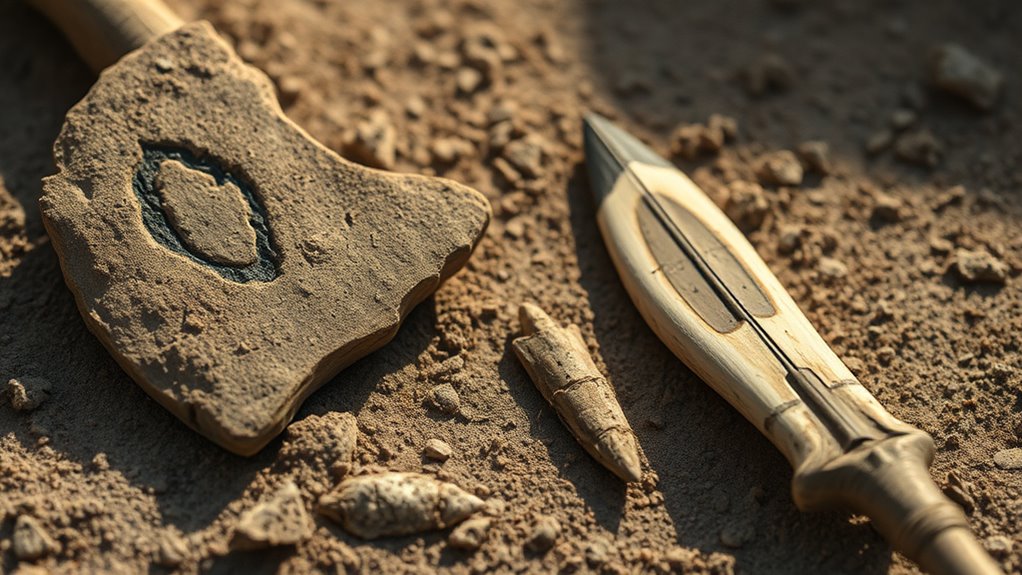
Primitive tools are the earliest inventions humans used to survive and adapt to their environment. These tools mark the beginning of technological innovation, enabling you to hunt, prepare food, and build shelters. The first tools were simple, but their effectiveness laid the foundation for future advancements. When exploring primitive tools, you’ll notice different stone tool types, each suited for specific tasks. For example, sharp flakes could be used for cutting, while larger, more robust stones served as hammers or chopping implements. These variations reflect an understanding of different materials and functions, even in the earliest stages of tool development.
Primitive tools laid the foundation for human survival and innovation through simple yet effective stone implements.
You’ll find that early tool making techniques involved striking one stone against another to produce sharp edges—this process is called knapping. By carefully flaking off pieces from a core stone, early humans could craft tools with pointed tips or blades. The craftsmanship required precision and patience, as every strike needed to be deliberate to produce the desired shape and edge. Over time, these techniques became more refined, allowing for the production of more specialized tools. For instance, you might observe that some tools were shaped into scrapers for cleaning animal hides, while others were modified into spears or arrowheads for hunting.
As you examine these tools, you’ll appreciate how early humans learned to select the right stones for different tasks. They understood that certain rocks, like flint or obsidian, could be knapped to produce extremely sharp edges. This knowledge of material properties was essential and represented an early form of scientific understanding. Furthermore, you’ll notice that some tools were retouched or reshaped after initial knapping, demonstrating an iterative process of improvement. This indicates that early humans not only made tools for immediate use but also adapted and refined their techniques over generations.
Building primitive tools also involved understanding where to find suitable raw materials. You might see evidence of tool production near sources of high-quality stone, such as riverbeds or rocky outcrops. Once a suitable core was selected, you or your ancestors would begin shaping it through a series of controlled strikes, creating tools that could be used repeatedly. This process was labor-intensive but essential for survival, as durable and effective tools increased your chances of hunting success and food processing.
In essence, primitive tools and their early making techniques exemplify human ingenuity. They show how you, even in ancient times, utilized available resources with skill and foresight. These innovations allowed you to thrive in diverse environments, paving the way for more complex tools and technologies in the future. Every chipped flake and shaped core represents a step in your ancestors’ journey toward mastering their surroundings and securing their survival.
As an affiliate, we earn on qualifying purchases.
Frequently Asked Questions
How Did Early Humans Discover Different Materials for Tools?
You likely discovered different materials for tools through observation and experimentation. By noticing which materials, like stones or bones, were durable or sharp, you engaged in material selection. Over time, you adapted your tools by testing and refining them, improving their effectiveness for tasks. This process of tool adaptation helped you find the best materials for specific purposes, making your tools more efficient and suited to your needs.
What Are the Earliest Known Primitive Tools?
Imagine you’re holding the keys to ancient discovery. The earliest known primitive tools are simple stone flakes and cores, shaped by stone flaking. You select materials like flint and obsidian for their sharp edges, then carefully strike to create these tools. These primitive implements helped early humans hunt and process food, opening a new chapter in survival and innovation. Your role in material selection and stone flaking made you a pioneer of progress.
How Did Primitive Tools Influence Human Evolution?
Primitive tools during the Stone Age markedly influenced your evolution by improving your ability to hunt, gather, and adapt. As tool evolution progressed, you developed sharper, more efficient implements, which boosted your survival chances. These advancements led to bigger brains and better problem-solving skills. By using and creating tools, you shaped your environment and your biological development, making you more intelligent and adaptable over time, ultimately paving the way for modern human civilization.
Were Primitive Tools Used for Specific Tasks or General Purposes?
You’d think primitive tools were the Swiss Army knives of their time, but no. They were mostly used for specific tasks, like hunting or cutting. Tool versatility was limited, so they didn’t double as all-in-one gadgets. Instead, early humans specialized tools for particular jobs, making each one a tiny, specialized masterpiece. This focus on tool specialization shaped the way humans adapted, rather than relying on one do-it-all tool.
How Did Primitive Toolmaking Spread Across Different Regions?
You can see that primitive toolmaking spread across regions mainly through trade networks and cultural transmission. As groups trade, they share techniques, ideas, and innovations, passing toolmaking skills from one community to another. This exchange helps societies adapt and improve their tools over time. You’ll notice that these interactions fostered the development of similar tools in distant areas, creating a shared technological foundation across different cultures.
Conclusion
By building and using primitive tools, you connect with our ancestors’ ingenuity. Imagine, like early humans shaping stones into cutting tools to hunt or gather food—these simple tools transformed survival. You can see how your own creativity and resourcefulness echo their innovations. Every scratch and shape reminds you that even the simplest tools hold incredible power, shaping your understanding of history. So, keep experimenting and discovering—your journey into primitive tool-making is just beginning.
Halloween Picks
halloween
As an affiliate, we earn on qualifying purchases.