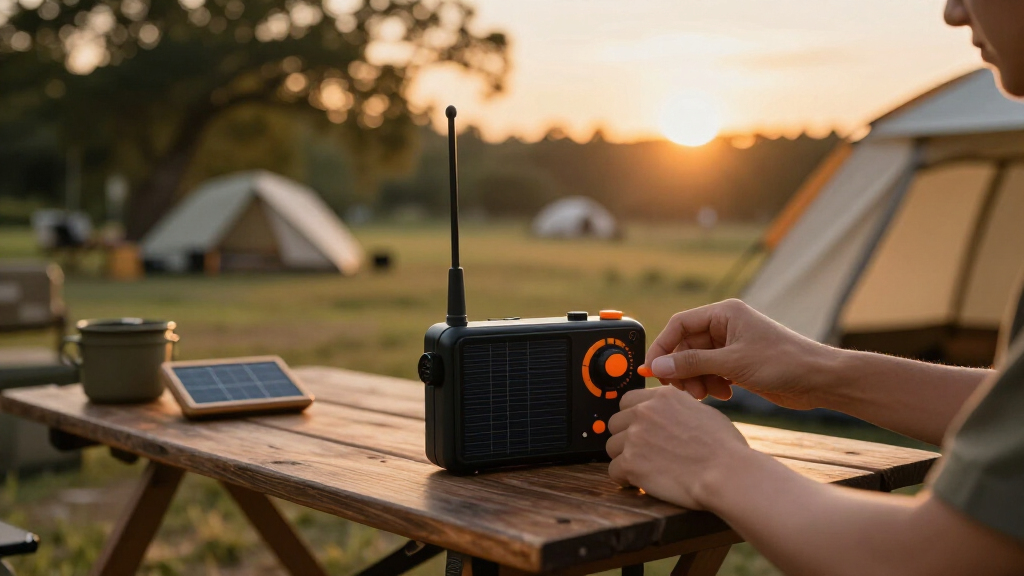
Solar-powered emergency radios occupy a strange place in preparedness shopping. Most buyers will never use one in a true emergency, which makes it tempting to grab the cheapest $25 unit with a crank and a solar panel. But the entire point of the purchase is the day the power goes out for three days, and on that day the differences between a $30 radio and a $80 radio stop being trivia and start being the difference between a working flashlight and a dead plastic brick. This comparison pits budget solar emergency radios — typified by brands like RunningSnail, Degen, and Retrospec in the $25–$40 range — against premium models like the Midland ER310, Eton FRX3+, and Kaito Voyager Pro in the $60–$100 range. The core tension is simple: budget radios deliver most of the feature checklist on paper, but cut corners on battery capacity, weather alerting, reception quality, and durability — the exact things that fail when you need them. We’ll compare them across the criteria that actually matter in an outage, tell you where the gaps are real versus cosmetic, and give a clear verdict on who should buy which.

Get emergency and outdoor gear delivered free — and shop member deals
- Fast, free delivery on millions of items
- Access to Prime Big Deal Days deals on October 6–7
- Prime Video, Amazon Music and more included
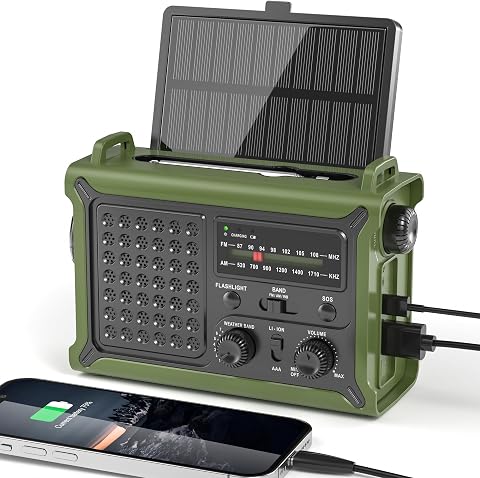
Solar Emergency Radio with Hand Crank, 12,000 mAh Battery, and NOAA/AM/FM Reception
- ✔ Battery capacity: 12,000 mAh
- ✔ Radio bands: NOAA, FM, AM
- ✔ Power sources: Solar panel, hand crank, 12,000 mAh lithium battery, USB-C input, 3 AAA batteries
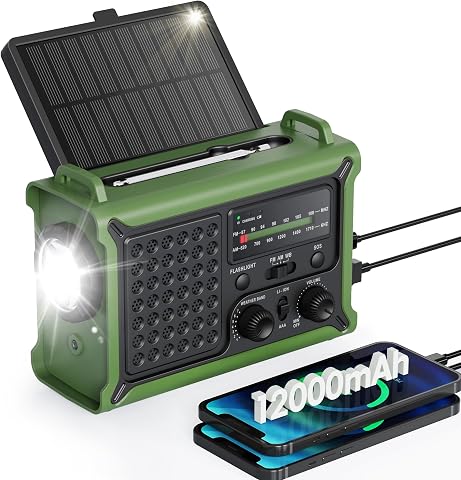
Emergency Weather Radio with Large Solar Panel and 12,000mAh Battery
- ✔ Battery capacity: 12,000mAh
- ✔ Solar panel: 8500mm² monocrystalline
- ✔ Radio bands: AM/FM/7 NOAA bands

Kaito KA500 Multi-Powered Emergency Weather Radio with Flashlight and Phone Charger
- ✔ Radio bands: AM, FM, 2-band shortwave
- ✔ Weather channels: 7 pre-programmed NOAA channels
- ✔ Power sources: Hand crank, solar panel, 3 AA batteries, USB input, AC/DC input, rechargeable NiMH battery pack
At a Glance
| Criteria | Budget solar emergency radios ($25–$40) | Premium solar emergency radios ($60–$100) | Winner |
|---|---|---|---|
| Battery capacity and runtime | 2000–4000 mAh lithium battery; typically 4–8 hours radio runtime per full charge | 2600–10,000 mAh; the Midland ER310’s 2600 mAh cell runs up to 32 hours, and larger models double as phone chargers | B |
| Weather band and alerts | NOAA weather band usually included, but few models support SAME localized alerts | NOAA with S.A.M.E. localized alerts on most models; some auto-activate on emergency broadcasts | B |
| Radio reception quality | Adequate for strong local AM/FM stations; struggles with weak or distant signals | Better tuners and antennas; hold weak stations and pull in distant NOAA broadcasts reliably | B |
| Charging options and speed | Hand crank, small solar panel, USB-in; crank charging is slow and laborious | Hand crank, larger solar panel, USB-in, and often swappable/rechargeable batteries (AA fallback) | B |
| Flashlight and signaling | Small LED flashlight (1–3 LEDs), no SOS beacon on most models | Brighter flashlight (up to 140+ lumens), ultrasonic dog whistle, SOS flashlight modes | B |
| Build quality and water resistance | Lightweight plastic, minimal or no water-resistance rating | Ruggedized housing, splash or IPX-rated sealing on several models | B |
| Warranty and support | Often 12 months or unclear; support from smaller brands is inconsistent | Typically 1–3 years from established brands (Midland, Eton) with real customer support | B |
Solar Emergency Radio with Hand Crank, 12,000 mAh Battery, and NOAA/AM/FM Reception
This radio earns our top spot because it gets the fundamentals right without overreaching. The 12,000 mAh battery is the headline feature: that’s enough stored energy to run the radio for days of intermittent listening and still act as a meaningful phone charger when the grid is down. Compared with the Kaito KA500, whose replaceable battery pack is far smaller, this model is the one you want when an outage stretches past a single evening.The five power sources — solar, hand crank, USB-C, the internal battery, and AAA backup — give you redundancy in the order you’d actually use it: drain the battery, top up with solar during the day, crank only in desperation. The 5-watt speaker is noticeably more robust than typical emergency radios, which matters when you’re trying to hear a NOAA broadcast in a noisy room or shelter. A 260-foot flashlight beam and a two-brightness reading lamp round out a well-considered feature set.The drawbacks are real, though. The manufacturer doesn’t publish charging times or runtime figures, so you’ll need to charge it fully before an emergency and treat the estimates conservatively. It’s also only water resistant rather than waterproof, so unlike our IPX6-rated runner-up, it shouldn’t be left out in driving rain.
Pros:
- Massive 12,000 mAh battery doubles as a genuine emergency phone charger
- Five independent power sources, including solar and hand crank
- Loud 5-watt speaker and 260-foot flashlight beam
- Two-brightness flashlight and reading lamp cover both task and area lighting
Cons:
- No published charging times or runtime figures
- Only water resistant, not waterproof rated
- Must be fully charged before first use
Best for: Households preparing for extended power outages who want a radio that doubles as a serious phone charger
Not ideal for: Anyone who needs a radio that can sit outside in heavy rain without protection
Bottom line: The most complete all-around package — big battery, real speaker, and full charging redundancy make it our best overall pick.
“The most complete all-around package — big battery, real speaker, and full charging redundancy make it our best overall pick.”
Emergency Weather Radio with Large Solar Panel and 12,000mAh Battery
If our top pick is the stay-inside option, this one is built for the storm itself. The IPX6 waterproof rating is the key differentiator — it can withstand heavy rain and direct water jets, which neither the water-resistant-only top pick nor the Kaito KA500 can claim. For campers, boaters, and anyone whose emergency plan involves being outdoors, that rating alone justifies choosing it.The second standout is the 8500mm² monocrystalline solar panel, which is substantially larger than what you’ll find on most emergency radios, including the Kaito. In practice, that means faster solar recovery during daylight hours — the difference between topping up and merely trickling. It matches our top pick on the essentials: 12,000 mAh of storage, the same five charging methods, and NOAA alert reception with an SOS alarm.Where it falls slightly short is in documentation and details. Charging times and runtime are unspecified, and the AAA battery option requires batteries you must supply yourself. We also found less transparency around real-world performance data than we’d like for a device you’re betting on in an emergency — a reason it sits second rather than first despite its superior weatherproofing.
Pros:
- IPX6 waterproof rating handles heavy rain and jets of water
- Large 8500mm² monocrystalline solar panel charges faster than typical units
- Same 12,000 mAh capacity and five charging methods as our top pick
- NOAA alerts plus a loud SOS alarm
Cons:
- No published charging or runtime data
- AAA batteries not included
- Heavier emphasis on rugged design than on documentation transparency
Best for: Campers, hikers, and anyone in flood- or hurricane-prone areas who needs a radio that shrugs off heavy rain
Not ideal for: Buyers who want detailed runtime and charging specifications before committing
Bottom line: The rugged, rain-ready choice — its IPX6 rating and oversized solar panel make it the best pick for outdoor emergencies.
“The rugged, rain-ready choice — its IPX6 rating and oversized solar panel make it the best pick for outdoor emergencies.”
Kaito KA500 Multi-Powered Emergency Weather Radio with Flashlight and Phone Charger
The Kaito KA500 is the veteran of this lineup, and it takes a fundamentally different approach: instead of maximizing battery capacity, it maximizes reception flexibility. It’s the only radio here with 2-band shortwave alongside AM, FM, and the seven pre-programmed NOAA channels, which makes it the clear choice for anyone who needs news beyond North American broadcasts — travelers, missionaries, offshore workers, and international listeners.Its power strategy is the most diverse of the three: hand crank, solar, AA batteries, USB, AC/DC input, and a rechargeable NiMH pack. Compared with the two 12,000 mAh models, the KA500 is lighter on stored energy, so it’s a weaker emergency phone charger — think one partial top-up rather than multiple charges. But its 14.5-inch telescopic antenna and shortwave circuitry pull in stations the others simply can’t receive, and its impact-resistant ABS housing has proven durable over years on the market.The tradeoffs: AA batteries and a wall adapter are not included, so budget for those. NOAA coverage is limited to the USA and Canada — irrelevant for most buyers, but a genuine limitation for anyone crossing borders. If your priority is domestic weather alerts with maximum battery, buy our top pick instead; buy the Kaito if the radio, not the battery bank, is the point.
Pros:
- Only model with 2-band shortwave reception for international broadcasts
- Six power options including AC/DC input and USB
- Impact-resistant, water-resistant ABS construction with telescopic antenna
- Three lighting modes including a red LED SOS beacon
Cons:
- Smaller battery makes it a limited phone charger compared with 12,000 mAh rivals
- AA batteries and wall power adapter not included
- NOAA weather coverage limited to USA and Canada
Best for: Shortwave listeners, travelers, and anyone who wants the broadest reception coverage rather than maximum battery capacity
Not ideal for: Buyers whose main goal is recharging a phone repeatedly during a long outage
Bottom line: The reception-first choice — unmatched band coverage and power flexibility for listeners who need more than domestic NOAA alerts.
“The reception-first choice — unmatched band coverage and power flexibility for listeners who need more than domestic NOAA alerts.”
As an Amazon Associate we earn from qualifying purchases.
Key Differences
The honest headline is that premium radios win on nearly every measurable criterion — but not by margins that matter equally to every buyer. The two differences with real emergency consequences are battery capacity and weather alerting. A budget radio’s 2000 mAh cell might run the radio for an evening; a Midland ER310 can run 32 hours on a charge and, more importantly, can recharge a phone twice. In a multi-day outage, the radio stops being just a radio and becomes your information appliance and partial power bank, and budget units simply don’t have the reserves for that role. Similarly, S.A.M.E. localized weather alerts — standard on most premium models, rare on budget ones — mean the radio wakes itself up and warns you about a tornado warning for your specific county at 3 a.m. A budget radio requires you to be listening at that moment.
The second tier of differences — reception, build quality, charging flexibility — matters most for people in rural areas or harsh climates. Budget radios often have mediocre tuners that hiss and drop weak NOAA signals, and their lightweight plastic housings with no water-resistance rating are a liability in the flood-and-hurricane scenarios where you’d most likely deploy them. Premium models frequently add AA-battery fallback, which sounds boring until you realize spare AAs are the most available power source in any extended crisis.
Where budget radios genuinely win is value for casual preparedness. If your realistic emergency scenario is a 12-hour power outage and you just want AM/FM news, a flashlight, and a phone top-up, a $30 RunningSnail MD-090 style unit does that job nearly as well as an $80 Midland. The premium price buys resilience against longer, harsher scenarios that may never happen — which is exactly what insurance is.
Detailed Comparison
This is the biggest gap between the two tiers and the one with the most practical consequences. Budget radios typically ship with 2000–4000 mAh lithium cells that deliver roughly 4–8 hours of radio playback per full charge — enough for an evening, not a multi-day event. Their USB output can usually add 20–50% to a modern smartphone before the radio itself is drained. Premium radios carry larger or better-managed cells: the Midland ER310’s 2600 mAh battery runs up to 32 hours in low-power mode and larger units in the $80–$100 class hold 6,000–10,000 mAh, enough to fully recharge a phone once or twice while still running the radio. In an outage lasting several days, the budget radio becomes a device you ration; the premium radio becomes a device you rely on. Winner: B, by a major margin.
Both tiers almost universally include the NOAA weather band — it’s table stakes at this point. The real difference is alerting. Premium models like the Midland ER310 and Eton FRX series support S.A.M.E. (Specific Area Message Encoding), which lets you program your county so the radio sounds an audible alarm when the National Weather Service issues a warning for your exact area, even if the radio is otherwise idle. Several models also feature an alert mode that wakes the device automatically. Most budget radios make you tune to the weather band manually and keep it playing to hear anything. If your emergency scenario includes tornadoes, hurricanes, or flash floods — events that strike with minutes of warning, often overnight — this feature alone justifies the price difference. Winner: B, by a moderate-to-major margin depending on your hazard profile.
Radio reception is where manufacturing cost quietly shows up. Budget radios use inexpensive tuner chips and short internal antennas; they perform acceptably on strong local AM/FM stations but hiss, drift, or drop weak signals — which is precisely the NOAA broadcast you’ll want if you’re rural or the emergency is regional. Premium radios use better tuners and often telescoping or larger antennas that lock onto weak stations and hold them. The gap is minor if you live in a metro area with strong transmitters; it’s meaningful-to-major if you’re twenty miles past the suburbs. Winner: B, moderate gap, situational impact.
Both tiers offer the same charging trinity: hand crank, solar panel, and USB-in. What differs is execution. Budget radios have small solar cells that deliver a trickle — expect many hours of direct sun for modest charge — and cranks that feel flimsy and produce roughly 10–15 minutes of runtime per 5 minutes of cranking. Premium radios fit larger panels, sturdier cranks with better gearing, and — the underrated feature — many accept standard AA batteries as a fallback. In an extended emergency, spare AAs are the cheapest, most available, most shareable power source in existence, and being able to run your emergency radio on them is a genuine resilience advantage. Winner: B, moderate gap.
Budget radios include a small LED flashlight — usually 1 to 3 LEDs, adequate for finding the fuse box but not for lighting a room. Premium units step this up meaningfully: the ER310’s flashlight produces up to 140 lumens with an SOS flasher mode, and Eton models add red emergency beacons. Some premium units (including the ER310) add an ultrasonic dog whistle, aimed at search-and-rescue scenarios. If you already own good flashlights and headlamps, this criterion shrinks to a tie; if the emergency radio will be your only light source, the gap is real. Winner: B, moderate.
Budget radios are built to a price: lightweight plastic shells, no ingress-protection ratings, and buttons that can feel vague. They survive a shelf and a backpack; whether they survive a drop onto concrete or a rain-soaked evacuation is less certain. Premium radios use thicker housings, better-sealed controls, and several carry splash resistance or IP ratings. Durability is unglamorous until the emergency itself involves weather — which, for most people who buy these radios, it does. Winner: B, moderate-to-major depending on your climate and bug-out plans.
Budget brands frequently offer a one-year warranty with support that’s slow or hard to reach, and some generic Amazon listings are unclear about the manufacturer entirely. Midland and Eton are established companies with documented warranties (Midland backs the ER310 for a year, and their support channels are responsive), real parts availability, and brand accountability. For a device that may sit unused for two years before you need it, knowing the company will still exist and honor a claim has value. Winner: B, minor-to-moderate gap.
Budget solar emergency radios ($25–$40): Pros and Cons
Pros:
- A third to half the price — viable for buying one per car or per family member
- Covers the core checklist: AM/FM/NOAA, crank, solar, USB out, flashlight
- Compact and light enough for a glove box or desk drawer
- Low financial risk if you’re unsure how serious you are about preparedness
Cons:
- Small battery that runs out in hours, not days, and barely charges a phone
- No S.A.M.E. localized alerts on most models — you must be actively listening
- Weaker reception on distant or weak stations
- Fragile, non-water-resistant build; unclear long-term brand support
Pros:
- Multi-day runtime and enough reserve to recharge a phone once or twice
- S.A.M.E. county-specific alerts that wake the radio automatically
- AA-battery fallback on many models — the most available power in a crisis
- Ruggedized, splash-resistant build from established brands with real warranties
Cons:
- Two to three times the cost of a budget unit
- Larger and heavier — less pocketable, more of a kit item
- Overkill for buyers whose worst case is a brief power blip
Who Should Choose What
Choose Budget solar emergency radios ($25–$40) if:
- Your realistic emergency is a short outage and you mainly want news, a light, and a partial phone charge
- You want to equip multiple locations — car, office, kids’ apartments — on a tight budget
- You’re testing whether preparedness gear is for you before committing real money
- You live in a strong-signal urban area and already own quality flashlights and power banks
Choose Premium solar emergency radios ($60–$100) if:
- You face real weather hazards — hurricanes, tornadoes, floods, wildfire — where overnight warnings matter
- Your outage scenarios could last days, and the radio may be your primary information device and backup charger
- You live rural or fringe-signal and need reliable NOAA reception
- You’re building a home or vehicle emergency kit where the gear must work years from now, in bad conditions, first try
Skip both if: If you have no weather hazards, strong cell coverage, and a home battery generator, a smartphone plus NOAA app covers most short outages — or skip standalone radios entirely and put the budget toward a power station.
Value for Money
Value here depends on what you’re insuring against. At $25–$40, budget radios are excellent value for casual preparedness: you get 80% of the feature list for 40% of the price, and for a 12-hour outage, that 80% is everything you’ll use. At $60–$100, premium radios are worse value on paper and better value in a real emergency — the extra $40–$60 buys battery reserves, automatic alerts, and durability that only pay off when things go genuinely wrong. That’s a fair definition of insurance. The strongest value play for most households is one premium unit (the Midland ER310 at roughly $70–$80 is the standard recommendation) as the home base, supplemented by a cheap budget unit in the car. Buying two budget radios instead of one premium one is a reasonable hedge, but understand you’re doubling down on short runtime and no automatic alerts. Paying more than $100 gets you diminishing returns — larger batteries and nicer aesthetics — unless you specifically need IP-rated ruggedness or ham-band capability, at which point you’re shopping a different category.
Final Verdict
If you live anywhere with serious weather risk — and that’s most of the United States — buy a premium radio, and specifically one with S.A.M.E. alerts and AA-battery fallback. The Midland ER310 is the benchmark for a reason: 32-hour runtime, county-coded alerts, AA fallback, and a ruggedized shell for around $70–$80. That extra forty-plus dollars over a budget unit buys the two features that matter in an actual emergency: the radio that wakes you when a warning is issued, and the battery that’s still alive on day three. Choose a budget radio only if your worst case is a brief, mild outage or if you’re distributing radios across several locations — it’s a fine product for that job and poor insurance for anything bigger. The single deciding factor is battery capacity plus automatic alerting: if your emergency plan depends on the radio working unattended for days, premium is not a luxury upgrade, it’s the minimum spec. One premium unit at home, one budget unit in the car, is the configuration that covers the most people for the least money.
Frequently Asked Questions
Do the solar panels on these radios actually work?
They work, but slowly. Both budget and premium panels deliver a trickle charge — expect 10+ hours of direct sunlight for a meaningful charge on budget models and somewhat faster on premium units with larger panels. Treat solar as a maintenance/top-up method, not your primary charging source. Hand cranking and USB pre-charging are your real power sources; solar’s value is keeping a topped-off battery topped off during a long event.
How long does hand cranking actually take to charge the radio or a phone?
Realistically, about 5 minutes of cranking yields 10–20 minutes of radio runtime or a 1–3% phone charge. Cranking is exhausting and meant for short bursts — enough to catch a news update or make one call. This is true across both tiers, though premium units have smoother gearing and better efficiency. Never plan on cranking as your primary power strategy.
What is S.A.M.E. and is it worth paying extra for?
Specific Area Message Encoding lets you program the radio for your county so it sounds an alarm only for warnings that affect you — a tornado warning at 3 a.m. will wake the radio and you, even if it was otherwise idle. Without it, you must be actively listening to the weather band to hear anything. If your area has tornadoes, hurricanes, or flash floods, yes, it’s worth the premium almost by itself.
Can these radios replace a power bank for charging my phone?
Budget radios: barely — expect a 20–50% top-up before the radio’s own battery is depleted. Premium radios with larger cells can deliver one to two full phone charges. If phone charging is a priority, buy a dedicated 10,000 mAh power bank (cheaper and faster) and let the emergency radio focus on information and alerts.
How often should I recharge a stored emergency radio?
Lithium cells self-discharge and degrade if stored empty. Top up the battery every 3–6 months, and store the unit out of direct heat. If your premium model accepts AA batteries, keep a fresh pack of lithium AAs alongside it — those have a 10+ year shelf life and eliminate the self-discharge problem entirely.
Fall Picks
fall essentials
As an affiliate, we earn on qualifying purchases.