
TL;DR

Get emergency and outdoor gear delivered free — and shop member deals
- Fast, free delivery on millions of items
- Access to Prime Big Deal Days deals on October 6–7
- Prime Video, Amazon Music and more included
Solar-powered emergency radios are portable devices designed for disaster preparedness, combining multiple charging methods (solar panel, hand crank, USB) with AM/FM and NOAA weather radio reception. The solar panels are small (usually 0.3–1W) and charge slowly, so treat solar as a backup — the internal battery, charged from USB before an emergency, is your primary power source. Expect to pay $20–60 for a reliable unit from brands like Midland, Eton, or FosPower.
The power was out for three days after the storm. Your phone sat at 12%, the cell towers were down, and the only news coming in was from a $35 plastic box sitting on the windowsill, soaking up sun. That’s the pitch for solar-powered emergency radios — and mostly, it holds up. Just not quite the way the packaging implies.
Here’s the part most buyers miss: the solar panel is the slowest charging method on nearly every model. The real value isn’t the sun. It’s the redundancy — solar, hand crank, USB, and a built-in battery all backing each other up, paired with NOAA weather alerts that work when nothing else does.
In this article, you’ll learn what these radios actually do well, where the marketing oversells, which features are worth paying for, and how to store one so it works the day you need it.
Treat the solar panel as a slow backup: most emergency radio panels produce only 0.3–1W, so charge the internal battery from USB before an emergency and use so…
One minute of hand cranking yields only a few minutes of radio playback or roughly 1% of a phone charge — budget your cranking for NOAA weather updates.
Insist on NOAA weather band reception (with SAME alerts if possible) and FCC certification; distrust budget brands claiming 10,000 mAh at suspiciously low pric…
Store the radio at 50–70% charge in a cool, dry place and recharge it every 3–6 months — internal batteries degrade over 2–5 years and can die permanently in s…
Use the phone-charging feature for one critical call, not daily use; pair the radio with a dedicated power bank for real device charging.
Reliable models from Midland, Eton, FosPower, RunningSnail, and Kaito typically cost $20–60 — you don’t need to spend more unless you want shortwave reception.
What a Solar Emergency Radio Actually Is (Beyond the Solar Part)
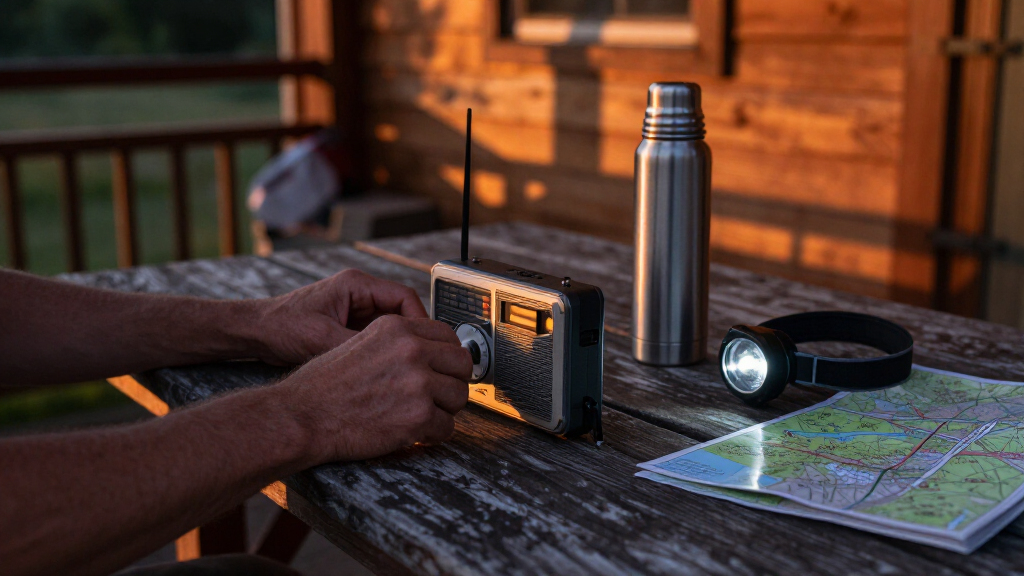
Solar-powered emergency radios are portable devices designed for disaster preparedness that combine multiple charging methods with radio reception — and usually a flashlight, SOS alarm, and USB port for charging your phone. Think of them as a survival Swiss Army knife built around a radio, not a radio with a gimmick attached.
The typical unit receives AM/FM and NOAA weather bands (in the US; Canada has its own Weatheradio service through Environment Canada). NOAA matters more than most people realize: it’s a dedicated network broadcasting continuous weather forecasts and, during emergencies, official alerts from the National Weather Service. When cell networks fail, that signal is still there.
Most models add a hand-crank dynamo, an LED flashlight, and a USB-out port. Some include SAME technology (Specific Area Message Encoding), which filters alerts so you only hear warnings for your specific county instead of every siren in a three-state area.
The Solar Truth: Why the Panel Is Your Slowest Option
Yes, the solar panel works — but it’s a trickle, not a firehose. The panels on these radios are tiny, typically 0.3 to 1 watt, which means a full charge from empty can take many hours of direct sunlight, sometimes spread across multiple days. Leave it on a sunny windowsill for a week before a hurricane and you’re fine. Expect it to save you during the blackout itself, and you’ll be disappointed.
The hand crank is faster in the short term but brutal on the wrists. A common rule of thumb: one minute of cranking buys you a few minutes of radio playback or roughly a 1% phone charge. During a real emergency, that trade is worth it for a weather update. It’s not how you’ll power a phone call of any length.
The real primary power source is the internal lithium-ion battery — often rated 2,000 to 10,000 mAh — which you charge from a USB port before anything goes wrong. Solar and crank are your backups, not your engine.
The honest framing: a solar emergency radio is a battery-powered radio with two emergency escape hatches. Charge it from the wall, and the sun becomes your insurance policy.
Hand Crank vs. Solar vs. USB: Which Power Source Pulls Its Weight
Not all charging methods are equal, and knowing the hierarchy changes how you use the radio. Here’s how the three main sources compare in practice:
| Charging Method | Speed | Best Use | Realistic Expectation |
|---|---|---|---|
| USB (wall/laptop) | Hours for full charge | Pre-emergency top-ups | Primary power source |
| Solar panel | Many hours of direct sun | Slow maintenance charging | Backup — 0.3–1W output |
| Hand crank | Instant but minimal | Emergency radio sessions | ~1 min cranking = a few min of radio |
A practical pattern: after a storm knocks out power, listen to NOAA updates in crank-powered bursts during the day, and let the unit soak up sun on a windowsill or porch rail between sessions. That rhythm can stretch a radio’s usefulness for days.
5 Features Worth Paying For (and 2 You Can Skip)
Price differences between a $20 radio and a $60 one come down to a handful of features. Some are genuinely useful; others are spec-sheet padding. Here’s what matters:
- NOAA weather band with alerts — non-negotiable in North America. If a radio lacks it, keep shopping.
- USB-C charging port — newer models are moving past micro-USB, and you don’t want to hunt for a legacy cable mid-emergency.
- Genuine battery capacity — look for FCC certification and be skeptical of budget brands claiming 10,000 mAh at $25; capacity claims are frequently overstated.
- Real water resistance — check the IP rating. IPX3 means splash-resistant; IPX5 or higher means it can survive rain and hose spray.
- SAME alert technology — worth it if you want county-specific warnings instead of every alert in the broadcast region.
What you can skip: shortwave reception is a nice-to-have unless you’re a radio hobbyist, and bolted-on compasses are usually too small to trust. Trusted brands in this space include Midland, Eton (which licenses the American Red Cross name), FosPower, RunningSnail, and Kaito.
How to Store Your Radio So It Actually Works in Year Three
Stored wrong, your emergency radio becomes a paper weight long before the disaster arrives. The internal batteries — lithium or NiMH — degrade over 2–5 years, and a battery left fully dead for months may never hold a charge again.
The fix is a simple maintenance habit:
- Store the radio partially charged (around 50–70%), not empty and not pinned at 100%.
- Keep it in a cool, dry spot — a hallway closet, not a hot garage or damp basement.
- Recharge it every 3–6 months, the same weekend you test your smoke detectors.
- Do a 10-minute function check while you’re at it: tune to a local station, spin the crank, test the flashlight.
One reader scenario worth picturing: you bought the radio during a scare four years ago, tossed it in a bin, and the wildfire evacuation order arrives at 2 a.m. If the battery died in storage, none of those charging methods will resurrect it quickly. Six minutes of upkeep twice a year prevents that.
Can It Really Charge Your Phone? The Honest Answer
Yes — but only in the sense that a garden hose can fill a swimming pool. A radio’s USB-out port will charge a phone, and a large 10,000 mAh unit can deliver a meaningful top-up once. But cranking a phone to life is deeply inefficient: ten minutes of cranking might get you a few percent of battery, enough for a short emergency call or a few texts, and nothing more.
The right mindset: the phone-charging feature is for making one critical call when your phone is dead and the outage is dragging on. It is not a daily charging solution. For extended emergencies, a dedicated power bank charged ahead of time does that job far better — the radio handles information, not power.
According to FEMA and Red Cross preparedness guidance, a battery or hand-crank radio remains a standard item on every recommended emergency kit checklist precisely because information, not electricity, is the scarcest resource in a disaster.
Frequently Asked Questions
Do solar-powered emergency radios actually work on solar alone?
Yes, but slowly. The panels are small — usually 0.3 to 1 watt — so a full charge can take many hours or days of direct sunlight. Solar works best as a trickle-maintenance method during an extended outage, not as your primary way to power the radio. Charge from USB beforehand and let the sun extend your runtime.
How long does hand cranking give me?
Expect roughly a few minutes of radio playback per minute of cranking, or about 1% of phone charge per several minutes of effort. It’s tiring but reliable — enough for weather updates and short listening sessions when every other power source is gone.
Do I really need the NOAA weather band?
In North America, yes. NOAA’s weather radio network broadcasts continuous forecasts and official emergency alerts, and it keeps operating when cell service fails. Look for SAME (Specific Area Message Encoding) support if you want alerts limited to your county rather than the whole broadcast region.
What’s the difference between a $20 and a $60 emergency radio?
Higher-priced models typically offer larger genuine battery capacity, USB-C instead of micro-USB, better build and water resistance (IPX5 versus IPX3), and sometimes SAME alerts or shortwave reception. Below $20, expect overstated mAh ratings and cheaper components. Brands like Midland, Eton, and FosPower hit the sweet spot in the $20–60 range.
How should I store my emergency radio between disasters?
Store it at roughly 50–70% charge in a cool, dry location, and recharge it every 3–6 months. Internal lithium or NiMH batteries degrade over 2–5 years, and one left fully dead for months may never hold a charge again. Tie maintenance to your smoke-detector testing days so you don’t forget.
Conclusion
If you remember one thing: buy the radio for its redundancy, charge it from the wall, and maintain it twice a year. The solar panel will rarely save you — but a pre-charged battery backed up by a crank and a panel, tuned to NOAA, will keep information flowing when everything else goes dark.
Somewhere in a closet right now, there’s a radio bought during the last emergency, battery quietly dying. Give yours ten minutes this weekend. Future you, sitting in the dark at 2 a.m. with a storm outside, will be glad you did.
Evergreen bestsellers Picks
bestsellers
As an affiliate, we earn on qualifying purchases.