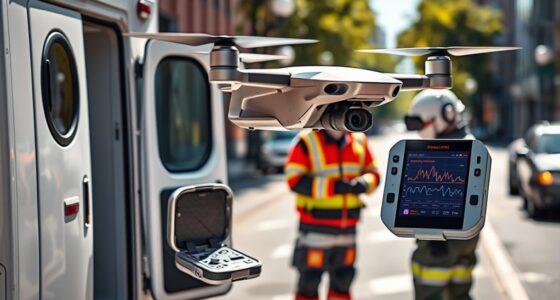
Wearable sensors help you monitor essential signs like heart rate, oxygen levels, and temperature in real time during crises. They’re user-friendly, lightweight, and stay on even in chaos, allowing you to maintain routines while staying safe. These sensors wirelessly send data to emergency teams, helping them prioritize care quickly. Advances in AI and technology continue to improve their accuracy and effectiveness, enabling faster, more precise responses if you explore further.
Key Takeaways
- Enable real-time vital sign monitoring like heart rate and oxygen levels during emergencies for immediate assessment.
- Facilitate wireless data transmission to responders and hospitals for rapid decision-making.
- Designed for comfort and extended wear, ensuring continuous data collection in chaotic environments.
- Support integration with health records and AI analytics to predict complications and optimize responses.
- Enhance crisis management by helping responders prioritize cases and coordinate interventions efficiently.

In crisis situations, timely health monitoring becomes critical, and wearable sensors have emerged as essential tools to meet this need. These devices continuously collect sensor data that offers real-time insights into an individual’s vital signs, such as heart rate, blood oxygen levels, and body temperature. This constant stream of data allows healthcare providers and emergency responders to assess a patient’s condition instantly, even from a distance. When seconds matter, having immediate access to accurate sensor data can be the difference between life and death. As a responder, you can prioritize urgent cases based on the information gathered, ensuring that resources are allocated efficiently and effectively. Wearable sensors eliminate the delays associated with traditional monitoring methods, providing a dynamic picture of a person’s health status during a crisis.
In crisis, wearable sensors provide instant health insights, enabling rapid response and effective resource allocation.
You’ll find that these sensors are designed to be user-friendly, often lightweight, and non-intrusive, allowing individuals to wear them comfortably for extended periods. This ease of use means that even in chaotic environments, people can continue their daily routines while still being monitored. The real power of wearable sensors lies in their ability to transmit data wirelessly to centralized systems, such as emergency response teams or hospitals. This immediate transmission ensures that critical health information is available at a moment’s notice, enabling swift decision-making. For emergency responders, this means you can act with confidence, knowing you have access to up-to-date health metrics, which helps in triaging patients effectively.
Moreover, sensor data collected during crises can be integrated with other health records and analytics platforms, offering an all-encompassing view of an individual’s health trajectory. This integration supports not only immediate emergency response but also long-term recovery planning. When disaster strikes, you’re often working under intense pressure, and having reliable, real-time sensor data helps you prioritize care, predict potential complications, and deploy appropriate interventions quickly. These sensors also contribute to better coordination among responders, hospitals, and public health agencies, streamlining efforts and reducing response times. Advances in AI are increasingly enhancing the capabilities of wearable sensors, enabling more sophisticated data analysis and predictive insights.
In essence, wearable sensors transform the way health monitoring is conducted during crises. They provide vital sensor data that enhances emergency response capabilities, ensuring that help reaches those in need faster and more accurately. As technology advances, these devices will become even more integrated into emergency protocols, making crisis management more effective and saving more lives. If you’re involved in emergency response, leveraging wearable sensor technology means you’re better equipped to handle unpredictable, fast-moving situations with precision and confidence.
Frequently Asked Questions
How Do Wearable Sensors Ensure User Privacy During Crises?
During crises, wearable sensors protect your privacy by implementing data encryption, which secures your health information from unauthorized access. They also guarantee user anonymity, so your identity remains confidential even if data is shared. You can trust these devices to prioritize your privacy while monitoring your health, giving you peace of mind knowing that sensitive information stays protected through robust encryption methods and anonymous data handling.
What Are the Costs Associated With Deploying Wearable Sensors Widely?
You face significant costs when deploying wearable sensors widely, including equipment expenses, maintenance, and data management. A thorough cost analysis helps identify budget needs, while funding challenges may slow implementation. You must also consider training users and upgrading infrastructure, which add to overall costs. Balancing these financial factors guarantees effective deployment, but requires careful planning and resource allocation to overcome the hurdles and maximize health monitoring benefits.
How Do Sensors Function in Extreme Environmental Conditions?
You’ll find that sensors function well in extreme conditions by prioritizing sensor durability and environmental calibration. Durable sensors are built to withstand harsh elements like extreme temperatures, humidity, and physical shocks. Proper environmental calibration guarantees the sensors provide accurate readings despite environmental changes. Regular maintenance and adaptive algorithms also help maintain performance, allowing you to rely on wearable sensors even in challenging environments.
What Are the Limitations of Current Wearable Sensor Technology?
You’ll find that current wearable sensors face limitations in sensor accuracy and battery life. While they provide valuable data, inaccuracies can occur due to environmental factors or device design, affecting reliability. Additionally, short battery life restricts continuous monitoring, especially during extended crises. These issues challenge consistent health tracking, so improvements in sensor precision and power efficiency are essential for more effective and reliable health monitoring in demanding situations.
How Accessible Are Wearable Sensors for Low-Resource Communities?
You might find that affordable access to wearable sensors remains limited in low-resource communities due to high costs and infrastructure gaps. However, community engagement plays a vital role in increasing accessibility by fostering local support, education, and tailored solutions. By involving the community, you can help develop affordable, culturally appropriate wearable sensors that meet local needs, ultimately improving health monitoring and crisis response in underserved areas.
Conclusion
As you embrace wearable sensors, you become a vigilant guardian of your health amid chaos. These devices act like loyal sentinels, constantly watching over you, ready to alert you at the first sign of trouble. In crises, they turn your body into a fortress of awareness, empowering you to take swift action. With each heartbeat and breath monitored, you hold the power to navigate uncertainty confidently, transforming technology into your personal shield in the storm.