
For most households, I’d start with the Midland WR400 for its dedicated home-radio design, then compare the Midland ER310 for portable backup power and the FosPower A1 for a hand-crank-and-solar option. Emergency weather radios differ most in how they deliver alerts, how long they can operate without wall power, and how easily you can use them during a stressful outage. A plug-in model can be simpler at home, while portable radios trade some convenience for charging options and mobility. Battery capacity, alert setup, and reception also vary, so the most feature-packed choice may not be the easiest one for your situation. Read on for the full breakdown and buying advice.

Get emergency and outdoor gear delivered free with Prime
- Fast, free delivery on millions of items
- Prime Video, Amazon Music and more included
- Member-only deals all year
Key Takeaways
- The Midland WR400 is the strongest home-focused pick in this lineup; it prioritizes dedicated alerting rather than hand-crank charging or high-capacity portable power.
- The Midland ER310 and ER310PRO serve portable-use buyers, while the FosPower A1 and Kaito KA500 emphasize multiple ways to recharge when outlets are unavailable.
- Large advertised battery capacity is not the same as proven runtime. The 12,000 mAh and 22,000 mAh models stand out for capacity claims, but buyers should also check what the manufacturer specifies about charging and actual use.
- The WR120B and DreamSky battery-backup radio suit straightforward home alerting; they are a better fit for a dedicated indoor location than for carrying on a long evacuation.
- Feature count creates tradeoffs. Cranks, solar panels, lights, Bluetooth, and extra charging can add flexibility, but may also make controls, setup, or maintenance less straightforward.
| Midland WR400 Deluxe NOAA Weather Radio with Emergency Alerts |  | Best for Detailed Home Alerts | Weather channels: 10 | County programming: Up to 25 counties | Emergency alerts: 80 types | VIEW LATEST PRICE | See Our Full Breakdown |
| DreamSky NOAA Weather Alert Radio with Battery Backup and FM Radio |  | Best for Simple Localized Alerts | Alert technology: S.A.M.E. localized county programming | County codes: 23 customizable | Emergency alerts: More than 80 events | VIEW LATEST PRICE | See Our Full Breakdown |
| Midland ER310PRO Portable Emergency Bluetooth Weather AM/FM Radio |  | Best for Extended Portable Power | Battery capacity: 10,000 mAh | Listed battery life: Up to 200 hours during radio use | Power sources: Solar panel, hand crank, and lithium-ion battery | VIEW LATEST PRICE | See Our Full Breakdown |
| DreamSky NOAA Emergency Weather Radio with Hand Crank |  | Best for Broad Radio-Band Coverage | Radio bands: AM, FM, shortwave, and NOAA weather | AM frequency range: 520–1710 kHz | FM frequency range: 87–108 MHz | VIEW LATEST PRICE | See Our Full Breakdown |
| FosPower A1 NOAA Emergency Weather Radio with Solar and Hand Crank, Orange |  | Best for a Compact, Water-Resistant Kit | Radio bands: AM/FM/WB | Power sources: Solar, hand crank, AAA batteries, and USB | Power bank capacity: 7400 mWh (2000 mAh) | VIEW LATEST PRICE | See Our Full Breakdown |
| Midland WR120B NOAA Emergency Weather Alert Radio |  | Best for Localized Home Alerts | Alert coverage: More than 60 types of weather hazards and emergencies | Programmable counties: Up to 25 | Display: Continuously backlit LCD | VIEW LATEST PRICE | See Our Full Breakdown |
| Emergency Weather Radio with 12,000 mAh Battery and Solar Panel | 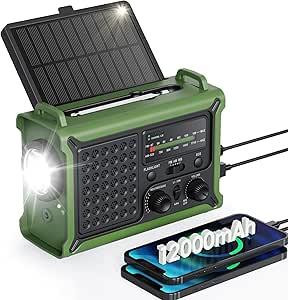 | Best for Waterproof Outdoor Use | Battery capacity: 12,000 mAh | Charging options: USB-C, solar panel, hand crank, built-in battery, or AAA batteries | Radio bands: AM, FM, and 7 NOAA bands | VIEW LATEST PRICE | See Our Full Breakdown |
| 22,000 mAh Emergency Weather Radio with Solar and Hand Crank Charging |  | Best for Phone Charging Capacity | Battery capacity: 22,000 mAh | Charging options: USB-C, solar panel, or hand crank | USB-C output: Up to 20 W | VIEW LATEST PRICE | See Our Full Breakdown |
| RunningSnail NOAA Weather Radio with Emergency Alerts and Battery Backup |  | Best for Configurable Alert Notifications | Alert types: More than 80 | County codes: Up to 23 | NOAA channels: 7 selectable | VIEW LATEST PRICE | See Our Full Breakdown |
| Kaito KA500 Emergency Weather Radio with Solar Charging, Hand Crank, Flashlight, and Reading Lamp |  | Best for Broad Radio Band Coverage | Radio bands: AM, FM, 2-band shortwave, and 7 NOAA weather channels | Power sources: Hand crank, solar, 3 AA batteries, built-in rechargeable NiMH pack, or optional adapter | USB output: 5V | VIEW LATEST PRICE | See Our Full Breakdown |
| Midland ER310 Emergency Crank Weather AM/FM Radio |  | Best for Off-Grid Backup | Radio bands: AM/FM, 2-band | Weather alerts: NOAA weather scan and alert | Power sources: Solar, hand crank | VIEW LATEST PRICE | See Our Full Breakdown |
| PRUNUS J161 Portable NOAA Weather Radio with AM/FM, White |  | Best Compact Listening Radio | Weather band: 162.40–162.55 MHz; seven NOAA weather bands | AM frequency: 520–1710 kHz | FM frequency: 87–108 MHz | VIEW LATEST PRICE | See Our Full Breakdown |
| emergency weather radio | Radio bands | Dimensions |
|---|---|---|
| Midland WR400 Deluxe NOAA Weat | AM/FM and NOAA weather | 5.5 x 6.8 x 2.3 in |
| DreamSky NOAA Weather Alert Ra | — | 5.8 x 5.1 x 1.9 in |
| Midland ER310PRO Portable Emer | AM/FM/NOAA weather | 8.1 x 2.8 x 3.4 in |
| DreamSky NOAA Emergency Weathe | AM, FM, shortwave, and NOAA weather | 6.7 x 1.9 x 3.3 in |
| FosPower A1 NOAA Emergency Wea | AM/FM/WB | 6.2 x 2.1 x 2.9 in |
| Midland WR120B NOAA Emergency | — | 2 × 5.3 × 6.1 inches |
| Emergency Weather Radio with 1 | AM, FM, and 7 NOAA bands | — |
| 22,000 mAh Emergency Weather R | NOAA weather and FM | — |
| RunningSnail NOAA Weather Radi | — | — |
| Kaito KA500 Emergency Weather | AM, FM, 2-band shortwave, and 7 NOAA weather channels | 8.3 × 2.3 × 5.3 inches |
| Midland ER310 Emergency Crank | AM/FM, 2-band | — |
| PRUNUS J161 Portable NOAA Weat | — | 4.7 × 2.8 × 1.2 inches |
More Details on Our Top Picks
Midland WR400 Deluxe NOAA Weather Radio with Emergency Alerts
The Midland WR400 is the strongest fit here for a household that wants localized alerts and several ways to notice them. Its S.A.M.E. programming covers up to 25 counties, while 80 alert types and siren, voice, or visual notifications let buyers tailor warnings to their needs. Compared with the portable Midland ER310PRO, the WR400 is built more around staying plugged in at home than around carrying, lighting, or self-powered operation. It also adds AM/FM listening, an alarm clock, and USB output for charging a device.
The tradeoff is its dependence on an outlet for regular use: backup requires four AA batteries, which are not included. It is also not water resistant, so I would keep it indoors rather than treat it as a storm-ready outdoor radio.
Pros:- S.A.M.E. programming supports alerts for up to 25 counties.
- Siren, voice, and visual LED notifications provide different ways to catch an alert.
- Scans NOAA weather channels and receives AMBER and other emergency alerts.
- Combines AM/FM radio, alarm clock, LCD display, and USB output.
Cons:- Four AA backup batteries are not included.
- Not water resistant, limiting use in wet or exposed locations.
- Corded operation makes it less suitable for mobile emergency use than the Midland ER310PRO.
Best for: Households that want county-specific alerts, multiple warning styles, and an indoor radio with clock and USB charging features.
Not ideal for: Campers or anyone needing a weather radio to operate outdoors or through extended power outages without separately supplied AA batteries.
- Weather channels:10
- County programming:Up to 25 counties
- Emergency alerts:80 types
- Alert options:85 dB siren, voice, or visual LED flasher
- Power:Corded electric or 4 AA batteries (not included)
- Radio bands:AM/FM and NOAA weather
- Connectivity:USB output
- Dimensions:5.5 x 6.8 x 2.3 in
- Display:LCD and LED
Our verdict“Choose the WR400 for a stationary home setup where localized alerts and flexible notification styles matter more than portability.”
DreamSky NOAA Weather Alert Radio with Battery Backup and FM Radio
The DreamSky NOAA Weather Alert Radio keeps the focus on home warnings without the WR400’s broader county capacity or AM/FM combination. It offers S.A.M.E. alerts for 23 counties and more than 80 emergency events, with voice, tone, and display modes that make it easier to match alerts to a room or household. Its LCD has three backlight modes, and the snooze alarm adds everyday bedside utility. Compared with the Midland WR400, it is a straightforward FM-only option with a slightly smaller footprint, but gives up AM reception and two county codes.
That simpler setup has limits: it runs from an outlet or three AA batteries, and those batteries are not included. I would treat battery operation as a backup plan, not a ready-to-go feature, unless the required cells are kept nearby.
Pros:- S.A.M.E. programming supports 23 customizable county codes.
- Voice, tone, and display alert modes offer useful notification choices.
- LCD includes three backlight modes.
- FM radio and snooze alarm add practical bedside functions.
Cons:- Three AA batteries are required for battery backup and are not included.
- FM is the only listed entertainment radio band, unlike the WR400’s AM/FM tuner.
- Its county coverage is narrower than the WR400’s capacity of up to 25 counties.
Best for: Bedside users who want localized weather alerts, adjustable display lighting, and an FM radio with an alarm and snooze.
Not ideal for: Buyers who need AM reception, wider county programming, or a radio supplied with backup batteries.
- Alert technology:S.A.M.E. localized county programming
- County codes:23 customizable
- Emergency alerts:More than 80 events
- Alert modes:Voice, tone, and display
- Radio tuner:FM
- Power:Corded electric or 3 AA batteries (not included)
- Display:LCD with 3 backlight modes
- Additional features:Alarm clock with snooze and adjustable volume
- Dimensions:5.8 x 5.1 x 1.9 in
Our verdict“Pick this DreamSky model for a simple bedside alert radio if FM is enough and you are prepared to supply the backup batteries.”
Midland ER310PRO Portable Emergency Bluetooth Weather AM/FM Radio
For a portable emergency kit, the Midland ER310PRO brings together weather reception, useful lighting, and several ways to replenish its battery. Its 10,000 mAh battery is listed for up to 200 hours of radio use, and solar charging or a hand crank can help when outlets are unavailable. It also scans NOAA broadcasts for severe-weather alerts and can charge external devices. Compared with the home-focused Midland WR400, it is much better suited to evacuation or outdoor use; unlike the hand-crank DreamSky radio, it adds Bluetooth and a specified battery capacity.
Those extras make this a more capable portable pick, but the product data does not provide charging times, and the stated battery life applies to radio use rather than every feature. The 130-lumen flashlight, SOS beacon, and rescue siren add emergency utility, though they also make it a more feature-rich choice than a basic alert radio.
Pros:- 10,000 mAh battery with solar and hand-crank charging options.
- Scans NOAA weather broadcasts and supports severe-weather alerts.
- Can charge external devices and stream audio over Bluetooth.
- Includes a 130-lumen flashlight, SOS beacon, and rescue siren.
Cons:- The listed battery life of up to 200 hours applies to radio use, not necessarily all functions.
- Charging times are not provided, making recharge planning less certain.
- Lacks the WR400’s listed S.A.M.E. county programming and home-oriented alert setup.
Best for: Campers, road-trip households, and emergency-kit planners who want NOAA alerts, rechargeable power options, lighting, and device charging in one portable radio.
Not ideal for: People seeking a compact, plug-in bedside alert unit with county-specific S.A.M.E. programming, or buyers who need clear charging-time figures.
- Battery capacity:10,000 mAh
- Listed battery life:Up to 200 hours during radio use
- Power sources:Solar panel, hand crank, and lithium-ion battery
- Radio bands:AM/FM/NOAA weather
- Connectivity:Bluetooth
- Flashlight brightness:130 lumens
- Emergency features:SOS beacon and rescue siren
- Dimensions:8.1 x 2.8 x 3.4 in
Our verdict“Choose the ER310PRO when portable power and emergency tools matter more than county-specific programming or a simple bedside setup.”
DreamSky NOAA Emergency Weather Radio with Hand Crank
The DreamSky NOAA Emergency Weather Radio with Hand Crank is the most versatile tuner in this group: beyond NOAA weather, AM, and FM, it receives shortwave broadcasts. That wider band selection may appeal to users who want more listening options during a prolonged outage, while USB-C, solar, hand-crank, and battery power offer several ways to keep it running. Compared with the FosPower A1, it adds shortwave reception and a reading lamp; the FosPower instead specifies a removable AAA-battery option and water resistance.
This DreamSky also includes an SOS siren, flashlight, and USB phone charging, giving it more than alert reception alone. Its key compromise is the non-removable included lithium-ion battery, which cannot be swapped for a fresh pack. The available details also do not specify battery capacity or a weather-resistance rating, so I would not choose it for exposed, wet conditions.
Pros:- Receives AM, FM, shortwave, and NOAA weather broadcasts.
- Offers USB-C, solar, hand-crank, battery, and corded power options.
- Includes an SOS siren, flashlight, and separate reading lamp.
- USB output can charge a phone.
Cons:- Included lithium-ion battery is non-removable.
- Battery capacity and charging times are not specified in the supplied product data.
- No water-resistance rating is provided, unlike the FosPower A1’s stated water-resistant design.
Best for: Emergency-kit users who value AM, FM, shortwave, and NOAA reception alongside multiple charging methods and built-in lighting.
Not ideal for: Buyers who want a replaceable battery, clearly specified battery capacity, or documented water resistance for outdoor use.
- Radio bands:AM, FM, shortwave, and NOAA weather
- AM frequency range:520–1710 kHz
- FM frequency range:87–108 MHz
- Shortwave frequency range:2.3–22 MHz
- NOAA frequency range:162.400–162.550 MHz
- Power sources:USB-C, solar panel, hand crank, included battery, and corded electric
- Battery:1 included non-removable lithium-ion battery
- Lighting:11-bulb flashlight and 6-LED reading lamp
- Dimensions:6.7 x 1.9 x 3.3 in
Our verdict“Choose this DreamSky model if shortwave reception and varied power options matter more than a replaceable battery or documented water resistance.”
FosPower A1 NOAA Emergency Weather Radio with Solar and Hand Crank, Orange
The FosPower A1 is a compact emergency-kit radio with NOAA weather, AM/FM reception, and four listed power sources: solar, hand crank, USB, or four AAA batteries. Its water-resistant design gives it an advantage over the indoor-focused WR400 and the DreamSky hand-crank model, which has no stated water-resistance rating. It also includes a small power bank, SOS alarm, flashlight, and reading light, so the radio can support basic communication and visibility when the lights go out.
The tradeoff is modest capacity: its 2000 mAh power bank is intended for charging a phone or small tablet, not for serving as a large reserve. Buyers relying on battery power need to supply four AAA cells, and the water-resistance level is not specified. Compared with the ER310PRO, the A1 is smaller and lists water resistance, but has a lower stated power-bank capacity and fewer advanced features.
Pros:- Can run on solar, hand crank, USB, or four AAA batteries.
- Receives NOAA weather and AM/FM broadcasts.
- Water-resistant construction is useful for an emergency kit or outdoor use.
- Includes a 2000 mAh power bank, SOS alarm, flashlight, and reading light.
Cons:- Four AAA batteries are required for battery power and are not listed as included.
- Water-resistance level is not specified.
- The 2000 mAh power bank has less capacity than the ER310PRO’s 10,000 mAh battery.
Best for: People assembling a compact emergency or outdoor kit who want NOAA reception, multiple power options, and some protection from wet conditions.
Not ideal for: Buyers who need a high-capacity phone-charging reserve, a specified water-resistance standard, or the ER310PRO’s Bluetooth and larger battery.
- Radio bands:AM/FM/WB
- Power sources:Solar, hand crank, AAA batteries, and USB
- Power bank capacity:7400 mWh (2000 mAh)
- Flashlight:1 W LED
- Reading light:4 LEDs
- Maximum speaker output:2 W
- Water resistance:Water resistant; level not specified
- Dimensions:6.2 x 2.1 x 2.9 in
- Weight:310 g
Our verdict“Pick the FosPower A1 for a compact, water-resistant emergency kit, but choose the ER310PRO if extended battery capacity is the priority.”
Midland WR120B NOAA Emergency Weather Alert Radio
I’d choose the Midland WR120B for a home where dependable, location-specific warnings matter more than portable extras. Its S.A.M.E. programming for up to 25 counties lets households target alerts to selected areas, while Weather Scan and coverage of more than 60 hazard types help it serve as a dedicated warning station. The continuously lit display and color-coded indicators make alerts easier to check at a glance, and the alert override can activate the radio when danger is approaching. Compared with the portable Kaito KA500, the WR120B is more focused on unattended home monitoring, not lighting or device charging. Its tradeoff is power flexibility: it runs from an outlet or six AAA batteries, but those batteries are required for backup and are not included in the supplied details.
Pros:- S.A.M.E. programming targets warnings to selected areas
- Supports alerts for up to 25 counties
- Color-coded indicators help distinguish alert information
- Alert override can turn on the radio for impending danger
Cons:- Battery backup requires six AAA batteries
- Lacks the hand-crank charging and lighting tools found on the Kaito KA500
Best for: Households that want a stationary radio with county-specific alerts and a continuously visible display.
Not ideal for: Campers or outage kits that need a built-in rechargeable battery, hand-crank power, or a flashlight.
- Alert coverage:More than 60 types of weather hazards and emergencies
- Programmable counties:Up to 25
- Display:Continuously backlit LCD
- Alert indicators:Color-coded
- Power:Corded electric or battery
- Battery requirement:6 AAA batteries
- Dimensions:2 × 5.3 × 6.1 inches
- Weight:16 ounces
Our verdict“Choose the WR120B for targeted, always-visible home alerts, not as a portable all-in-one outage kit.”
Emergency Weather Radio with 12,000 mAh Battery and Solar Panel
This radio is the strongest fit here for buyers who expect wet conditions and want several ways to keep a portable emergency kit powered. Its IPX6 waterproof design and combination of USB-C, solar, hand crank, built-in battery, and AAA power give it more charging flexibility than the home-focused Midland WR120B. The 12,000 mAh battery supports its role as a compact preparedness hub, while the flashlight, reading lamp, phone charging, and SOS alarm add practical functions when the lights go out. It receives AM/FM and NOAA broadcasts, so it is not limited to weather alerts. The tradeoff is that its many functions do not replace a dedicated S.A.M.E. alert setup like the WR120B’s, and the three-AAA option still depends on spare batteries. I’d pick it for portability and weather resistance, not for precise county-by-county alert management.
Pros:- IPX6 waterproof design suits wet outdoor conditions
- Five power options include USB-C, solar, hand crank, built-in battery, and AAA batteries
- NOAA alerts, SOS alarm, flashlight, and reading lamp combine several emergency functions
- Can provide phone charging
Cons:- The three-AAA power option requires separate batteries
- Does not list S.A.M.E. county programming like the Midland WR120B
- Its multifunction design may be more than buyers need for a stationary alert radio
Best for: Campers, boaters, and outdoor emergency-kit builders who need water resistance, lighting, and several backup charging methods.
Not ideal for: Home users prioritizing S.A.M.E. county targeting or a dedicated alert radio with a continuously lit display.
- Battery capacity:12,000 mAh
- Charging options:USB-C, solar panel, hand crank, built-in battery, or AAA batteries
- Radio bands:AM, FM, and 7 NOAA bands
- Water resistance:IPX6 waterproof
- Flashlight:5W adjustable-beam
- Reading lamp:12 LEDs
- Solar panel:8,500 mm² monocrystalline
- AAA battery option:3 AAA batteries
Our verdict“Pick this model for a water-resistant outdoor kit with flexible charging and useful lighting.”
22,000 mAh Emergency Weather Radio with Solar and Hand Crank Charging
For emergency planning that includes keeping a phone powered, I’d favor this model’s 22,000 mAh battery and USB-C and wireless charging outputs. Those phone-charging options set it apart from the simpler alert-first Midland WR120B, while Bluetooth audio, a flashlight, reading lamp, and SOS signal make it a more versatile portable station. USB-C, solar, and hand-crank charging provide alternatives when wall power is unavailable, though solar and crank performance depends on conditions and should not be treated as a quick substitute for a full charge. Its key limitation for radio listeners is clear: it receives NOAA weather and FM but does not support AM. That makes it less flexible than the AM/FM-capable Kaito KA500. I’d choose it for battery-backed device charging and convenience, provided AM reception is not part of the plan.
Pros:- 22,000 mAh capacity provides substantial onboard battery capacity
- USB-C and wireless outputs can charge compatible phones
- USB-C, solar, and hand-crank charging offer multiple replenishment methods
- Combines NOAA reception, Bluetooth audio, flashlight, reading lamp, and SOS signal
Cons:- No AM reception, unlike the Kaito KA500
- Solar and hand-crank charging performance varies with conditions
- Does not list S.A.M.E. county targeting like the Midland WR120B
Best for: RV travelers and households who want a large-capacity emergency battery with phone charging, NOAA reception, and lighting in one unit.
Not ideal for: Listeners who rely on AM broadcasts or buyers who need S.A.M.E. county-specific alert programming.
- Battery capacity:22,000 mAh
- Charging options:USB-C, solar panel, or hand crank
- USB-C output:Up to 20 W
- Wireless charging output:Up to 15 W
- Radio bands:NOAA weather and FM
- AM reception:Not supported
- Additional functions:Bluetooth, LED flashlight, reading lamp, and SOS signal
- Enclosure materials:ABS and zinc
Our verdict“Choose this radio if phone charging and a large battery matter more to you than AM or localized S.A.M.E. alerts.”
RunningSnail NOAA Weather Radio with Emergency Alerts and Battery Backup
The RunningSnail is a good match for buyers who want a home alert radio that can communicate danger in more than one way. It covers 80+ alert types, offers S.A.M.E. programming for up to 23 counties, and lets you select voice, siren, or visual notifications, a more configurable approach than the Midland WR120B’s described color-coded indicators. Seven selectable NOAA channels and a stated battery backup runtime of over 54 hours add useful detail for outage planning. The 110 dB siren can be helpful when a household might miss a spoken message, though it may be too forceful for some settings. Compared with the portable Kaito KA500, this is designed around alert delivery rather than outdoor lighting and hand-crank power. It needs three AA batteries for backup, and one system-required alert function cannot be disabled.
Pros:- S.A.M.E. programming supports up to 23 counties
- Voice, siren, and visual notification modes can be selected
- Specified battery backup runtime exceeds 54 hours
- Clock, alarm, snooze, and backlit display support everyday home use
Cons:- Three AA backup batteries are not included
- One system-required alert function cannot be disabled
- Lacks the hand-crank, solar, and lighting features of the Kaito KA500
Best for: Households that want configurable voice, siren, and visual warnings with county-level targeting and battery backup.
Not ideal for: People seeking a rechargeable, hand-crank portable radio or complete control over every alert function.
- Alert types:More than 80
- County codes:Up to 23
- NOAA channels:7 selectable
- Frequency range:162.400–162.550 MHz
- Power:110V AC or 3 AA batteries
- Battery backup runtime:Over 54 hours
- Maximum siren output:110 dB
- Additional features:Clock, alarm, 9-minute snooze, selectable voice/siren/visual alerts
Our verdict“Choose the RunningSnail for flexible home alert styles and county targeting, but skip it if you need portable self-charging power.”
Kaito KA500 Emergency Weather Radio with Solar Charging, Hand Crank, Flashlight, and Reading Lamp
The Kaito KA500 earns its place for listeners who want more than NOAA and FM: it also receives AM and two shortwave bands, giving it broader broadcast coverage than the 22,000 mAh radio, which omits AM and shortwave. Seven preset NOAA channels and emergency alerts for the US and Canada keep weather information central, while solar, hand-crank, AA, built-in rechargeable NiMH, and optional adapter power provide several ways to operate it. Its USB output and included flashlight, reading lamp, and SOS beacon make it useful beyond listening. The tradeoff is less defined battery capacity and charging output than the 22,000 mAh model, which specifies phone-charging outputs. The KA500 is also water resistant rather than listed as IPX6 waterproof like the 12,000 mAh radio. I’d choose it for band variety and self-powered basics, not for strong water protection or targeted county alerts.
Pros:- Receives AM, FM, two shortwave bands, and seven NOAA channels
- Hand-crank, solar, AA, rechargeable pack, and optional adapter provide several power choices
- Includes flashlight, reading lamp, and SOS beacon
- USB output can charge compatible devices
Cons:- Three AA batteries are not included and the wall adapter is sold separately
- Water-resistant housing is not described as waterproof like the 12,000 mAh model
- NOAA weather coverage is specified for the US and Canada
Best for: Preparedness-minded listeners who want NOAA plus AM and shortwave reception, with hand-crank and solar power for outages.
Not ideal for: Buyers who need S.A.M.E. county targeting, an explicitly waterproof enclosure, or specified high-capacity phone charging.
- Radio bands:AM, FM, 2-band shortwave, and 7 NOAA weather channels
- Power sources:Hand crank, solar, 3 AA batteries, built-in rechargeable NiMH pack, or optional adapter
- USB output:5V
- Lighting:5-LED reading lamp, LED flashlight, and red LED SOS beacon
- Antenna length:Up to 14.5 inches
- Water resistance:Water resistant
- Enclosure material:ABS plastic
- Dimensions:8.3 × 2.3 × 5.3 inches
Our verdict“Pick the KA500 if AM and shortwave reception matter alongside NOAA alerts and off-grid power options.”
Midland ER310 Emergency Crank Weather AM/FM Radio
The ER310 is a strong fit for emergency kits where access to replacement batteries or a wall outlet may be uncertain. Its hand-crank and solar charging give it more ways to stay powered than the battery-only PRUNUS J161, while NOAA weather scan and alert support adds a warning function the PRUNUS lacks. An SOS flashlight and ultrasonic dog whistle make the Midland more useful for signaling during an evacuation or outdoor emergency, though those extras add little for someone who only wants a bedside alert radio. The tradeoff is that this model is not water resistant, so it needs protection from rain, and the included six AA batteries are another power option rather than a substitute for checking and maintaining the radio. Choose it for backup flexibility, not weatherproofing.
Pros:- Hand-crank and solar charging provide alternatives when mains power is unavailable.
- NOAA weather scan and alert support weather monitoring.
- SOS flashlight and ultrasonic dog whistle add signaling options.
- USB connectivity supports compatible devices.
Cons:- Not water resistant, so it needs shelter during wet conditions.
- Its 9.61-inch length is less compact than the PRUNUS J161.
- The included six AA batteries require storage and upkeep if used as backup power.
Best for: Campers and households building an emergency kit who want NOAA alerts plus several ways to recharge without relying on a power outlet.
Not ideal for: People who need a radio that can sit exposed to rain, or buyers who only want a small, simple receiver for listening to broadcasts.
- Radio bands:AM/FM, 2-band
- Weather alerts:NOAA weather scan and alert
- Power sources:Solar, hand crank
- Included batteries:6 AA batteries
- Connectivity:USB
- Flashlight:Built-in SOS flashlight
- Additional feature:Ultrasonic dog whistle
- Water resistance:Not water resistant
- Dimensions and weight:9.61 × 2.95 × 6.85 inches; 16 ounces
Our verdict“Choose the ER310 if you want a rechargeable emergency radio with multiple backup power options and signaling features, and can keep it protected from rain.”
PRUNUS J161 Portable NOAA Weather Radio with AM/FM, White
The PRUNUS J161 suits buyers who want a small receiver for checking weather broadcasts, rather than a radio that automatically warns them when an alert is issued. It tunes seven NOAA weather bands along with AM and FM, and its two-AA-battery power keeps the setup straightforward for a travel bag or emergency kit. At 4.7 × 2.8 × 1.2 inches, it is far easier to pack than the larger Midland ER310, but it gives up the Midland’s hand-crank and solar charging, SOS flashlight, and NOAA alert notifications. Its speaker and headphone jack offer a choice between shared listening and private monitoring. Since it does not support automatic NOAA alerts, I’d choose it for manual weather checks, not as the sole warning system for someone who may miss a broadcast.
Pros:- Compact dimensions and low weight make it easy to pack.
- Receives seven NOAA weather bands plus AM and FM.
- Runs on two replaceable AA batteries.
- Built-in speaker and headphone jack support shared or private listening.
Cons:- Does not automatically notify users of NOAA alerts.
- Requires AA batteries, which are not stated to be included.
- No solar or hand-crank charging, unlike the Midland ER310.
Best for: Travelers and emergency-kit owners who want a lightweight radio for manually tuning NOAA, AM, and FM broadcasts with replaceable AA batteries.
Not ideal for: People who need automatic NOAA alert notifications or charging options that do not depend on stocked batteries.
- Weather band:162.40–162.55 MHz; seven NOAA weather bands
- AM frequency:520–1710 kHz
- FM frequency:87–108 MHz
- Power source:2 AA batteries
- NOAA alert notifications:Not supported
- Audio output:Built-in speaker and headphone jack
- Dimensions:4.7 × 2.8 × 1.2 inches
- Weight:0.24 lb excluding batteries; 3.84 oz listed product weight
- Color:White
Our verdict“Pick the PRUNUS J161 for compact, battery-powered weather listening, but choose a model with automatic alerts if you need warnings without manual checking.”
How We Picked
I ranked these radios by how well their stated features support the main emergency tasks: receiving weather alerts, staying usable during a power outage, and being easy to operate when time or light is limited. I gave priority to clear alert-focused design and practical backup power, then weighed portability, charging options, lighting, and everyday versatility. A radio intended to stay plugged in at home does not need to beat a portable model at hand-crank flexibility to rank well; each is judged against the job it appears designed to do.
The order also reflects tradeoffs buyers can verify before purchase. Radios with several power sources can be useful when outages last, but solar and hand-crank charging are not automatic substitutes for keeping batteries charged. Models with large battery-capacity claims may appeal to people who also want a phone-charging source, while simpler radios can be easier to set up and maintain. I did not treat extra features as a win on their own: alert controls, power needs, portability, and the intended home or go-bag role matter more.
Factors to Consider When Choosing Emergency Weather Radios
Before choosing an emergency weather radio, decide where it will live and what you need it to do when regular power or communication is disrupted. That choice helps separate a stationary alert receiver from a portable, multi-power tool. I’d also plan for setup and upkeep rather than relying on a crank or solar panel as a last-minute fix.
Choose a home receiver or a portable backup first
A radio that stays in one room can prioritize easy access to alerts and dependable connection to household power. A portable model is more useful if you may need to leave home, move between rooms, or keep emergency supplies in a vehicle or go-bag. These roles overlap, but one device may not perform both equally well. A larger unit with a built-in light or charging functions can be awkward to carry, while a compact radio may offer fewer conveniences for a fixed household station. Decide on a primary location before comparing features. If you want coverage at home and while traveling, a dedicated home radio plus a smaller portable backup may be more practical than asking one radio to do everything.
Understand what alert features mean for setup
Weather alert capability is only useful if the radio is configured for the area and alert types you need. Check the product instructions for how alerts are selected, whether the radio needs to remain plugged in or switched to a particular mode, and how it signals an alert. Do not assume every radio handles alerts identically just because it receives weather broadcasts. A model with more setup options can suit people who want to tailor notifications, but it may take longer to configure. Keep the instructions with your emergency supplies and test the settings according to the manufacturer’s guidance. If several people may use the radio, favor controls and alert behavior they can recognize without guesswork.
Treat backup power as a plan, not a guarantee
Battery backup, rechargeable batteries, USB charging, solar panels, and hand cranks solve different problems. A battery compartment can be a dependable fallback if you keep suitable batteries nearby, while a rechargeable pack needs to be maintained before an outage. Solar charging depends on available light and time, and hand-crank charging requires effort; neither should be treated as instant power. Large capacity figures may also refer to stored energy rather than a specific number of operating hours, so look for manufacturer runtime details and charging instructions. Decide what you can realistically keep charged and maintain. For a long outage, a radio with several charging methods can add options, but a charged radio and a separate battery plan are still sensible.
Match the radio’s size and charging role to your supplies
Portability is more than weight: consider whether the radio fits your storage space, can be reached quickly, and has controls that are manageable in low light. A hand crank, flashlight, or reading lamp can reduce the need to pack separate items, but those additions do not make a radio automatically suitable for a go-bag. If you expect to use the radio to charge a phone, check the manufacturer’s output details and treat that feature as backup rather than a replacement for a power bank. Also consider whether the extra charging functions will be useful where you live. A household with a reliable vehicle or battery bank may gain less from solar and crank features than someone preparing for extended off-grid use.
Plan for reception, location, and regular checks
Reception depends on location, terrain, buildings, and the radio’s antenna, not just the product name. A radio that works well near a window may receive a weaker signal in a basement or interior room. Before relying on it, check reception in the place where you plan to keep it and follow the maker’s guidance on antenna positioning. Set a simple maintenance reminder to check batteries, charging, alert settings, and operation. This catches problems such as depleted backup cells or a setting that was changed after a move. A radio that stays untouched in a kit for years can fail at the moment it is needed, regardless of how many features it lists.
Pay for functions you will actually use
Extra features can be worthwhile when they replace equipment you would otherwise carry or solve a clear need. Bluetooth may help with everyday use, while a light or phone-charging output can add utility during an outage. Those functions also add controls and may draw from the same stored power the radio needs. For a basic home alert station, a simpler model can be easier to operate and maintain than a device packed with charging options. For extended outages or evacuation preparation, paying more attention to power flexibility and portability may make sense. Compare the exact capabilities and manufacturer instructions rather than choosing by the longest feature list.
Frequently Asked Questions
Should I choose a plug-in weather radio or a hand-crank model?
Choose a plug-in model if the radio will stay in a known spot at home and you can keep its backup power ready. A hand-crank model adds a way to generate some power without an outlet, which can help during a prolonged outage or when you are away from home. Cranking takes time and effort, so it is better treated as a fallback than as the only charging plan. Consider whether you will carry the radio and whether its other power sources match your routine. For some households, a home alert radio paired with a separate portable crank radio is a more useful setup than relying on one device for both roles.
Can I rely on a radio’s solar panel to keep it charged during an outage?
Solar charging can help when the panel receives enough light, but the time and conditions required vary by device. Cloud cover, indoor placement, and limited daylight can make it less useful when power is needed quickly. Check the manufacturer’s instructions for charging expectations, and do not assume a built-in panel can keep the radio fully charged on its own. Keep the radio charged before severe weather and maintain another backup source, such as compatible batteries or a charged power bank. Solar works best as one part of a power plan, not the entire plan.
Is a larger battery-capacity rating always the better choice?
No. A higher capacity claim may be helpful if you need extended operation or want a radio that can also provide backup phone charging, but it does not by itself tell you how long the radio will run. Runtime depends on the device’s power use and which functions are active. Check for manufacturer runtime information and details about the output used for external charging. A larger unit may also take up more space or be less convenient to carry. Choose capacity around your intended use, and keep the radio charged rather than relying on the number alone.
Do all NOAA weather radios alert me automatically?
Do not assume that every radio uses alerts in the same way or will be ready without setup. Check the instructions for alert configuration, supported settings, and whether the radio must be connected to power or placed in a specific mode. Reception also depends on location, so test the radio where you plan to use it. If the radio allows area or alert selection, configure those settings before an emergency. A short routine check helps catch changes to power, reception, or settings.
Should I buy one radio for both home and evacuation use?
That can work if the radio is portable enough for your needs and has power options you can maintain. A stationary model may be easier to keep connected and ready at home, while a portable model may offer a crank, solar charging, or a light for travel. Trying to cover both jobs with one device can mean compromising on convenience in one setting. Consider where the radio will be stored, who needs to carry it, and whether you want it available at home while someone takes it away. If those needs conflict, two purpose-specific radios may be the more dependable arrangement.
Conclusion
For a main household alert station, I’d choose the Midland WR400 as the best overall fit because this roundup’s strongest home-focused option is more relevant to that job than a portable radio with features you may rarely use. For buyers seeking a more straightforward home backup, the Midland WR120B or DreamSky battery-backup model makes more sense than a larger multi-function unit. The FosPower A1 is my best value-style choice for someone who wants both solar and hand-crank options, while the Midland ER310PRO is a better portable pick for people who want added versatility. For a premium-style feature set, compare the 22,000 mAh radio and Kaito KA500 based on whether capacity or multiple charging and lighting features matter more to you. Beginners should favor the simpler WR120B or WR400 setup; buyers preparing for off-grid use should focus on a portable model with several power methods. Whatever you choose, set it up, check reception, and keep its backup power ready before severe weather arrives.