Backpack survival gear spans two very different products: all-in-one kits packed with tools and first aid supplies, and lightweight emergency shelters like mylar sleeping bags and thermal blankets. The 260-Piece Emergency Survival Kit stands out as the best overall pick because it combines a genuinely useful tool loadout, first aid supplies, a thermal tent, and a MOLLE-compatible backpack into one package. If budget or weight is the main constraint, the Mylar Thermal Emergency Blankets 4-Pack and the 2.0 Backpacker Survival Fishing Kit cover the basics at a fraction of the size. The main tradeoff in this category is between piece count and actual quality — bigger kits often pad their numbers with filler items, while smaller kits demand you build the rest of your setup yourself. Read on for the full breakdown of what each option does well, where each falls short, and which one fits your situation.

Get emergency and outdoor gear delivered free with Prime
- Fast, free delivery on millions of items
- Prime Video, Amazon Music and more included
- Member-only deals all year
Key Takeaways
- Piece count is the worst way to compare these kits: the 99-piece Skywod kit with its 45L backpack can be more practical than the 262-piece kit that arrives in a small crossbody bag.
- Every large kit in this lineup includes first aid supplies, but none include food or significant water storage — buyers must add calories and water separately regardless of which kit they choose.
- Mylar products split into two distinct use cases: the 4-pack of blankets works best for distributing across vehicles and households, while the Leberna sleeping bags and bivy sack are the right choice for actual overnight warmth in a pack.
- The fishing kit is the only option here that addresses long-duration food procurement rather than short-term shelter and first aid, making it a supplement to a kit, never a substitute for one.
- Bag quality varies more than contents quality across these kits — the MOLLE-compatible backpacks on the larger kits are the biggest differentiator for anyone planning to carry their gear on foot.




| backpack survival gear | Material |
|---|---|
| 260-Piece Emergency Survival K | — |
| Mylar Thermal Emergency Blanke | Aluminized Mylar |
| TAIMASI 238-Piece Emergency Su | — |
| 2.0 Backpacker Survival Fishin | Nylon |
| HIHEGD 250-Piece Survival Kit | — |
| Skywod 99-Piece Survival and F | 900D Oxford cloth and nylon fabric |
| 262-Piece Survival Kit with Fi | — |
| Leberna Emergency Mylar Sleepi | Mylar |
| Mylar Emergency Sleeping Bag B | Mylar foil |
More Details on Our Top Picks
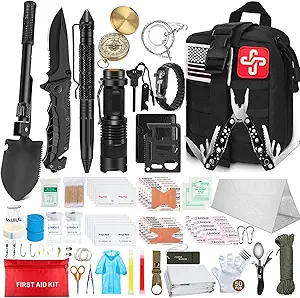
260-Piece Emergency Survival Kit with First Aid Supplies, Thermal Emergency Tent, Tactical Axe and Waterproof MOLLE Backpack
This kit earns the top spot because it solves the two problems that sink most all-in-one survival kits: disorganization and weather exposure. Where the TAIMASI 238-Piece kit squeezes everything into a small pouch, this set spreads 260 pieces across a waterproof Oxford fabric backpack with dedicated compartments, which means faster access when seconds matter. The inclusion of a 14-in-1 tactical axe and a thermal tent rated to retain 90% of body heat gives it real capability beyond first aid. The tradeoff is weight and bulk — this is a grab-and-stow kit for a car trunk or home closet, not something to clip onto a daypack. Buyers should also temper expectations on individual components, which are budget-grade rather than professional tools.
Pros:- Covers first aid, shelter, tools, and lighting in one organized system
- Waterproof backpack keeps contents protected in wet conditions
- Thermal emergency tent retains up to 90% of body heat
- MOLLE webbing lets it attach to larger packs or vests
Cons:- Heavier and bulkier than minimalist survival kits
- Individual budget components won’t match professional-grade gear quality
Best for: Households and drivers who want a single, organized emergency kit ready to grab during earthquakes, roadside breakdowns, or evacuations
Not ideal for: Ultralight backpackers and minimalist hikers — the weight and bulk compete directly with the goal of a light pack
- Brand:DOZAVI
- Number of Pieces:260
- Included Components:Flashlight, tactical axe, first aid kit, thermal emergency tent, MOLLE backpack
- Materials:Stainless steel, waterproof Oxford fabric
- Bag Type:Waterproof MOLLE-compatible backpack
- Thermal Tent Heat Retention:90% of body heat
- Tactical Axe:14-in-1 stainless steel
Our verdict“The most complete and best-organized option here — buy it if you want one purchase that covers shelter, injury, and tools for a family emergency.”
Mylar Thermal Emergency Blankets 4-Pack – Survival Space Blankets
Not every survival purchase needs to be a 250-piece kit — sometimes the smartest buy is the cheapest item that prevents the deadliest outcome. These aluminized Mylar blankets retain up to 90% of body heat, weigh almost nothing, and fold down small enough to stash in a glovebox, jacket pocket, or every compartment of a bug out bag. Compared with the Leberna Mylar sleeping bags elsewhere in this roundup, these flat blankets trade a mummy-style enclosure for sheer versatility: ground cover, shelter reflector, or wrapping an injured person. The catch is comfort — Mylar is noisy, crinkly, and crinkles with every movement, and none of these blankets replaces an actual sleeping setup. They are insurance, not gear.
Pros:- Retains up to 90% of body heat for critical warmth
- Extremely compact and lightweight for pockets and kits
- Tear-resistant and reusable unlike cheapest single-use blankets
- Versatile as shelter, ground cover, or hypothermia prevention
Cons:- Mylar is loud and crinkly during use
- Not a substitute for a real sleeping blanket in sustained cold
Best for: Budget-conscious preppers and day hikers who want redundant warmth backups scattered across multiple bags and vehicles
Not ideal for: Anyone expecting a primary sleep system — these supplement a sleeping bag, they don’t replace one
- Quantity:4-pack
- Material:Aluminized Mylar
- Unfolded Dimensions:82″ x 52″
- Heat Retention:Up to 90% of body heat
- Weight:Lightweight
- Reusability:Reusable and tear-resistant
Our verdict“Four lives-saving blankets for the price of a sandwich — the highest-value safety margin you can add to any pack.”
TAIMASI 238-Piece Emergency Survival Kit with First Aid Kit and MOLLE Pouch
Where the DOZAVI 260-piece kit comes as a full backpack, the TAIMASI takes the opposite approach: a compact 8 × 6.5 × 6-inch 600D nylon pouch that attaches to a belt, a MOLLE vest, or the outside of a pack you already own. That modularity is the whole point — this pick suits buyers whose existing backpack is the survival platform and who just need the contents. The 45-piece first aid kit anchors the set, but the 4-in-1 shovel and fishing tools push it past pure medical use. Two honest caveats: a large share of the 238 pieces are cotton swabs and gloves rather than hard survival tools, and the tiny pouch makes reorganization after any use genuinely fiddly.
Pros:- Combines first aid, shelter, fishing, and digging tools in one pouch
- MOLLE straps attach to belts, vests, or existing backpacks
- Compact footprint leaves pack space free for other gear
- Dual zippers and interior storage aid organization
Cons:- Many of the 238 pieces are low-value consumables
- Small pouch makes repacking and organization difficult
Best for: Hikers and outdoor workers who already carry a pack and want a clip-on kit that expands its capability
Not ideal for: Buyers who expect 238 pieces of tools — much of the count is consumables like swabs and gloves
- Item Count:238 pieces
- First Aid Kit:45 pieces
- Key Tools:4-in-1 shovel and pick, emergency tent, thermal blanket, fishing tools
- Pouch Dimensions:8 × 6.5 × 6 inches
- Pouch Material:600D nylon
- Storage Features:Dual zippers, interior storage, back attachment straps, removable hook-and-loop panel
- Mounting:MOLLE-compatible, belt or backpack attachment
Our verdict“A smart pick if you’re upgrading a pack you already love rather than buying a whole new survival backpack.”
2.0 Backpacker Survival Fishing Kit – Emergency Lightweight Fishing System
Every other product in this roundup answers the question “how do I survive the first 48 hours?” This one answers a different question: how do I feed myself on day five? The bottle-mount head screws onto a standard plastic bottle to create an improvised rod handle, the hollow grip stores bait and tackle, and the lanyard keeps the whole rig from disappearing into a river. Compared with the TAIMASI kit’s basic fishing tools, this is a purpose-built system rather than an afterthought — though the TAIMASI kit covers far more survival categories for similar pack space. The real tradeoff is specialization: a miniature rod limits catch size, and there’s a genuine learning curve before anyone lands dinner with it.
Pros:- Extremely lightweight and packable for backpacking
- Durable nylon construction handles large fish and drops
- Hollow handle stores bait and small tackle internally
- Bottle-mount design improvises a full rod from a plastic bottle
Cons:- Miniature size limits catch size versus a full rod
- Noticeable learning curve for anglers used to full-size setups
Best for: Experienced backpackers and bushcraft-focused preppers planning for extended wilderness scenarios where food procurement matters
Not ideal for: Casual campers and short-trip hikers — it’s dead weight unless a trip actually involves fishing or long-term scenarios
- Color:Black
- Material:Nylon
- Weight:Lightweight
- Handle:Extended hollow storage compartment
- Head Design:Rotary thread for bottle mounting
- Includes:Storage bag, lanyard
- Recommended Use:Travel, hiking, camping, survival/bugout, fishing
Our verdict“A niche but clever addition for those planning beyond the first two days — skip it if your emergencies end at shelter and first aid.”
HIHEGD 250-Piece Survival Kit with First Aid Supplies and MOLLE-Compatible Bag
The HIHEGD sits between the TAIMASI 238-piece pouch and the DOZAVI 260-piece backpack in both count and character. Its 1000D nylon bag is a step up in abrasion resistance from the TAIMASI’s 600D fabric, and its tool list — axe, folding shovel, fire starter, compass, whistle — leans harder into hard survival tools than kits that pad their counts with swabs and gloves. The same 8 × 6.5 × 6-inch footprint means it mounts to MOLLE gear rather than replacing a backpack, so it competes directly with the TAIMASI for the modular slot. The honest weakness: like its rivals, the 250-piece figure reveals nothing about per-item quantities, and the bag is only water-resistant, not waterproof like the DOZAVI’s.
Pros:- Heavier emphasis on hard tools: axe, folding shovel, fire starter, compass
- Rugged 1000D nylon bag outlasts lighter-duty pouches
- MOLLE-compatible mounting on packs, vests, or belts
- Includes emergency tent and blanket for shelter basics
Cons:- Piece count doesn’t disclose quantities of each item
- Water-resistant rather than fully waterproof construction
Best for: Buyers who prioritize survival tools like an axe, shovel, and fire starter over medical consumables in a belt-mounted kit
Not ideal for: Anyone needing guaranteed waterproofing for wet-climate stowage — the bag is only water-resistant
- Brand:HIHEGD
- Number of Pieces:250
- Bag Material:1000D water-resistant nylon
- Bag Dimensions:8 × 6.5 × 6 inches
- Key Tools:Axe, folding shovel, fire starter, whistle, compass
- Shelter Items:Emergency tent and blanket
- Mounting:MOLLE-compatible with packs, vests, or belts
Our verdict“The tool-forward modular pick — choose it over the TAIMASI when chopping and digging matter more than medical volume.”
Skywod 99-Piece Survival and First Aid Kit with 45L Backpack
This option stands out for solving two problems at once: you get a genuine 45L tactical backpack plus a 99-piece tool and first aid loadout, rather than a pouch that needs to be attached to a pack you already own. Compared with the 262-Piece Survival Kit, which arrives in a MOLLE crossbody bag you must pair with a separate backpack, the Skywod is the more complete grab-and-go package for someone starting from zero. The double-stitched 900D Oxford cloth construction translates to a pack that can survive being thrown in a truck bed, and the axe, folding saw, and fire-starting tools cover the core survival bases. The tradeoff is depth: 99 pieces spread across tools, first aid, and fishing gear means everything is basic rather than specialized, and the listing’s inconsistent backpack measurements make it worth verifying dimensions before you buy.
Pros:- 45L tactical backpack included, so no separate pack purchase is needed
- Double-stitched 900D Oxford cloth and nylon build holds up to rough handling
- Covers core categories: axe, saw, fire starting, fishing, first aid, and shelter blanket
- Multiple compartments keep tools organized and accessible
Cons:- 99 pieces means basics-only depth in each category rather than specialized gear
- Conflicting backpack measurements across the listing create sizing uncertainty
Best for: Buyers who want a ready-packed bug out solution with a real backpack included, not just a pouch of supplies
Not ideal for: Experienced preppers who already own a quality pack and want deeper, more specialized first aid or tool selections
- Brand:Skywod
- Pieces:99
- Backpack Capacity:45L
- Backpack Dimensions:11.81 x 19.68 x 11.81 inches
- Material:900D Oxford cloth and nylon fabric
- Item Weight:7.9 lb
- Included Components:Axe, first aid kit, flashlight, folding saw, survival bracelet, whistle, emergency blanket, fire-starting and fishing tools
Our verdict“If you need one purchase that yields both a durable backpack and a starter survival loadout, this is the most direct path; if you already own a pack, a pouch-based kit offers more for the space.”
262-Piece Survival Kit with First Aid Kit Pouch and Crossbody Bag
This model makes the most sense for households planning around the critical first 72 hours of a disaster, because it’s the only option here that addresses every survival category at once: first aid, water, food procurement, fire, lighting, and shelter. Where the Skywod 99-Piece Kit gives you a backpack with modest tool depth, this kit flips the ratio — 262 pieces anchored by a full-size 17-inch axe and a 2-in-1 shovel with pick, tools that actually work rather than miniaturized versions. The MOLLE-compatible crossbody bag attaches to a tactical backpack, which is smarter than it sounds for families: one adult carries the pack, another carries this. The honest weakness is the first aid contents, which lean on adhesive strips and cotton basics — supplement them with real trauma supplies, and note the crossbody format is bulky for everyday carry.
Pros:- 262 pieces spanning first aid, water, food, fire, shelter, and lighting in one kit
- Full-size 17-inch axe and 2-in-1 shovel deliver real utility, not toy versions
- MOLLE-compatible crossbody bag with D-rings expands or attaches to a tactical pack
- Developed with survival expert input and tested against disaster agency guidelines
Cons:- First aid supplies are basic adhesive strips and cotton items that need supplementing
- Large crossbody bag is bulky for everyday carry or smaller builds
Best for: Families building a 72-hour disaster plan who want category-complete coverage in one organized bag
Not ideal for: Everyday-carry minimalists — the full-size tools and large crossbody bag are overkill for a daily commute bag
- Pieces:262
- Axe Length:17 inches
- Shovel:2-in-1 with pick
- Blade Material:Carbon steel
- Bag:Crossbody, MOLLE-compatible with D-rings and detachable strap
- Lighting Duration:Up to 72 hours
Our verdict“For a household that wants a single 72-hour grab bag covering every survival category, this is the strongest pick — just plan on upgrading the first aid contents.”
Leberna Emergency Mylar Sleeping Bags, 2 Pack
The appeal here is simple arithmetic: two full bivy sacks that each reflect up to 90% of body heat, at a packed size and weight that disappear into any survival kit. Compared with the Mylar Emergency Sleeping Bag Bivy Sack single-pack option, the Leberna set is the better fit for couples or parent-and-child bug out plans — one pack covers two people, and each bag includes its own drawstring carry bag and 120-decibel whistle, so nobody shares emergency gear. The 84 x 36 inch footprint with head cover keeps rain and wind off a reclining adult, which a flat space blanket from the 4-pack alternatives cannot do. The tradeoff is material reality: thin Mylar tears easily on rock or brush, and these are emergency shelters, not sleeping bags you’ll rest comfortably in night after night.
Pros:- Two complete bivy sacks cover two people from one purchase
- Reflects up to 90% of body heat with waterproof, windproof protection
- Just 2.8 oz per bag and 7 x 3 inches packed — fits any kit or glovebox
- Head cover and included 120-decibel whistle add real emergency function
Cons:- Thin Mylar material is vulnerable to tearing on rough ground
- Emergency-only design — not comfortable or durable enough for regular sleeping
Best for: Couples or parents who need emergency warmth for two people in a compact, kit-friendly format
Not ideal for: Anyone expecting a reusable camping sleeping bag — the Mylar is thin, crinkly, and tear-prone under regular use
- Material:Mylar
- Quantity:2 sleeping bags
- Dimensions:84 x 36 inches each
- Packed Dimensions:7 x 3 inches
- Weight:2.8 oz per bag; 3.0 oz with carry bag
- Heat Reflection:Up to 90% of body heat
- Included Accessories:Drawstring carry bags and 120-decibel whistles
Our verdict“If two people need emergency shelter coverage at minimal weight and bulk, this two-pack is the obvious choice over single-bag alternatives.”
Mylar Emergency Sleeping Bag Bivy Sack – Thermal Heat Survival Gear
This option is built for the solo prepper who wants one ultralight thermal bivy slipped into a bug out bag and forgotten until it’s needed. Compared with the Leberna 2-Pack, it’s the leaner play: no duplicate weight, a bright orange exterior that aids rescue visibility in snow or forest, and the same 84 x 36 inch coverage that fits adults and children. Its versatility as a sleeping bag, bivy blanket, or improvised shelter means it earns its slot even in a packed go bag where every ounce is contested against items like the Backpacker Survival Fishing Kit. The tradeoffs are the ones inherent to the category: Mylar foil is far less durable than fabric sleeping bags, and the crinkly material is loud enough to make actual sleep difficult — a fair price for a shelter that weighs almost nothing.
Pros:- Full-body 84 x 36 inch coverage fits both adults and children
- Ultralight and compact enough to live permanently in a go bag
- Waterproof, heat-reflective foil retains warmth in extreme cold and rain
- Doubles as a bivy blanket or improvised shelter without a tent
Cons:- Mylar construction is less durable than traditional sleeping bags
- Noisy, crinkly material makes comfortable sleep difficult
Best for: Solo hikers and preppers adding one lightweight thermal shelter to a single bug out bag
Not ideal for: Light sleepers or frequent campers — the noisy Mylar and low durability make it a poor everyday sleeping bag
- Size:84 x 36 inches
- Quantity:1 pack
- Material:Mylar foil
- Color:Orange
- Features:Waterproof, thermal heat reflective, ultralight, reusable
- Included:Bivy storage sack
- Use Cases:Camping, hiking, emergency survival, bug out bag, disaster preparedness
Our verdict“For a solo go bag that needs maximum thermal insurance at minimum weight, this single bivy is the cleanest addition — just don’t expect camp-comfort durability.”

How We Picked
I evaluated each product against what actually matters when you are carrying survival gear on your back: weight-to-usefulness ratio, bag or pouch quality, redundancy of critical items, and whether the contents justify the piece count. A kit with 260 pieces means nothing if half of them are low-quality single-use items, so I looked at whether each kit covers the four core pillars — first aid, shelter, tools, and signaling/fire — rather than counting components. I also compared how each option is meant to be carried, since a crossbody pouch and a 45L backpack serve completely different evacuation scenarios.
The ranking reflects a simple logic: complete kits that balance quality and portability rank highest, specialized gear like mylar shelters and fishing kits fills specific roles lower in the list because they are supplements rather than standalone solutions. Where two kits looked similar on paper, the deciding factors were MOLLE compatibility, bag capacity, and whether the shelter component was an actual tent or just a blanket. This ordering is designed so readers can start at the top for a one-purchase solution and work down as their needs narrow.
Factors to Consider When Choosing Backpack Survival Gear
Choosing backpack survival gear is less about finding the best products and more about matching gear to a realistic emergency scenario. These are the factors that actually separate a smart purchase from a box of unused tools.Know Your Scenario Before You Buy
The most common mistake buyers make is purchasing a survival kit for a scenario they will never face. A bug-out kit for evacuation on foot demands a real backpack, comfortable straps, and weight discipline — which favors options like the Skywod 45L setup. A shelter-in-home emergency kit can afford to be heavier and bulkier since you will never carry it ten miles. A vehicle emergency kit falls somewhere in between, prioritizing compactness and thermal protection over tool variety. Before comparing piece counts, decide whether you are preparing to walk, drive, or stay put. That single decision eliminates roughly half of the options in any roundup and prevents you from paying for gear sized to someone else’s emergency. Buyers who skip this step end up with either a kit too heavy to carry or one too thin to matter.
Piece Count Versus Actual Capability
Manufacturers know that shoppers compare numbers, so kits are often padded with items like individual bandages counted separately, cheap plastic whistles, and duplicate small tools. A 238-piece kit and a 99-piece kit may contain nearly identical real capability once you strip out the filler. The better question is whether the kit covers the functional categories: wound care, bleeding control, fire starting, shelter, cutting tools, light, and signaling. One quality folding knife outweighs a dozen gimmick tools. When comparing kits, mentally group the contents into those categories and see where the gaps are — a kit heavy on novelty tools but light on first aid is a warning sign. Also check whether the first aid portion can actually treat more than a scraped knee; genuine trauma supplies are what separate useful kits from toy kits.
The Bag Is Half the Purchase
With backpack-based kits, the carrying system deserves as much scrutiny as the contents. A great tool set in a bag with thin straps, no hip belt, and weak zippers becomes a liability the moment you have to walk any distance. Look for MOLLE webbing if you plan to expand your loadout later, since it lets you attach pouches, a fishing kit, or a water bottle without repacking everything. Capacity matters too: a 45L backpack leaves room for water, food, and clothing layers you must add yourself, while a fully packed small pouch leaves zero room for growth. Consider whether the bag doubles as an everyday pack — some survival backpacks are tactical enough to draw attention, which may or may not fit your situation. The bag is also the first thing to fail under load, so weak stitching anywhere is grounds to look elsewhere.
Thermal Protection: Blanket, Bag, or Tent
Mylar products are not interchangeable, and choosing the wrong format is a frequent and consequential error. A mylar blanket reflects body heat but leaves gaps and shifts in wind — it is a backup layer, not a shelter. A mylar sleeping bag or bivy sack encloses you fully and retains dramatically more warmth overnight, making it the right choice for the inside of a survival backpack. A thermal emergency tent adds shared shelter for two people at the cost of bulk. The practical approach for most buyers is layered: a couple of cheap blankets distributed across cars and jackets, plus one enclosed bivy in the actual bug-out bag. Also remember that mylar is single-use fragile — it tears against rough ground, so an enclosed sack needs a ground barrier to survive the night.
Food, Water, and the Gaps No Kit Fills
Here is the truth that no kit in this category advertises: none of them include meaningful food or water. Even the largest kits here will sustain you for hours, not days, and dehydration becomes dangerous far faster than hunger. Budget separate capacity for water bottles or a filtration method, and add calorie-dense food like bars or pouches that you rotate regularly. The survival fishing kit addresses food, but fishing requires water access, time, skill, and calories expended — it is a supplement for extended scenarios, not a primary plan. A common and expensive mistake is buying a big kit and considering preparedness complete. The kit is the tool layer; water, food, medications, and documents are the personal layer only you can assemble.
Skills Determine Whether Gear Works
Every product in this roundup assumes the user knows how to deploy it, and most people do not. A fire starter, a fishing kit, and a trauma bandage are all useless or dangerous without practice. Before buying the biggest kit available, honestly assess which items you can use under stress and in bad weather. A smaller kit whose contents you have actually practiced with outperforms a comprehensive kit you have never opened. Set a habit of unpacking and repacking the kit twice a year — this also catches expired first aid items and batteries. Take a basic first aid course if your kit includes trauma supplies. The gear-versus-skills gap is the single biggest predictor of whether a survival purchase ends up being insurance or decoration.
Frequently Asked Questions
Is one large survival kit enough, or should I buy separate specialized gear?
One large kit covers the tool and first aid foundation well, but no single kit in this category covers everything. The large options here handle wound care, tools, and basic shelter, yet they all leave gaps in food, water, and overnight warmth. The strongest setup combines a complete kit as the base, then adds a mylar sleeping bag for real overnight protection and calorie-dense food you rotate yourself. Specialized items like the fishing kit only earn their place if you already have the basics secured. Buyers who chase one perfect kit usually end up with strong tools and weak shelter or no water plan. Think of the large kit as the chassis and specialized gear as the upgrades that fill its specific gaps.
What is the difference between a mylar blanket and a mylar sleeping bag, and which do I need?
A mylar blanket is a flat reflective sheet you drape over yourself, while a mylar sleeping bag or bivy sack fully encloses your body and traps heat far more effectively. Blankets work well as backups in glove compartments, first aid kits, and jackets because they pack tiny and cost little, but wind and movement constantly undermine them. A sleeping bag is the correct choice for anything inside a survival backpack where you might actually spend a night outdoors. The Leberna two-pack and the bivy sack both offer enclosed protection, with the bivy format being the most robust against tearing. Most prepared households use both: blankets distributed everywhere, one enclosed sack in the bug-out bag. If forced to pick one for a backpack, pick the enclosed version every time.
How important is MOLLE compatibility on a survival backpack?
MOLLE webbing matters if you plan to expand or customize your loadout, and it matters little if you want a closed, grab-and-go solution. The advantage is modular growth: you can attach a fishing kit pouch, extra water bottle, or first aid pouch without repacking the main compartment, which keeps frequently used items accessible. It also lets you redistribute weight or hand a pouch to someone else in a group. The tradeoff is that MOLLE bags look tactical, which draws attention in urban or travel settings where a plain pack is safer. If your plan is one bag stored untouched until an emergency, skip the MOLLE premium. If your plan involves building and adjusting your kit over years, MOLLE compatibility is worth prioritizing.
Do these pre-packed kits contain quality items or cheap filler?
Honestly, every pre-packed kit in this price range contains a mix of both. The multitools, axes, and fire starters are generally serviceable but rarely match the quality of gear bought individually. The first aid components are usually the strongest part of these kits, while the knives and miscellaneous gadgets are the weakest. The practical approach is to treat a kit as a starting chassis: use it as-is for the first year, then replace individual items as you learn what you actually reach for. Buyers expecting premium standalone quality from a bundled kit will be disappointed. Buyers wanting broad coverage in one purchase are getting exactly what these kits are designed to deliver.
Is a survival fishing kit actually useful in an emergency?
It can be, but only under specific conditions, and it is never a primary food plan. Fishing requires access to water with fish, time, some skill, and the caloric reserve to spend hours possibly catching nothing. Where the Backpacker Survival Fishing Kit earns its spot is in extended-duration scenarios — stranded situations lasting more than a few days — and in wilderness regions where waterways are plentiful. It weighs almost nothing, so the cost of carrying it is minimal even if you never use it. For urban or suburban emergency planning, food bars and stored water are far more reliable. Add it to a bug-out bag as insurance, not as the plan itself.
Conclusion
For most buyers preparing a serious bug-out bag, the 260-Piece Emergency Survival Kit is the best overall choice — it is the only option here that combines a real backpack, a thermal tent, a capable tool loadout, and first aid supplies in one purchase. For best value, the Mylar Thermal Emergency Blankets 4-Pack delivers the single most survival-critical function, warmth, at minimal cost, making it the smartest first purchase for anyone on a tight budget. The TAIMASI 238-Piece Kit and the HIHEGD 250-Piece Kit sit in the middle as strong best-for-beginners options, offering a complete foundation without overwhelming complexity. For buyers focused on carrying capacity, the Skywod 99-Piece Kit with its 45L backpack is the top pick for on-foot evacuation because it leaves room for the food and water no kit provides. For specific needs, the Leberna Mylar Sleeping Bags or the Bivy Sack handle overnight shelter, the 2.0 Backpacker Fishing Kit covers long-duration food procurement, and the 262-Piece Crossbody Kit suits everyday-carry minimalists. Whichever direction you take, remember that every option here still needs water, calories, and practiced skills added by you — the kit is the beginning of preparedness, not the end of it.
Halloween Picks
halloween
As an affiliate, we earn on qualifying purchases.