
For most preppers, I’d start with the Baofeng UV-5R as the best overall pick: its dual-band handheld format suits a basic emergency kit, though it takes practice and programming. The Radtel RT-950 PRO adds GPS and APRS features for buyers who value location reporting, while the Retevis RT95 is a better fit for a vehicle setup. The main tradeoffs are portability versus power, simple operation versus extra features, and handheld convenience versus the antenna and power needs of a fixed station. None of these radios communicates reliably everywhere on its own; range depends on terrain, antennas, power, repeaters, and operator skill. Read on for how the nine options differ and which one fits your plan.

Get emergency and outdoor gear delivered free with Prime
- Fast, free delivery on millions of items
- Prime Video, Amazon Music and more included
- Member-only deals all year
Key Takeaways
- The UV-5R is the straightforward starting point: it covers the basic handheld role, while the UV-5R Mini’s USB-C charging favors a more compact kit.
- Location features set the Radtel RT-950 PRO apart: GPS and APRS may help with position reporting, but add setup and learning demands.
- A mobile radio changes the installation tradeoff: the Retevis RT95 suits a vehicle better than a pocket kit, but needs a suitable power source and antenna.
- Several Baofeng listings overlap in purpose: compare the UV-5RM single-radio and two-pack listings by included accessories and your need for a second unit.
- Power and band labels do not replace planning: the 10-meter HS4 base station and tri-band BF-F8HP PRO serve different setups, so match bands and operating rules to your actual plan.
| Baofeng UV-5R Dual-Band Handheld Two-Way Radio |  | Best Budget Starter | Frequency range: 144–148 MHz, 420–450 MHz | Channels: 128 | Display: Dual-band, dual-frequency | VIEW ON AMAZON | See Our Full Breakdown |
| Baofeng UV-5R Mini Two-Way Ham Radio with USB-C Charging |  | Best Compact USB-C Pick | Channels: Up to 999 | Output power: 5W | Charging: USB-C | VIEW ON AMAZON | See Our Full Breakdown |
| Radtel RT-950 PRO Handheld Ham Radio with GPS/APRS |  | Best for Position Sharing | Channels: 960 | Frequency range: 144–148 MHz / 420–450 MHz | Maximum output power: 10W | VIEW ON AMAZON | See Our Full Breakdown |
| Retevis RT95 Dual-Band Mobile Ham Radio |  | Best Vehicle or Base Station | Frequency bands: 2 meters and 70 centimeters | Channels: 200 | Display: 180-degree rotatable TFT LCD with brightness control | VIEW ON AMAZON | See Our Full Breakdown |
| Baofeng UV-5RM Dual-Band Handheld Ham Radio |  | Best for Broad Reception | Receiving frequency ranges: 108–136 MHz, 136–174 MHz, 220–260 MHz, 350–390 MHz, 400–520 MHz | Transmit frequency ranges: 144–148 MHz and 420–450 MHz | Display: 1.77-inch color | VIEW ON AMAZON | See Our Full Breakdown |
| Baofeng AR-5RM 10W Two-Way Ham Radios with NOAA Weather, USB-C Charging, Programming Cable, and Accessories, 2-Pack |  | Best Two-Radio Emergency Kit | Model: AR-5RM | Transmit power: 10 W | Transmit frequency ranges: 144–148 MHz; 420–450 MHz | VIEW ON AMAZON | See Our Full Breakdown |
| Retevis Ailunce HS4 10-Meter Ham Radio Base Station |  | Best for Long-Distance HF Experimentation | Radio modes: CW, SSB (USB/LSB), FM, AM, PA | Frequency bands: 6 (A/B/C/D/E/F) | Channels per band: 60 | VIEW ON AMAZON | See Our Full Breakdown |
| Baofeng UV-5RM Dual-Band Handheld Ham Radio Walkie-Talkies, 2-Pack | 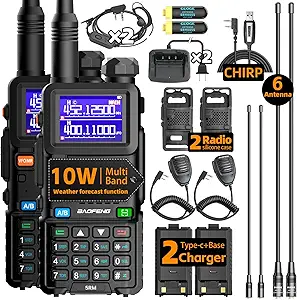 | Best for Shared Setup | Package quantity: 2 radios | Channel capacity: 999 | Transmit frequency ranges: 144–148 MHz; 420–450 MHz | VIEW ON AMAZON | See Our Full Breakdown |
| BAOFENG BF-F8HP PRO Tri-Band Amateur Radio |  | Best for Organized Channel Plans | Channel capacity: 1,000 | Named zones: 10 | Frequency coverage: 1.25 m, VHF, UHF; receive-only AM Airband (108–137 MHz) and FM broadcast (65–108 MHz) | VIEW ON AMAZON | See Our Full Breakdown |
| ham radios for prepper | Display | Charging |
|---|---|---|
| Baofeng UV-5R Dual-Band Handhe | Dual-band, dual-frequency | — |
| Baofeng UV-5R Mini Two-Way Ham | — | USB-C |
| Radtel RT-950 PRO Handheld Ham | — | USB Type-C; desktop charger included |
| Retevis RT95 Dual-Band Mobile | 180-degree rotatable TFT LCD with brightness control | — |
| Baofeng UV-5RM Dual-Band Handh | 1.77-inch color | USB-C cable and desktop charging base |
| Baofeng AR-5RM 10W Two-Way Ham | 1.77-inch color screen | USB-C cable and US base charger |
| Retevis Ailunce HS4 10-Meter H | — | — |
| Baofeng UV-5RM Dual-Band Handh | 1.77-inch color display | USB-C and desktop charging base |
| BAOFENG BF-F8HP PRO Tri-Band A | — | — |
More Details on Our Top Picks
Baofeng UV-5R Dual-Band Handheld Two-Way Radio
The UV-5R is a straightforward entry point for licensed preppers who want a handheld for local communication and can handle programming it before an emergency. Its 128 channels and dual-band display make it easier to organize a small set of repeater and simplex frequencies than a simpler single-band radio. Compared with the Baofeng UV-5RM, it has fewer memory channels and lacks the listed USB-C charging and NOAA weather reception, so it is less convenient for extended power outages. Selectable high and low transmit power lets users favor battery conservation when lower output will do. Its tradeoff is a narrow transmit range limited to the stated amateur bands, plus PC or CHIRP programming may take preparation. I’d choose it for basic local readiness, not as a weather-alert receiver or all-in-one emergency radio.
Pros:- Dual-band display helps monitor two frequencies
- 128 channels for organizing local and repeater frequencies
- Selectable transmit power can help conserve battery
- PC and CHIRP programming support
Cons:- Transmit coverage is limited to the stated 144–148 MHz and 420–450 MHz ranges
- No NOAA weather reception or USB-C charging is listed
- Programming may require a computer and advance setup
Best for: Licensed beginners who want an inexpensive, programmable dual-band handheld for local communication and already have a charging plan.
Not ideal for: Preppers who need NOAA alerts, USB-C charging, or extensive channel storage in one handheld.
- Frequency range:144–148 MHz, 420–450 MHz
- Channels:128
- Display:Dual-band, dual-frequency
- Transmit power:Selectable high or low
- Bandwidth:12.5 kHz or 25 kHz
- CTCSS:50 tones
- DCS:104 codes
- Programming:PC and CHIRP compatible
Our verdict“Choose the UV-5R for basic, programmable local communication if weather alerts and modern charging options are not priorities.”
Baofeng UV-5R Mini Two-Way Ham Radio with USB-C Charging
For a prepper who wants a compact handheld that can recharge from a common power bank, the UV-5R Mini has a practical edge over the older Baofeng UV-5R. Its USB-C charging reduces dependence on a dedicated charging setup, while NOAA alerts add a useful source of weather information. The 999-channel capacity and OLA Radio app programming can make frequency setup less tedious, and the included long antenna and headset give buyers useful accessories from the start. The tradeoff is that its listed maximum talking range is 999 feet, which limits its appeal for broader-area communication. It is also not water resistant, a real concern for outdoor readiness. Compared with the more feature-packed Radtel RT-950 PRO, this is the simpler, lighter-duty choice; I’d pick it for compact local use and convenient charging.
Pros:- USB-C charging works with common USB power sources
- NOAA weather alert reception
- Up to 999 channel memories
- Includes a long antenna and headset
Cons:- Not water resistant
- Listed maximum talking range is only 999 feet
- App-based frequency copying depends on phone and radio setup
Best for: Preppers who want a compact handheld for nearby communication, NOAA alerts, and charging from USB-C power banks.
Not ideal for: Outdoor users who expect rain exposure or need a radio with a longer stated communication range.
- Channels:Up to 999
- Output power:5W
- Charging:USB-C
- Weather alerts:NOAA
- Radio reception:FM and AM
- Programming:OLA Radio app; CHIRP compatible
- Additional features:Dual PTT, VOX, DTMF, frequency copying
- Water resistance:Not water resistant
Our verdict“Pick the UV-5R Mini for compact local readiness when USB-C charging and weather alerts matter more than range or weather sealing.”
Radtel RT-950 PRO Handheld Ham Radio with GPS/APRS
The RT-950 PRO is the specialist pick here for preppers who value sharing location as well as voice communication. Its GPS/APRS capability can support position reporting, while Bluetooth programming, a spectrum analyzer, and broad reception give technically minded users more ways to manage and monitor signals than the Baofeng UV-5RM. The listed 10W maximum output may appeal to buyers seeking more transmit power, but the product data limits its 27 MHz FM transmission to 3–4W and specifies 144–148 MHz and 420–450 MHz as its frequency ranges. Those details make band-by-band expectations worth checking before purchase. At 1.5 pounds and without water resistance, it is less appealing as a lightweight field radio than the UV-5R Mini. I’d choose it for feature-rich monitoring and position sharing, with careful attention to its operating limits.
Pros:- GPS/APRS supports position sharing
- Bluetooth app programming and wireless frequency copying
- Broad reception includes NOAA weather channels
- Spectrum analyzer and full-color display
Cons:- Not water resistant
- Listed weight is 1.5 pounds
- Product data gives different output details for 27 MHz and other bands
Best for: Technically experienced, licensed preppers who want GPS/APRS position sharing, broad reception, and app-based programming.
Not ideal for: Buyers seeking a light, water-resistant handheld or a simple radio with clearly uniform power across bands.
- Channels:960
- Frequency range:144–148 MHz / 420–450 MHz
- Maximum output power:10W
- 27 MHz transmission:FM only, 3–4W
- Reception bands:AM, FM, CB, SW, MW, LW, LSB, USB, CW
- Connectivity:Bluetooth
- Charging:USB Type-C; desktop charger included
- Weight:1.5 lb
- Water resistance:Not water resistant
Our verdict“Choose the RT-950 PRO if position sharing and advanced monitoring matter more than low weight and weather resistance.”
Retevis RT95 Dual-Band Mobile Ham Radio
The Retevis RT95 suits a prepper building a vehicle station or a fixed communications point rather than a grab-and-go kit. Its 2-meter and 70-centimeter mobile format, rotatable color display, and cooling fan are more at home mounted in a car or used for longer operating sessions than the handheld Baofeng UV-5R. VFO operation and CHIRP programming support frequency setup, while VOX and microphone gain adjustment give operators some hands-free and audio control. A base-station setup needs a separate 13.8V/10A power source, which is not included, so this radio requires more supporting gear than the handhelds in this roundup. Raising microphone gain can also bring up background noise. I’d favor it when installation and sustained operation matter more than portability.
Pros:- Compact mobile transceiver for vehicle or fixed installation
- Rotatable TFT display with brightness control
- Built-in cooling fan supports longer operating sessions
- VFO mode and CHIRP programming support
Cons:- Separate 13.8V/10A source is required for base-station use
- Microphone gain can also raise background noise
- Mobile setup is less portable than the handheld radios listed here
Best for: Licensed preppers setting up a vehicle radio or fixed home station with access to a suitable power source.
Not ideal for: People who need a portable, battery-powered radio that can be carried away from a vehicle or base setup.
- Frequency bands:2 meters and 70 centimeters
- Channels:200
- Display:180-degree rotatable TFT LCD with brightness control
- Operating modes:VFO mode; two display modes
- Dimensions:6.42 × 4.88 × 1.54 inches
- Features:VOX, microphone gain adjustment, built-in speakers, cooling fan
- Signaling:CTCSS/DCS, DTMF, 5Tone
- Base station power requirement:13.8V/10A power source, not included
Our verdict“Choose the RT95 for a vehicle or fixed station if you can supply power and do not need handheld portability.”
Baofeng UV-5RM Dual-Band Handheld Ham Radio
The UV-5RM is the most reception-focused handheld in this group, with listed receive ranges spanning airband, amateur, and other bands plus NOAA weather alerts. For a prepper who wants to monitor different sources, that breadth makes it more flexible than the basic Baofeng UV-5R, whose listed tuning and display are oriented to dual-band operation. It also brings 999 memory channels, USB-C charging, a desktop charging base, frequency cloning, and a speaker microphone, giving users several practical tools for organizing and using a go-kit radio. The key limitation is that wide reception does not mean wide transmission: transmitting is specified only for 144–148 MHz and 420–450 MHz. Battery runtime is not provided, which makes power planning less certain than the feature list might suggest. I’d choose it for monitoring flexibility, not all-band transmitting.
Pros:- Wide multi-band receiving coverage
- NOAA weather receiver and frequency cloning
- USB-C charging with desktop charging base
- Speaker microphone included
Cons:- Transmission is limited to 144–148 MHz and 420–450 MHz
- Battery runtime is not stated
- USB-C cable and desktop base are listed, but no charging time is provided
Best for: Licensed preppers who want a handheld to monitor several receive bands, NOAA alerts, and local amateur frequencies.
Not ideal for: Buyers expecting transmission across every receive band or needing documented battery runtime for outage planning.
- Receiving frequency ranges:108–136 MHz, 136–174 MHz, 220–260 MHz, 350–390 MHz, 400–520 MHz
- Transmit frequency ranges:144–148 MHz and 420–450 MHz
- Display:1.77-inch color
- Memory channels:999
- Battery capacity:2500mAh
- Charging:USB-C cable and desktop charging base
- Weather reception:NOAA weather receiver
- Programming:Frequency cloning; CHIRP compatibility
- Included accessory:Speaker microphone
Our verdict“Pick the UV-5RM if broad reception and NOAA monitoring matter more than transmitting outside the listed amateur bands.”
Baofeng AR-5RM 10W Two-Way Ham Radios with NOAA Weather, USB-C Charging, Programming Cable, and Accessories, 2-Pack
The AR-5RM two-pack makes sense for preppers who want a matched pair of handhelds ready for household or small-group communication. Both radios include 2,500 mAh batteries, USB-C and base charging, NOAA weather reception, and frequency copying, while the included programming cable and speaker microphones add useful setup options. Compared with the single-radio BF-F8HP PRO, this package gives two people radios from the start; the BF-F8HP PRO offers named zones and IP54 water resistance that the AR-5RM listing does not specify. The AR-5RM stores up to 999 channels and receives across several bands, but transmitting is limited to the listed amateur bands. I’d choose it for a prepared pair comfortable with radio setup, not for someone expecting a simple, weatherproof walkie-talkie with no programming work.
Pros:- Two radios let a pair communicate without buying a second unit separately.
- USB-C and base charging offer flexible ways to recharge.
- NOAA weather reception and frequency copying support preparedness use.
- Programming cable, speaker microphones, and other accessories are included.
Cons:- Programming and frequency setup may take extra effort.
- Transmission is limited to the specified amateur bands and requires appropriate licensing.
- Water resistance is not specified.
Best for: Two licensed household members or preparedness partners who want matching handheld radios, NOAA reception, and included programming accessories.
Not ideal for: Beginners seeking a simple setup or anyone who needs specified water resistance; frequency programming takes extra steps, and water resistance is not listed.
- Model:AR-5RM
- Transmit power:10 W
- Transmit frequency ranges:144–148 MHz; 420–450 MHz
- Receive frequency ranges:108–136, 136–174, 220–260, 350–390, and 400–520 MHz
- Channel capacity:Up to 999
- Display:1.77-inch color screen
- Battery:2,500 mAh rechargeable battery per radio
- Charging:USB-C cable and US base charger
- Package:2 radios; NOAA weather reception
Our verdict“Choose the AR-5RM if you need two feature-rich handhelds for a licensed preparedness pair and can handle initial programming.”
Retevis Ailunce HS4 10-Meter Ham Radio Base Station
The Ailunce HS4 is the unusual choice in this group: a 10-meter station with CW, SSB, FM, AM, and PA modes, suited to operators who want to explore more than local handheld communication. Its dual watch, RF gain, noise reduction, and auto squelch provide controls for managing reception, while its vehicle or home setup gives it a different role from the handheld Baofeng AR-5RM. That flexibility comes with a planning cost: home use requires a suitable power supply, and the product data does not state its output power or operating frequency range. Those missing details make it harder to judge against a clearly specified handheld. I’d rank it for radio enthusiasts building a fixed or vehicle station, while preppers prioritizing a ready-to-carry emergency radio should look elsewhere.
Pros:- CW, SSB, FM, AM, and PA modes support varied operating styles.
- Dual watch can monitor two channels.
- Noise reduction and auto squelch help manage incoming audio.
- Designed for vehicle installation or home base-station use.
Cons:- Home base-station operation requires a suitable power supply.
- Output power and operating frequency range are not specified in the supplied product data.
- Its station format is less portable than handheld choices such as the AR-5RM.
Best for: Licensed operators who want a vehicle or home station for experimenting with several 10-meter modes and managing reception.
Not ideal for: Preppers seeking a portable, ready-to-use handheld or buyers who need stated output power and frequency coverage before choosing.
- Radio modes:CW, SSB (USB/LSB), FM, AM, PA
- Frequency bands:6 (A/B/C/D/E/F)
- Channels per band:60
- Features:Dual watch, CTCSS/DCS, VOX, RF gain, ASQ, SWR and voltage protection
- Voltage protection range:13.8–15.9 V
- Dimensions:11.02 × 7.87 × 2.36 in
Our verdict“Pick the HS4 if your preparedness plan includes a powered vehicle or home station and you value multiple operating modes over portability.”
Baofeng UV-5RM Dual-Band Handheld Ham Radio Walkie-Talkies, 2-Pack
For a prepper equipping two people, the UV-5RM two-pack pairs familiar handheld form with features that help radios share channel settings: frequency cloning and CHIRP compatibility. NOAA weather alerts, USB-C charging, desktop bases, and 999 memory channels make it a practical option for a household pair. The similarly equipped AR-5RM also comes as a two-pack and includes a programming cable and speaker microphones, so the UV-5RM’s clearer distinction is its stated CHIRP compatibility and cloning rather than a broader accessory bundle. Its main field-use compromise is explicit: it is not water resistant. The claimed 8 km maximum talking range also should not be treated as a dependable field range, since actual coverage depends on terrain, antennas, and other conditions.
Pros:- Frequency cloning can simplify matching settings between the two radios.
- CHIRP compatibility offers a computer-based programming option.
- NOAA weather alerts and 999 memory channels support preparedness planning.
- USB-C charging accessories and desktop charging bases are included.
Cons:- Not water resistant, limiting confidence in wet outdoor conditions.
- Transmission is limited to licensed amateur bands.
- The stated maximum talking range does not guarantee coverage in a real deployment.
Best for: Preparedness partners who want two handhelds with shared channel setup, NOAA alerts, and USB-C charging.
Not ideal for: People expecting to use radios in rain or wet conditions, or buyers who need a dependable guaranteed communication distance.
- Package quantity:2 radios
- Channel capacity:999
- Transmit frequency ranges:144–148 MHz; 420–450 MHz
- Receive frequency ranges:108–136, 136–174, 220–260, 350–390, and 400–520 MHz
- Battery:2,500 mAh, 7.4 V
- Display:1.77-inch color display
- Charging:USB-C and desktop charging base
- Water resistance:Not water resistant
- FCC ID:2AJGM-5RH
Our verdict“Choose the UV-5RM pair if easy channel sharing matters more than weather sealing for your two-radio setup.”
BAOFENG BF-F8HP PRO Tri-Band Amateur Radio
The BF-F8HP PRO suits a prepper who wants one handheld to keep a large channel plan organized. Its 1,000 memories, 10 named zones, and configurable zone scanning make channel groups easier to sort and revisit than the 999-channel layouts listed for the AR-5RM and UV-5RM. Clear English menus and keypad controls also help with direct setup, while USB-C battery charging and IP54 protection add practical field value. This is still an analog radio: it does not decode digital or trunked systems, and computer programming or firmware updates require a separately sold cable. Location sharing is limited to compatible radios on the same channel and generally does not pass through repeaters. I’d favor it over the two-pack options for one operator who values organization and specified water resistance, not for equipping a team.
Pros:- Named zones and configurable scanning help organize a large channel plan.
- Clear English menus and keypad controls support direct radio setup.
- IP54 water resistance offers a stated level of protection for field carry.
- USB-C battery charging and receive-only Airband, NOAA, and broadcast FM are included.
Cons:- Analog scanning does not decode digital or trunked systems.
- A separately sold cable is needed for computer programming and firmware updates.
- Location sharing is limited to compatible radios on the same channel and generally does not pass through repeaters.
Best for: A licensed operator who wants one weather-resistant handheld with clearly organized channel zones and straightforward keypad controls.
Not ideal for: Teams needing multiple radios in one package, or users who need digital or trunked system reception and easy computer programming out of the box.
- Channel capacity:1,000
- Named zones:10
- Frequency coverage:1.25 m, VHF, UHF; receive-only AM Airband (108–137 MHz) and FM broadcast (65–108 MHz)
- Battery:Included 7.4 V lithium-ion
- Battery life:10 hours
- Water resistance:IP54
- Dimensions:1.54 × 2.4 × 5.31 in
- Weight:11 oz
- Programming:BTECH CPS or supported CHIRP-next with separately sold PC03
Our verdict“Pick the BF-F8HP PRO if channel organization and specified water resistance matter more than getting two radios in one package.”

How We Picked
I ranked these radios by how well their form, features, and setup demands fit preparedness use: carrying a handheld, equipping a vehicle, building a base station, or keeping a second unit ready. I gave more weight to practical usability, charging and power options, versatility, and the work needed to program and maintain each radio than to headline wattage alone. Emergency usefulness depends on the whole station, including antennas, batteries, compatible frequencies, repeaters, and a trained operator.
The UV-5R leads as a broadly useful handheld starting point; specialized features move the Radtel, mobile Retevis, and HS4 toward narrower needs rather than making them universal winners. The compact USB-C model and multi-radio packs suit kit-building, while the BF-F8HP PRO earns a place for buyers who specifically need its tri-band design. I treat similar product variants as distinct only where their listed form, charging, bands, or included quantities change the buyer’s decision.
| ham radios for prepper | Charging |
|---|---|
| Baofeng UV-5R Dual-Band Handhe | — |
| Baofeng UV-5R Mini Two-Way Ham | USB-C |
| Radtel RT-950 PRO Handheld Ham | USB Type-C; desktop charger included |
| Retevis RT95 Dual-Band Mobile | — |
| Baofeng UV-5RM Dual-Band Handh | USB-C cable and desktop charging base |
| Baofeng AR-5RM 10W Two-Way Ham | USB-C cable and US base charger |
| Retevis Ailunce HS4 10-Meter H | — |
| Baofeng UV-5RM Dual-Band Handh | USB-C and desktop charging base |
| BAOFENG BF-F8HP PRO Tri-Band A | — |
Factors to Consider When Choosing Ham Radios For Preppers
Choosing a prepper radio starts with the communication plan, not the product label. I’d work out where I expect to operate, who I need to reach, how I’ll power the radio, and what training I can complete before an emergency.
Match the radio to the location
A handheld is easy to carry, but its short antenna and limited battery capacity can restrict performance, especially indoors or behind hills. A vehicle radio can use a larger antenna mounted outside the car and draw from the vehicle’s electrical system, but it takes installation and may be unusable if the car is unavailable. A base station can suit a home communications point, yet needs a planned antenna, feed line, and dependable backup power. Avoid buying a higher-power model on the assumption that it will solve terrain or antenna problems. Decide where the radio will sit during an outage, then choose the form factor around that location.
Plan for the other end of the conversation
A radio is useful only if someone you need to reach has compatible equipment and is listening on an agreed channel or frequency. Before buying multiple units, check that they can be programmed for the same permitted frequencies and settings. For longer distance, learn which local repeaters are available and whether they have backup power during outages. A repeater can extend coverage, but it is infrastructure you may not control. If your plan depends on one, identify alternatives such as a scheduled check-in with a nearby operator or a different communications method.
Treat power as part of the station
Charging convenience matters when the grid is down, but a USB-C port alone does not tell you how long a radio will run or what power sources it accepts. Check battery capacity, spare-battery availability, charging accessories, and whether the radio can connect to a suitable external supply. A vehicle installation also needs wiring and a reliable vehicle battery; a home station may need a battery sized for its expected operating time. Set a routine for charging and rotating spares, since stored batteries can lose charge or degrade. A modest radio with a tested power plan may be more useful than a feature-rich one that cannot be charged.
Check bands, frequencies, and operating rules
Dual-band, tri-band, and 10-meter descriptions refer to different frequency capabilities, and they do not guarantee that a radio can communicate with every other amateur radio. Check the exact frequency ranges and modes against your local communications plan before purchase. Amateur radio operation generally requires an appropriate license, and permitted use varies by country and service. Do not assume that emergency preparedness makes ordinary transmission rules irrelevant. If you are new to radio, learn the applicable rules and practice with a local amateur radio group before relying on the equipment.
Budget time for programming and practice
Many handhelds arrive with settings that may not match local repeaters or the frequencies your group plans to use. Programming cables, software, channel lists, and clear labels can reduce confusion, but they still require setup and verification. Menus also differ between models, so a family member may struggle with an unfamiliar radio during a stressful event. Create a short channel plan and practice basic tasks such as selecting a channel, checking battery status, and making a call. A simpler unit can be the better choice when several people need to operate it with minimal instruction.
Buy for a complete kit, not a headline spec
Included quantities and accessories can change the value of a listing: a two-pack may help equip two people, while a programming cable or spare battery may save a separate purchase. Confirm exactly what is in the package, since product names can cover bundles or closely related variants. Consider a suitable antenna, protective storage, spare batteries, charging gear, and a way to keep a channel plan with the radio. Extra features such as GPS or APRS have little value if you will not configure and practice with them. Choose the equipment you can maintain and teach others to use.
Frequently Asked Questions
Can I use a ham radio for emergency communication without a license?
In ordinary circumstances, amateur radio transmission requires the appropriate license for your jurisdiction and operating privileges. Buying or listening to a radio does not itself authorize transmission. Rules for emergency communications can differ, so learn the local requirements rather than treating an emergency as a blanket exemption. I’d get licensed and practice before an outage, when there is time to understand frequencies, procedures, and equipment.
Will a higher-wattage handheld reach farther in an emergency?
More transmit power can help under some conditions, but it does not guarantee a longer connection. Terrain, antenna placement, obstructions, receiver quality, and whether a compatible repeater is reachable all affect the result. Higher power can also use battery capacity faster, which matters when charging is limited. I’d improve the antenna and learn local coverage before choosing a radio based on wattage alone.
Should I buy a handheld, a mobile radio, or a base station first?
Choose based on where you expect to communicate and what you can install and power. A handheld is portable and comparatively simple to keep in a personal kit, while a mobile unit suits a vehicle with a properly fitted antenna and power connection. A base station can anchor home communications but needs its own antenna and backup-power plan. If you are unsure, start with the setting you can practice from regularly, then add another radio type to cover a distinct gap.
Do GPS and APRS features make a radio a better choice for a prepper?
They can help operators share location or use supported data functions, but the features only help when they are configured, understood, and supported by the people or system you intend to contact. GPS and APRS do not automatically provide a private or guaranteed emergency tracking service. They may also add setup steps compared with a basic voice handheld. I’d choose them when location reporting is part of a practiced plan, not just because the feature appears on a specification list.
Is a two-pack a better emergency purchase than two different radios?
A matched two-pack can simplify equipping two people with similar controls and compatible settings. Two different models may make more sense if one person needs a portable handheld and another needs a vehicle or home station. Either way, confirm the radios can use the same planned channels and that you have enough batteries and charging options. Practice between the actual units, since programming and accessories can differ even within a brand’s lineup.
Conclusion
For a broadly useful handheld, I’d choose the Baofeng UV-5R as the best overall pick in this group. The UV-5RM two-pack is my value choice for equipping two people, while the Radtel RT-950 PRO is the premium feature pick for buyers who will use GPS and APRS. Beginners who want a basic portable radio can start with the UV-5R, provided they are ready to learn programming and operating rules; the USB-C UV-5R Mini suits those who put compact charging convenience first. For a vehicle, look at the Retevis RT95; for a planned 10-meter home station, consider the Ailunce HS4; and choose the tri-band BF-F8HP PRO only when its band coverage matches your plan. Whatever you select, pair it with compatible contacts, a power strategy, and regular practice.