TL;DR

Get emergency and outdoor gear delivered free with Prime
- Fast, free delivery on millions of items
- Prime Video, Amazon Music and more included
- Member-only deals all year
Outdoor Life published an Oct. 27, 2026 report arguing that waterfowl hunting remains productive in places many hunters avoid because they are difficult to conceal in. The article describes low-profile approaches for pastures, flooded fields, marshes and open water, while offering no independent harvest data or proof that the methods work everywhere.
Outdoor Life published a report on Oct. 27 arguing that duck and goose hunters can find productive opportunities by seeking out open areas that many hunters avoid because they offer little natural cover. The article describes using low-profile concealment and decoys in places such as pastures, flooded fields and marshes, while presenting the advice as the author’s experience rather than measured evidence of success across regions.
The report calls these locations “hard places”: areas that may hold waterfowl but are challenging to hunt because there is nowhere obvious to hide. Examples include flat pastures used by Canada geese, the open centers of flooded fields, and lakes, reservoirs and bays where birds gather. The author also points to open ice as a possible setting. The central recommendation is to choose locations where birds may face less hunting pressure, rather than assuming good hunting has disappeared.
For pasture hunting, the author describes lying on the ground instead of building an above-ground blind, which could stand out or be unwelcome to landowners concerned about damage to their fields. The report recommends minimizing movement, matching clothing to the ground or snow, and using terrain features such as shallow depressions and uneven grass to break up a hunter’s outline. Decoys, including larger shell or silhouette models, can also help obscure a prone hunter, according to the article.
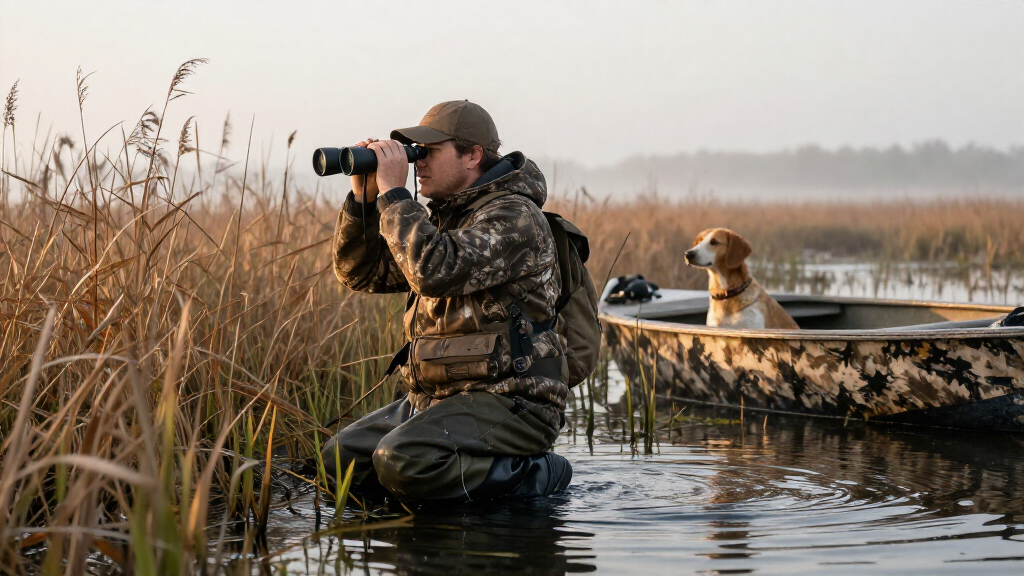
For flooded fields, the writer recounts using an air mattress as a low-profile platform in shallow, partly flooded ground, with decoys placed downwind. The report says a rubber raft can be an option where water is deeper or marsh grass is only partly above the surface. These are personal examples from the author’s hunting, not a guarantee of results or a substitute for checking conditions and using equipment appropriate to the water.
The Case for Open-Country Setups
The report challenges the idea that hunters must have a conventional blind or dense cover to pursue waterfowl. Its practical point is that concealment can come from staying low, limiting movement and blending into the terrain, potentially opening locations that are overlooked precisely because they appear difficult to hunt.
That advice may matter most in regions with broad expanses of pasture, prairie, flooded agricultural land or open water. However, the article offers no harvest figures, controlled comparison or evidence that pressure is lower at every suggested site. Local bird behavior, access, weather and hunting regulations all affect whether a particular setup is suitable.
Popular right now

De'Longhi Rivelia Fully Automatic Espresso Machine with Milk Frother, White

Bose QuietComfort Wireless Noise-Cancelling Over-Ear Headphones, Black

iRobot Roomba Max 715 Pet Robot Vacuum with AutoEmpty Dock
As an affiliate, we earn on qualifying purchases.
Why Hunters Avoid These Places
The article’s author says some hunters describe waterfowl hunting as far better decades ago, but argues that ducks and geese still move through the flyways each fall. The report attributes some birds’ wariness to repeated exposure to hunting: in heavily hunted places, birds may learn to avoid the cover where hunters commonly set up. In less-hunted open areas, the author argues, that conditioning may be weaker.
That explanation is the article’s account, not a finding supported there by population or behavioral research. Its examples draw on the writer’s experience in Oregon, including pasture hunting and fields flooded after harvest. The report also notes that access differs by region; hunters in some areas have fewer choices than those in parts of the prairie and Western states.
““You just have to hunt the hard places.””
— Outdoor Life report
Limits of the Hunting Advice
The report does not provide data comparing success rates in open, lightly hunted locations with conventional setups, and it does not establish how broadly the author’s methods apply. It is also unclear how often the described sites are accessible, whether local landowners permit access, or what conditions make a mattress or raft safe and workable.
The supplied article text ends partway through an anecdote about a hunter using a low-profile boat covered with chicken wire. Its full conclusion and any further details from that example are not available here. Readers should not treat the account as complete equipment or safety guidance, especially for deep water, changing weather or cold conditions.
Applying the Advice Locally
The report does not announce a scheduled follow-up or a new hunting program. Its practical next step for readers is to identify legal locations where waterfowl gather, then assess cover, wind, water depth, access and the landowner’s rules before choosing a setup.
Hunters considering an air mattress or raft should use equipment suited to the water and avoid entering conditions they cannot safely manage. They must also follow current local hunting regulations, including rules on seasons, species, licenses and permitted equipment. Whether the approach produces better hunting will depend on local conditions and each hunter’s results.
Key Questions
What does the report mean by “hard places”?
It means locations that may hold ducks or geese but are difficult to hunt because they offer little natural cover, such as open pastures and flooded fields.
What concealment methods does the article describe?
The author describes lying low, limiting movement, matching clothing to the surroundings, using small terrain variations and arranging decoys to help break up the hunter’s outline.
Does the report prove these methods work better?
No. It presents the author’s experiences and recommendations but gives no comparative success data or evidence that the methods work in every region or condition.
What safety and legal issues should hunters check?
Hunters should check current local regulations and land access, and assess water depth, weather and equipment suitability. The article’s anecdotes are not a complete safety guide.
Source: outdoorlife.com