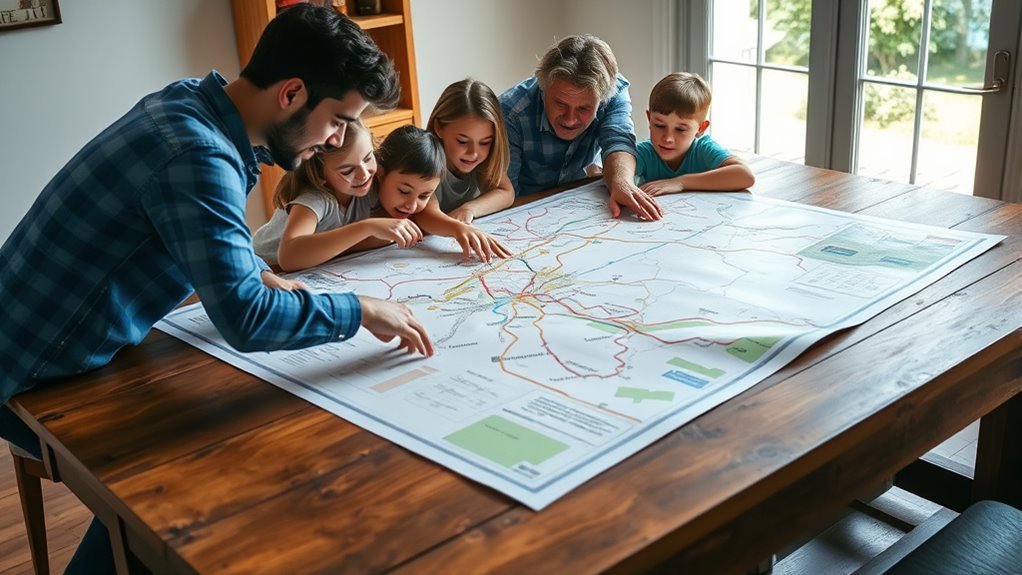

Creating a family rally plan is essential for staying safe during emergencies. You should identify 2-3 accessible meeting spots, clearly mark them on maps, and incorporate visual landmarks for easy recognition, especially for children. Practice walking or driving routes regularly, so everyone knows how to reach these points quickly. Keep printed and digital maps handy, and regularly review the plan to guarantee everyone stays familiar with the routes. If you keep going, you’ll find ways to make your plan even more effective.
Key Takeaways
- Select and clearly mark 2-3 accessible rally spots using landmarks for easy recognition.
- Create simple, high-contrast maps showing routes to each rally point for quick reference.
- Practice walking or driving routes regularly to ensure family members are familiar with them.
- Store printed copies of maps in multiple locations and keep digital backups on devices.
- Educate and rehearse with family members on reading maps and following designated routes during emergencies.

Have you ever wondered how to make certain your family stays safe and united during an emergency? One of the most effective ways to do this is by creating a solid family rally plan that includes maps everyone understands. Having clear, accessible maps ensures that no matter what happens—be it a fire, severe weather, or other crises—you can quickly locate safe meeting spots and navigate unfamiliar areas. The key is to prepare in advance so that everyone knows exactly where to go and how to get there, minimizing confusion and panic.
Start by selecting two or three safe, easily accessible locations where your family can gather if separated. These should include a nearby public place, like a library or community center, and a more distant location, such as a relative’s house or a park outside your neighborhood. Once you’ve identified these spots, mark them clearly on a map. You can use printed maps, online maps, or even create your own simple diagrams of your neighborhood. The goal is to make these locations unmistakable, with landmarks or distinctive features that everyone can recognize. For children, visual cues like a specific tree or statue can make the location more memorable.
Next, familiarize yourself and your family with the routes to each rally point. Knowing the best paths to reach your designated spots is vital, especially if roads are blocked or if you need to avoid danger areas. Practice walking or driving these routes during different times of the day so everyone gets comfortable with the quickest and safest way. If you live in an area prone to specific hazards, like floods or wildfires, incorporate evacuation routes into your plan and mark them clearly on your maps. Additionally, understanding the importance of high contrast visuals can improve the visibility of your maps, making them easier to interpret during stressful situations.
It’s essential that everyone understands how to read these maps and knows what to do if communication systems fail. Keep printed copies of your maps in multiple places—your emergency kit, the glove compartment of your car, and a secure spot in your home. Additionally, consider digital copies stored on a phone or tablet, but don’t rely solely on electronic devices. Children, in particular, should be familiar with the maps and routes so they can follow instructions without confusion.
Frequently Asked Questions
How Often Should We Update Our Family Rally Plan?
You should update your family rally plan at least once a year or whenever there’s a significant change in your family’s circumstances, such as moving, new members, or updated contact information. Regular reviews guarantee everyone knows the plan and can respond quickly during emergencies. Additionally, after any drill or real emergency, revisit the plan to identify improvements. Keeping it current helps your family stay prepared and confident.
What Are the Best Tools for Creating a Rally Map?
You should consider using tools like Google My Maps, MapQuest, or even custom printable templates for creating your rally map. These platforms let you easily mark key locations, add notes, and share the map with your family. You can also use apps like Evernote or physical paper maps for backup. Choose tools that are user-friendly, accessible, and adaptable to guarantee everyone knows where to go during an emergency.
How Do We Involve Children in Planning?
Imagine guiding tiny explorers through a treasure map; you involve children by turning planning into a fun adventure. Let them choose landmarks, help mark safe spots, or decorate the map with their favorite symbols. Encourage their ideas and ask questions to spark creativity. By giving them a sense of ownership, you make the process engaging and educational, ensuring everyone feels confident and excited about the rally.
What Should We Do if Someone Gets Lost?
If someone gets lost, stay calm and gather everyone at a designated safe spot you’ve previously agreed on. Use your phone to call or text the person if possible. Have a whistle or loud noise maker to attract attention. Assign a specific person to search nearby while others stay put. Most importantly, keep communicating and reassure everyone that help will arrive. Staying calm helps resolve the situation quickly.
How Can We Practice Our Rally Plan Effectively?
Think of practicing your rally plan as tuning a musical instrument. You want each family member to know their part perfectly. Gather everyone regularly, run through different scenarios, and assign roles. Use visual cues or signals like a conductor’s baton to reinforce communication. Keep it fun and engaging, like a game, so everyone stays alert. Repetition guarantees your family responds quickly and confidently if a real situation arises.
Conclusion
By creating a solid family rally plan, you guarantee everyone knows what to do and where to go in an emergency. Remember, a stitch in time saves nine—being prepared now can save a lot of stress later. Keep your plan simple, review it regularly, and make sure all family members understand it. When you’re ready, you’ll be able to face any situation with confidence, knowing you’ve got a plan in place that truly makes a difference.