
For a prepper who wants practical communications without buying more radio than needed, I’d make the Retevis RT85 two-pack my best overall pick for equipping two people, while the Baofeng UV-5R is the simpler value choice for one operator. The BAOFENG 5RH Pro adds GPS and APRS for users who can make use of location and data features. The tradeoffs across this lineup are mainly how many radios come in the box, how much complexity you’ll need to learn, and whether added power or features suit your actual plan. Handheld range also depends heavily on terrain, antenna, and access to repeaters, so a higher wattage claim alone does not make a reliable communications plan. Read on for how these seven options differ and which one fits your preparedness priorities.

Get emergency and outdoor gear delivered free with Prime
- Fast, free delivery on millions of items
- Prime Video, Amazon Music and more included
- Member-only deals all year
Key Takeaways
- The RT85 two-pack is the clearest ready-to-pair option: two radios in one purchase make it easier to equip a partner without matching separate models.
- The UV-5R keeps the choice simple: it is the straightforward single-radio pick for a buyer who wants a basic handheld and plans to build out the rest of the kit separately.
- Higher output is not a substitute for a communications plan: the BF-F8HP PRO and AR-5RM advertise 10W operation, but terrain, antenna placement, battery state, and repeater access still shape usable range.
- The 5RH Pro is the feature-led option: GPS and APRS can support location sharing, though those features add setup and learning needs that may not serve every prepper.
- Two-pack value and specialized capability serve different buyers: UV-5RM and AR-5RM bundles suit paired use, while the UV-5R Mini’s airband reception and compact format target a narrower set of needs.
| Baofeng UV-5RM Dual-Band Handheld Ham Radio Walkie-Talkies, 2-Pack | 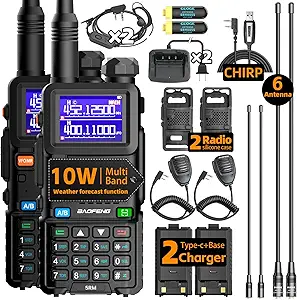 | Best Value Two-Radio Starter Set | Radios included: 2 | Memory channels: 999 | Display: 1.77-inch color display | VIEW ON AMAZON | See Our Full Breakdown |
| Baofeng UV-5R Dual-Band Handheld Two-Way Ham Radio |  | Best for Budget-Minded Beginners | Frequency ranges: 144–148 MHz and 420–450 MHz | Channels: 128 | Display: Dual-band, dual-frequency LCD | VIEW ON AMAZON | See Our Full Breakdown |
| Retevis RT85 Dual-Band Handheld Ham Radios, 2-Pack |  | Best for Rugged Neighborhood Use | Radios included: 2 | Radio type: Dual-band handheld amateur radio | Output power: 5W | VIEW ON AMAZON | See Our Full Breakdown |
| BAOFENG BF-F8HP PRO Tri-Band Ham Radio |  | Best Feature-Rich Single Radio | Channels: 1,000 | Named zones: 10 | Bands: 1.25 m, VHF, and UHF | VIEW ON AMAZON | See Our Full Breakdown |
| Baofeng AR-5RM 10W Handheld Two-Way Radios, 2-Pack |  | Best Accessory-Rich Two-Pack | Radios included: 2 | Transmit power: 10W | Storage channels: Up to 999 | VIEW ON AMAZON | See Our Full Breakdown |
| BAOFENG 5RH Pro Tri-Band Ham Radio with GPS and APRS |  | Best for Location-Aware Preparedness | Power: 10W | Bands: VHF, 1.25M, UHF, AM/FM | Channels: 640 across 10 zones | VIEW ON AMAZON | See Our Full Breakdown |
| BAOFENG UV-5R Mini Dual-Band Handheld Ham Radio with Airband Reception |  | Best Two-Radio Starter Kit | Quantity: 2 radios | Channels: 999 | Frequency range: 144–148 MHz and 420–450 MHz | VIEW ON AMAZON | See Our Full Breakdown |
| value ham radio for prepper | Charging | Channels | Display | Water resistance |
|---|---|---|---|---|
| Baofeng UV-5RM Dual-Band Handh | USB-C; desktop charging base included | — | 1.77-inch color display | Not water resistant |
| Baofeng UV-5R Dual-Band Handhe | — | 128 | Dual-band, dual-frequency LCD | — |
| Retevis RT85 Dual-Band Handhel | — | 200 | — | — |
| BAOFENG BF-F8HP PRO Tri-Band H | USB-C | 1,000 | — | IP54 |
| Baofeng AR-5RM 10W Handheld Tw | USB-C cable and US base charger | — | 1.77-inch color screen | — |
| BAOFENG 5RH Pro Tri-Band Ham R | USB-C | 640 across 10 zones | 1.77-inch color TFT | IP54 |
| BAOFENG UV-5R Mini Dual-Band H | USB-C | 999 | — | Not water resistant |
More Details on Our Top Picks
Baofeng UV-5RM Dual-Band Handheld Ham Radio Walkie-Talkies, 2-Pack
I’d choose this two-radio set when preparedness means having a matched pair ready for household or neighborhood coordination. Both radios include USB-C charging, a 2500mAh battery, a charging base, and a speaker microphone, so the bundle covers more of the basic setup than the single-radio Baofeng UV-5R. NOAA weather alerts add a useful receive option when cellular updates are unavailable, while frequency copying can make setup less fiddly between the pair. The tradeoff is that these are not water resistant, which limits their appeal for wet or exposed use. They can receive across several listed ranges, but transmission is limited to the specified amateur bands; broad reception does not mean unrestricted transmitting. I’d favor the rugged Retevis RT85 for harsher handling, but this pair offers a more complete charging and accessory package.
Pros:- Two radios provide a ready-made pair for household coordination.
- USB-C charging supports use with compatible power sources.
- NOAA weather alerts add a dedicated way to receive weather information.
- Frequency copying, speaker microphones, and charging bases are included.
Cons:- Not water resistant, limiting use in wet conditions.
- Transmit coverage is limited to 144–148 MHz and 420–450 MHz.
- The listed 8-kilometer maximum range may not reflect real-world terrain or obstructions.
Best for: Prepper households that want two matching radios, NOAA alerts, and USB-C charging for neighborhood communication.
Not ideal for: People who expect to use a handheld in rain or need a radio designed for rough outdoor conditions; this model has no water resistance.
- Radios included:2
- Memory channels:999
- Display:1.77-inch color display
- Battery:2500mAh, 7.4V
- Charging:USB-C; desktop charging base included
- Transmit frequencies:144–148 MHz and 420–450 MHz
- Receive frequencies:108–136, 136–174, 220–260, 350–390, and 400–520 MHz
- Water resistance:Not water resistant
Our verdict“Choose this set if you want two similarly equipped radios with weather alerts and convenient charging, and can keep them dry.”
Baofeng UV-5R Dual-Band Handheld Two-Way Ham Radio
The UV-5R is the straightforward single-radio pick for a prepper who wants to learn basic VHF and UHF operation before building a larger kit. Its 128 channels, dual-band display, and selectable transmit power give a beginner room to organize local channels and conserve power when high output is unnecessary. PC and CHIRP support can help with programming, though that setup may take more effort than the UV-5RM two-pack, which includes frequency copying and two ready-to-pair radios. The UV-5R also lacks the newer model’s stated USB-C charging and NOAA weather-alert features, so it is a simpler radio rather than a complete preparedness bundle. Its transmit bands are limited to the listed amateur ranges. I’d pick it for learning and individual use, but households needing immediate two-person communication should look at a two-pack.
Pros:- Dual-band operation and display show two frequencies at once.
- Selectable high or low transmit power offers a basic way to manage output.
- PC and CHIRP programming support lets owners organize channels.
- VOX, keypad lock, and an LED flashlight provide useful utility features.
Cons:- Only one radio is included, so a communicating pair requires another unit.
- Programming may require a PC, compatible software, and setup time.
- Transmit operation is limited to 144–148 MHz and 420–450 MHz.
Best for: A new amateur-radio user who wants one basic dual-band handheld for learning channel programming and local communication.
Not ideal for: Households that need two radios in one purchase or users who prioritize NOAA alerts and USB-C charging.
- Frequency ranges:144–148 MHz and 420–450 MHz
- Channels:128
- Display:Dual-band, dual-frequency LCD
- CTCSS tones:50
- DCS codes:104
- Transmit power:Selectable high or low
- Bandwidth:12.5 kHz or 25 kHz
- Programming:PC and CHIRP support
Our verdict“Pick the UV-5R as a single-radio learning platform if you are comfortable programming it and do not need a matched pair.”
Retevis RT85 Dual-Band Handheld Ham Radios, 2-Pack
For a prepper who expects radios to get knocked around during drills or outdoor work, the RT85 pair puts reinforced housing ahead of convenience extras. Its stated 5W output, repeater support, and 200 channels suit users who want to set up local routes and organize more than a few shared frequencies. Independent dual-band operation can also support two teams working different channels. Compared with the Baofeng UV-5RM two-pack, the RT85 emphasizes rugged construction and repeater features, while the UV-5RM supplies NOAA alerts, USB-C charging, and more memory channels. The RT85 description does not specify water resistance, so rugged housing should not be read as rain protection. CHIRP support helps with programming, but configuration still takes work. I’d choose it for handling resilience and radio flexibility, not for the easiest out-of-box preparedness setup.
Pros:- Two radios support communication between team members.
- Reinforced housing is designed to withstand shock and vibration.
- 5W output and repeater support suit local radio setups that use repeaters.
- SOS alarm, flashlight, and independent dual-band operation add field utility.
Cons:- Programming may take time to match local channels and individual needs.
- The supplied description does not specify water resistance.
- The description does not list USB-C charging or NOAA weather reception.
Best for: Two-person teams that expect frequent handling, want repeater support, and are willing to configure channels with CHIRP.
Not ideal for: Buyers who need stated water resistance, USB-C charging, or NOAA weather reception as part of the listed package.
- Radios included:2
- Radio type:Dual-band handheld amateur radio
- Output power:5W
- Channels:200
- Programming:CHIRP supported
- Repeater support:Supported
- Operating features:VFO and DTMF support
- Additional features:SOS alarm and flashlight
Our verdict“Choose the RT85 pair if tougher housing and repeater support matter more to you than the UV-5RM’s weather alerts and charging convenience.”
BAOFENG BF-F8HP PRO Tri-Band Ham Radio
The BF-F8HP PRO is the most organized single-radio option here for a prepper who expects to keep a sizable channel plan. Its 1,000 memories, ten named zones, English menus, and selective scanning make it easier to sort channels than the 128-channel Baofeng UV-5R. USB-C charging and an IP54 rating also give it a more practical equipment profile than the UV-5RM pair, which is not water resistant. It receives Airband, FM broadcast, and NOAA weather, but those are receive-only functions; it remains an analog ham radio and does not decode digital or trunked systems. Computer programming and firmware updates require a separately sold PC03 cable and compatible software. Location sharing is limited to compatible radios and generally does not pass through repeaters. This is a capable organizer, but not the most self-contained bundle.
Pros:- Large memory capacity with ten named zones helps keep channels organized.
- English menus and keypad controls support direct radio setup.
- USB-C charging and IP54 protection add practical field convenience.
- Receive-only Airband, FM broadcast, and NOAA weather broaden listening options.
Cons:- PC03 hardware for computer programming and firmware updates is sold separately.
- Analog scanning does not decode digital or trunked systems.
- Location sharing needs another compatible radio and generally does not pass through repeaters.
Best for: Licensed operators who want one radio to organize many analog channels and receive weather, aviation, and FM broadcasts.
Not ideal for: Buyers seeking two radios, digital or trunked system access, or computer programming without purchasing a separate cable.
- Channels:1,000
- Named zones:10
- Bands:1.25 m, VHF, and UHF
- Additional reception:Airband AM 108–137 MHz, FM broadcast 65–108 MHz, and NOAA weather
- Battery:Included 7.4V lithium-ion
- Battery life:10 hours
- Charging:USB-C
- Water resistance:IP54
- Programming:BTECH CPS or supported CHIRP-next with separately sold PC03
Our verdict“Choose this single radio if channel organization and broad receive options matter more than getting a complete two-radio kit.”
Baofeng AR-5RM 10W Handheld Two-Way Radios, 2-Pack
The AR-5RM bundle is aimed at buyers who want a pair of radios with much of the setup gear already included. Alongside two 2500mAh batteries and USB-C charging, the package lists a programming cable, antennas, earpieces, belt clips, hand straps, chargers, and speaker microphones. That accessory spread can make it more convenient to equip two people than the Baofeng UV-5R, which is a single-radio option with fewer listed bundle items. NOAA reception and up to 999 storage channels add practical listening and organization features. The stated 10W output should not be treated as a promise of longer real-world range, which depends on terrain, antenna, and operating conditions. The product data gives no battery runtime or range, and transmitting is limited to the listed ham bands. I’d choose it for the bundled kit, while the RT85 is the clearer pick for reinforced housing.
Pros:- Two radios come with a broad set of accessories, including earpieces and speaker microphones.
- USB-C charging and 2500mAh batteries are included for both radios.
- NOAA weather reception and frequency copying support practical setup.
- Up to 999 channels provide room to store a larger channel plan.
Cons:- The product data does not state battery runtime or communication range.
- Transmit frequencies are limited to 144–148 MHz and 420–450 MHz.
- The listed accessory bundle does not establish water resistance or ruggedness.
Best for: Prepper pairs who want two radios plus programming and personal-use accessories in one bundle.
Not ideal for: Buyers who need verified battery runtime, stated radio range, or protection against wet conditions; those details are not provided.
- Radios included:2
- Transmit power:10W
- Storage channels:Up to 999
- Transmit frequencies:144–148 MHz and 420–450 MHz
- Receive frequencies:108–136, 136–174, 220–260, 350–390, and 400–520 MHz
- Display:1.77-inch color screen
- Battery:2500mAh rechargeable
- Charging:USB-C cable and US base charger
- Included accessories:Programming cable, antennas, earpieces, belt clips, hand straps, chargers, and speaker microphones
Our verdict“Choose the AR-5RM if you want two radios with many included accessories and can accept unspecified runtime and range.”
BAOFENG 5RH Pro Tri-Band Ham Radio with GPS and APRS
The 5RH Pro is the more specialized choice here for preppers who want GPS and APRS alongside voice communication. Those tools can help share location when compatible equipment and a configured radio network are available; the NOAA weather alerts add a practical way to monitor conditions. Compared with the BAOFENG BF-F8HP PRO, this model’s 640 channels, color display, and USB-C charging make its setup and everyday charging more flexible on paper. Its tri-band, 10W design also covers more bands than basic dual-band picks in this roundup. The tradeoff is that it cannot use CHIRP or Bluetooth, which limits familiar programming options, and its 90-day warranty is short. I’d choose it for its positioning features, not for the simplest setup.
Pros:- GPS and APRS add location-sharing options when used with compatible, configured equipment.
- NOAA weather alerts provide a dedicated way to monitor weather broadcasts.
- 640 channels across 10 zones allow substantial channel organization.
- USB-C charging and an included base charger offer more than one charging option.
Cons:- No CHIRP or Bluetooth support limits programming choices.
- The 90-day warranty is short.
- IP54 protection does not make it waterproof.
Best for: Licensed preppers who want handheld GPS/APRS features and NOAA alerts, and are comfortable programming without CHIRP or Bluetooth.
Not ideal for: New operators who want straightforward app or CHIRP programming, or buyers who need a longer stated warranty.
- Power:10W
- Bands:VHF, 1.25M, UHF, AM/FM
- Channels:640 across 10 zones
- GPS/APRS:Yes
- Weather alerts:NOAA
- Water resistance:IP54
- Display:1.77-inch color TFT
- Battery capacity:2500mAh
- Charging:USB-C
Our verdict“Choose the 5RH Pro if GPS/APRS and weather alerts matter more to your preparedness setup than easy programming or a long warranty.”
BAOFENG UV-5R Mini Dual-Band Handheld Ham Radio with Airband Reception
The UV-5R Mini two-radio kit makes sense for a prepper who wants a radio for each of two people and programming options that are easier to adapt. Bluetooth app support and a PC cable give it a clear convenience advantage over the 5RH Pro, which lacks both, while 999 channels leave room for organizing a broad channel list. Airband scanning and one-key frequency search add functions beyond basic dual-band communication, though reception features do not replace a dedicated aviation radio. USB-C charging and NOAA weather alerts suit a grab-and-go kit. The compromises are substantial: the radios are not water resistant, listed battery life is only eight hours, and the stated 10 km maximum range should not be treated as a dependable field distance. I’d favor the UV-5RM two-pack if water resistance matters more than Bluetooth programming.
Pros:- Two radios provide a handheld for each person in a pair.
- Bluetooth app and PC cable programming offer flexible setup options.
- Airband scanning and one-key frequency search add listening and tuning features.
- USB-C charging and NOAA weather alerts support a portable readiness kit.
Cons:- Not water resistant, limiting use in rain or wet outdoor conditions.
- Listed battery life is eight hours, which may require spare batteries or recharging.
- The 10 km maximum talking range is not a reliable expectation for every terrain or situation.
Best for: Preparedness partners who want two handhelds, app or PC programming, and extra scanning features for dry conditions.
Not ideal for: Users who expect rain exposure, long shifts without recharging, or dependable communication across the listed maximum range.
- Quantity:2 radios
- Channels:999
- Frequency range:144–148 MHz and 420–450 MHz
- Airband reception:108–136 MHz
- Battery life:8 hours
- Charging:USB-C
- Connectivity:Bluetooth
- Water resistance:Not water resistant
- Package includes:2 radios, 2 batteries, 4 antennas, 2 earpieces, 2 chargers, programming cable
Our verdict“Pick this two-radio kit for flexible programming and paired use in dry conditions, and skip it if weather protection is a priority.”

How We Picked
I ranked these radios by how well their stated features serve practical preparedness: equipping one person or a pair, carrying and operating the handheld, and building a communications setup that can be learned and maintained. I gave weight to included quantity, band coverage, advertised output, and distinctive functions such as GPS/APRS or airband reception. I treated feature claims as selection factors rather than proof of real-world range; handheld performance varies with local terrain, antenna, repeater availability, and operating conditions.
The order favors broad usefulness and straightforward ownership first, then options with a narrower advantage or greater setup demands. That puts the RT85 two-pack ahead for a household starting with two operators, and the UV-5R high for a solo buyer seeking a basic handheld. Higher-output models and the GPS/APRS radio rank for buyers who have a reason to use those capabilities, while the Mini lands as a specialized compact pick. None of these radios replaces licensing, compatible programming, practice, spare power, or a tested plan for communicating when infrastructure is unavailable.
| value ham radio for prepper | Charging | Water resistance |
|---|---|---|
| Baofeng UV-5RM Dual-Band Handh | USB-C; desktop charging base included | Not water resistant |
| Baofeng UV-5R Dual-Band Handhe | — | — |
| Retevis RT85 Dual-Band Handhel | — | — |
| BAOFENG BF-F8HP PRO Tri-Band H | USB-C | IP54 |
| Baofeng AR-5RM 10W Handheld Tw | USB-C cable and US base charger | — |
| BAOFENG 5RH Pro Tri-Band Ham R | USB-C | IP54 |
| BAOFENG UV-5R Mini Dual-Band H | USB-C | Not water resistant |
Factors to Consider When Choosing Value Ham Radio For Preppers
I’d choose a radio by starting with the job it needs to do in your plan, then checking whether the rest of your kit supports it. The differences below can matter more than a feature list when you need to communicate with another person or operate away from home.
Plan Around People and Radios
Decide how many people need to communicate at the same time before choosing between a single radio and a two-pack. A bundle can simplify matching equipment for two operators, but it does not solve the need for spare batteries, charging, or a shared channel plan. If you already own compatible radios, an extra unit may be more useful as a spare than as part of a matching pair. Check what accessories are included and whether they suit how you intend to carry and charge the radios. Keep a written copy of your channel and contact plan with the equipment so another household member can follow it. Buy for the number of operators you can actually train, not just the number of handsets that fit in a kit.
Treat Range as a System Question
Handheld range is not a fixed distance printed on a box. Hills, buildings, vegetation, antenna position, and the receiving station can change what a radio can reach. A higher advertised output can be useful in some circumstances, but it also draws more power and cannot make a blocked signal pass through terrain. Before paying for more output, find out which local repeaters are accessible and what communications are possible without them. Practice from the locations and routes that matter to your plan. A modest handheld that works with your group’s equipment may be more useful than a stronger radio that nobody has tested.
Match Complexity to Training Time
Feature-rich radios can add options, but every menu and programmable setting creates something to configure and understand. A new operator should be able to turn the radio on, select the right channel, check the battery, and call a partner without relying on memory alone. Decide who will program the radios and keep the settings consistent across the group. Store a simple operating card with the radio and rehearse with the same controls you expect to use during an emergency. GPS and APRS are most useful when operators know how to configure and interpret them. If no one in the group wants to maintain those functions, a simpler model may make a more dependable kit.
Check Licensing, Bands, and Local Use
Confirm that your intended operation is permitted where you live and that operators hold any required amateur radio license. A radio capable of transmitting across multiple bands does not mean every frequency or mode is legal for every user. Check which bands your group, local amateur community, and repeaters actually use before buying around a feature claim. Airband reception on a handheld can be useful for listening where lawful, but it does not grant permission to transmit on aviation frequencies. Rules can vary by country, so rely on your regulator’s current guidance. Make the channel plan and licensing status part of preparation, rather than leaving them until an emergency.
Budget for Power and Maintenance
The radio is only one part of a kit that must stay ready. Batteries lose charge and capacity over time, and a radio that has sat unused may not be ready when needed. Plan how you will recharge or replace power sources during an outage, and check connector compatibility before adding chargers or battery packs. Store spare power safely and rotate it according to the manufacturer’s guidance. Include periodic checks of charge, programming, antenna condition, and the radio’s ability to reach another station. If your budget is limited, reliable power and practice can provide more practical value than a feature you rarely use.
Pay for Features You Can Use
Added features have value when they solve a defined problem for your group. GPS and APRS may help operators share position through supported setups, while a compact body or extra reception capability may suit a specific carry or monitoring need. Each feature can bring setup steps, compatibility questions, or additional power demands. Ask what other equipment and knowledge are needed to use it before choosing the feature-led model. Compare that complete setup with a basic radio plus the accessories and training your plan lacks. Spending more makes sense when the added capability changes what your group can do, not simply because the spec sheet is longer.
Frequently Asked Questions
Should I choose a two-pack or buy one radio first?
Choose a two-pack when two people need compatible radios and you are starting without equipment. It can simplify setup, though you should still confirm the bundle includes the accessories and charging options your plan requires. A single radio makes more sense for a solo operator or someone adding to an existing compatible group. Either way, a handheld cannot confirm that another person can hear you until you practice from realistic locations. Budget for training and spare power alongside the radios.
Does a 10W handheld guarantee better emergency range?
No handheld output rating guarantees a particular range. Terrain, obstructions, antenna placement, battery condition, and the station at the other end all affect communication. More output may help in some situations, but it also uses more power and cannot overcome every obstacle. Test the radio with the antenna and power setup you expect to carry, and check repeaters relevant to your area. Make an alternate contact plan for locations where direct handheld communication fails.
Can I use these radios without an amateur radio license?
Receiving and transmitting are governed differently, and the rules depend on your location, frequencies, and intended operation. Do not assume that a handheld marketed as a ham radio can be used to transmit freely on every channel it can access. Check your national regulator’s rules and licensing requirements before transmitting. Also verify that the people in your group are authorized to use the planned frequencies. A written channel plan should reflect those rules.
Is GPS and APRS worth choosing for a household preparedness kit?
It can be worthwhile if sharing position is part of your plan and someone can configure and maintain the setup. GPS identifies position, while using APRS to share information depends on the radio’s supported functions and other compatible equipment or stations. Neither feature by itself guarantees that another person will receive your location. Test the full setup with the people and equipment you expect to use. If your group mainly needs simple voice check-ins, learning those basics may take priority.
What should I test before relying on a new handheld?
First, confirm the radio has the correct programming and that each intended operator knows how to select the agreed channel. Test calls between your actual radios from useful locations, including places with buildings or terrain that may obstruct signals. Check charging, battery life during your planned use, antenna condition, and any accessories you intend to carry. If you plan to use a repeater, confirm that it is accessible and that the radio settings are correct. Repeat these checks periodically so stored equipment does not become an untested assumption.
Conclusion
I’d choose the Retevis RT85 two-pack as best overall for a household equipping two operators, and the Baofeng UV-5R as best value for someone who wants a basic single handheld. For beginners, I’d favor the simpler UV-5R and put time into licensing, programming, and practice before adding advanced functions. The BAOFENG BF-F8HP PRO is the best premium fit here for a buyer who specifically wants a tri-band, higher-output option, while the 5RH Pro suits a group prepared to use GPS and APRS. Choose the UV-5R Mini for compact carry and airband reception, or a two-pack such as the UV-5RM or AR-5RM when outfitting two people is the priority. The best fit is the radio your group can legally operate, power, and practice with as part of a complete communications plan.